The Tesla Model Y Performance, introduced in September 2021, represents the high-performance variant of Tesla’s compact SUV, the Model Y. Positioned within the burgeoning electric vehicle (EV) market, the Model Y Performance aims to deliver exhilarating acceleration and dynamic handling while retaining the practicality and spaciousness expected of a crossover SUV. It serves as a key model in Tesla’s strategy to accelerate the world’s transition to sustainable energy, offering a compelling alternative to traditional gasoline-powered vehicles. Production continued through 2025, establishing a significant presence in the premium EV segment, particularly in North America and Europe.
Tesla Model Y Performance: An Overview
The Model Y Performance builds upon the standard Model Y platform, enhancing its capabilities with a more powerful dual-motor powertrain, upgraded suspension components, and performance-focused styling cues. It directly competes with other premium electric SUVs such as the Porsche Taycan Cross Turismo, Audi e-tron GT, and the BMW iX. The vehicle’s appeal lies in its combination of rapid acceleration, long-range capability, and Tesla’s advanced technology suite, including Autopilot and over-the-air software updates. The Model Y’s popularity has contributed significantly to Tesla’s overall sales figures and solidified its position as a leader in the EV revolution.
Engine & Performance
The Tesla Model Y Performance is powered by a dual-motor all-wheel-drive (AWD) system. This configuration utilizes two independent electric motors – one driving the front axle and one driving the rear axle – providing precise torque vectoring and enhanced traction. The system delivers a combined output of 534 horsepower (Hp). The powertrain architecture is a Battery Electric Vehicle (BEV), relying entirely on electricity for propulsion. Acceleration is a defining characteristic, with a 0-60 mph time of approximately 3.5 seconds, as calculated by Auto-Data.net, and a 0-62 mph (0-100 km/h) time of 3.7 seconds. The vehicle boasts a maximum speed of 155.34 mph (250 km/h). The battery pack, located beneath the floor, has a gross capacity of 80.5 kWh, providing a usable capacity of 77.0 kWh. The battery technology employed is Lithium-ion (Li-Ion), operating at a voltage of 360V. The weight-to-power ratio is 3.7 kg/Hp, or 267.7 Hp/tonne, contributing to its impressive performance.
Design & Features
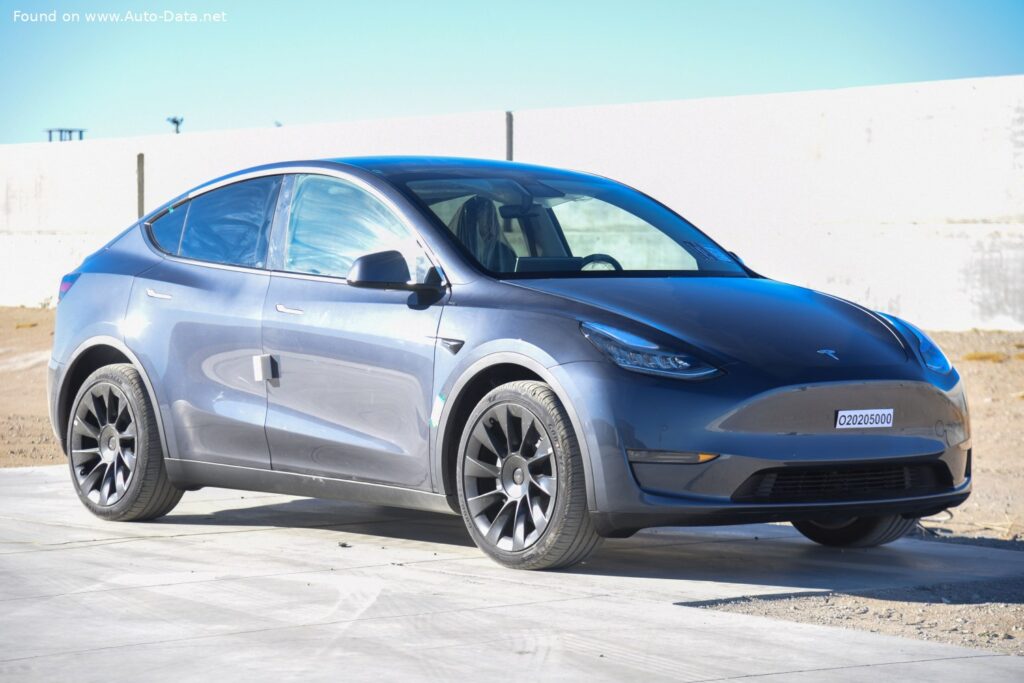
The Tesla Model Y Performance is a five-door SUV/Crossover body style, offering seating for up to seven passengers depending on the configuration. Its exterior design is characterized by a sleek, aerodynamic profile, minimizing drag and maximizing efficiency. Key features include a panoramic glass roof, distinctive LED lighting elements, and a minimalist aesthetic. Inside, the Model Y Performance features a spacious and modern cabin dominated by a large central touchscreen display that controls most vehicle functions. The interior emphasizes simplicity and technology, with premium materials and a focus on user experience. Safety features are comprehensive, including Tesla’s Autopilot system, which provides advanced driver-assistance capabilities such as adaptive cruise control and lane keeping assist. The vehicle also incorporates a suite of passive safety features, including multiple airbags and a reinforced safety cell. Trunk space is generous, ranging from 12.82 to 30.16 cubic feet (363-854 liters) with the rear seats up, and expanding to 76.21 cubic feet (2158 liters) with the rear seats folded down.
Technical Specifications
| Brand | Tesla |
| Model | Model Y |
| Generation | Model Y |
| Type (Engine) | Performance 80.5 kWh (534 Hp) Dual Motor AWD |
| Start of production | September, 2021 |
| End of production | 2025 |
| Powertrain Architecture | BEV (Electric Vehicle) |
| Body type | SUV, Crossover |
| Seats | 5-7 |
| Doors | 5 |
| Fuel Type | Electricity |
| Acceleration 0 – 100 km/h | 3.7 sec |
| Acceleration 0 – 62 mph | 3.7 sec |
| Acceleration 0 – 60 mph | 3.5 sec |
| Maximum speed | 155.34 mph (250 km/h) |
| Weight-to-power ratio | 3.7 kg/Hp, 267.7 Hp/tonne |
| Gross battery capacity | 80.5 kWh |
| Net (usable) battery capacity | 77.0 kWh |
| Battery voltage | 360 V |
| Battery technology | Lithium-ion (Li-Ion) |
| Battery location | Below the floor |
| All-electric range (WLTP) | 319.38 mi (514 km) |
| Average Energy consumption (WLTP) | 27.52 kWh/100 mi (17.1 kWh/100 km) |
| MPGe | 122 |
| km/kWh | 5.8 |
| mi/kWh | 3.6 |
| Electric motor 1 model/code | 3D3 |
| Electric motor 1 location | Front axle, Transverse |
| Electric motor 2 model/code | 3D6 |
| Electric motor 2 location | Rear axle, Transverse |
| System power | 534 Hp |
| Kerb Weight | 4398.22 lbs (1995 kg) |
| Trunk (boot) space – minimum | 12.82 – 30.16 cu. ft. (363-854 l) |
| Trunk (boot) space – maximum | 76.21 cu. ft. (2158 l) |
| Length | 187.05 in. (4751 mm) |
| Width | 75.63 in. (1921 mm) |
| Width with mirrors folded | 77.87 in. (1978 mm) |
| Width including mirrors | 83.82 in. (2129 mm) |
| Height | 63.94 in. (1624 mm) |
| Wheelbase | 113.78 in. (2890 mm) |
| Front track | 64.8 in. (1646 mm) |
| Rear (Back) track | 64.17 in. (1630 mm) |
| Front overhang | 34.45 in. (875 mm) |
| Rear overhang | 38.82 in. (986 mm) |
| Ride height (ground clearance) | 6.57 in. (167 mm) |
| Minimum turning circle (turning diameter) | 39.7 ft (12.1 m) |
| Drivetrain Architecture | One electric motor drives the front wheels, one electric motor drives the rear wheels. |
| Drive wheel | All wheel drive (4×4) |
| Number of gears and type of gearbox | 1 gears, automatic transmission |
| Front suspension | Double wishbone |
| Rear suspension | Independent multi-link suspension |
| Front brakes | Ventilated discs, 355×27 mm |
| Rear brakes | Ventilated discs, 335×22 mm |
| Assisting systems | ABS (Anti-lock braking system) |
| Steering type | Steering rack and pinion |
| Power steering | Electric Steering |
| Tires size Front | 255/35 R21 XLR |
| Tires size Rear | 275/35 R21 XL |
| Wheel rims size Front | 21 |
| Wheel rims size Rear | 21 |