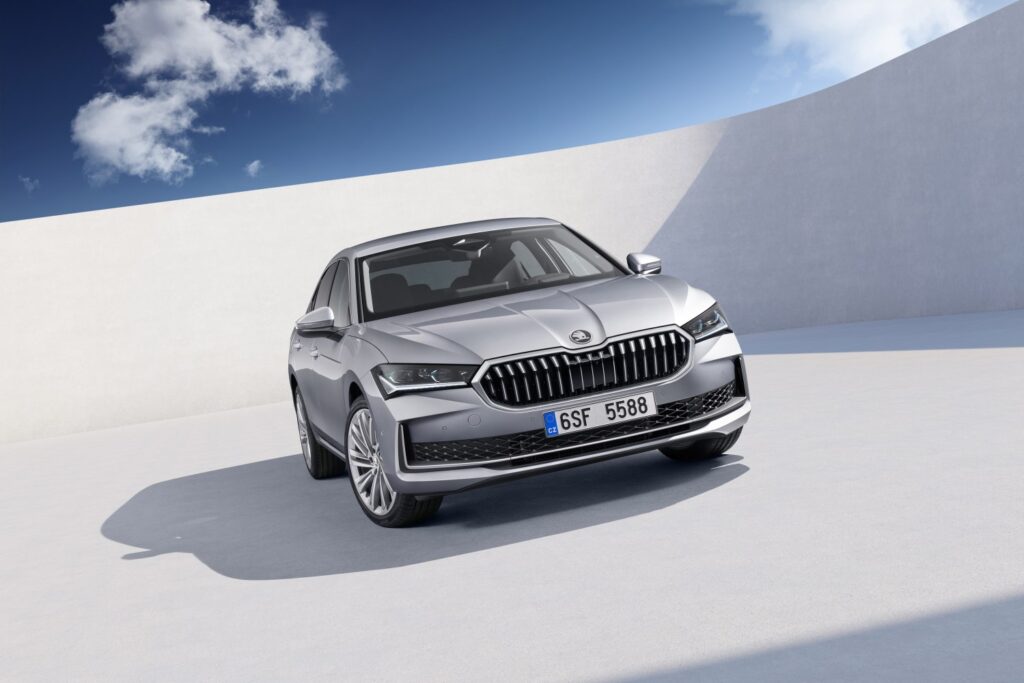
The Skoda Superb IV 1.5 TSI (150 Hp) Mild Hybrid DSG represents the fourth generation of Skoda’s flagship liftback, launched in February 2024. Positioned within the mid-size executive car segment, the Superb has become a popular alternative to more premium brands, offering a spacious interior, practical design, and a compelling value proposition. While Skoda is a Czech manufacturer, the Superb is primarily a European market vehicle, gaining recognition for its blend of comfort, technology, and affordability. This iteration focuses on incorporating mild hybrid technology to improve fuel efficiency and reduce emissions, aligning with increasingly stringent European regulations.
Skoda Superb IV 1.5 TSI: Overview and Market Position
The Superb has a long history dating back to 1936, but the modern iteration, launched in 2001, established its reputation as a spacious and well-equipped family car. The fourth generation builds upon this foundation, offering a refined driving experience and a host of modern features. The 1.5 TSI Mild Hybrid variant is a key offering, targeting buyers who prioritize fuel economy and lower running costs without sacrificing performance. It competes with vehicles like the Volkswagen Passat, Ford Mondeo (though discontinued in many markets), and BMW 3 Series, offering a more accessible price point.
Engine & Performance
The Skoda Superb IV 1.5 TSI is powered by a 1.5-liter turbocharged inline-four cylinder gasoline engine, designated EA211 evo2 / DXDB. This engine produces 150 horsepower (Hp) and 250 Newton-meters (184.39 lb.-ft.) of torque between 1500 and 3500 rpm. The engine benefits from direct fuel injection and an intercooler, optimizing combustion and power delivery. Crucially, this model incorporates a 48-volt mild hybrid system (MHEV). This system utilizes a small electric motor and battery to provide power assistance during acceleration and enable features like start-stop functionality, improving fuel efficiency. The engine is transversely mounted at the front of the vehicle. Power is delivered to the front wheels via a seven-speed dual-clutch transmission (DSG), known for its quick and smooth gear changes. Performance figures include a 0-100 km/h (0-62 mph) acceleration time of 9.2 seconds and a 0-60 mph time of 8.7 seconds, with a maximum speed of 225 km/h (139.81 mph).
Design & Features
The Superb IV maintains the liftback body style, offering a large and practical trunk opening. The design is evolutionary, with sharper lines and a more modern aesthetic compared to its predecessor. The vehicle seats five passengers comfortably and offers ample legroom in both the front and rear. Key features include a spacious 645-liter (22.78 cu. ft.) trunk, expandable to 1795 liters (63.39 cu. ft.) with the rear seats folded down. The interior is well-appointed, with a focus on practicality and user-friendliness. Modern safety features are standard, including ABS (Anti-lock Braking System) and a comprehensive suite of driver-assistance systems. The vehicle’s dimensions are 4912 mm (193.39 in) in length, 1849 mm (72.8 in) in width, and 1511 mm (59.49 in) in height, with a wheelbase of 2837 mm (111.69 in). The Superb IV prioritizes passenger comfort and cargo capacity, making it a versatile choice for families and individuals who require a spacious and practical vehicle.
Technical Specifications
| Brand | Skoda |
| Model | Superb |
| Generation | Superb IV |
| Type (Engine) | 1.5 TSI (150 Hp) Mild Hybrid DSG |
| Start of production | February, 2024 |
| Powertrain Architecture | MHEV (Mild Hybrid Electric Vehicle) |
| Body type | Liftback |
| Seats | 5 |
| Doors | 5 |
| Fuel consumption at Low speed (WLTP) | 7.1-7.2 l/100 km (33.1 – 32.7 US mpg) |
| Fuel consumption at Medium speed (WLTP) | 5.1-5.2 l/100 km (46.1 – 45.2 US mpg) |
| Fuel consumption at high speed (WLTP) | 4.4-4.5 l/100 km (53.5 – 52.3 US mpg) |
| Fuel consumption at very high speed (WLTP) | 5.2-5.4 l/100 km (45.2 – 43.6 US mpg) |
| Combined fuel consumption (WLTP) | 5.2-5.3 l/100 km (45.2 – 44.4 US mpg) |
| CO2 emissions (WLTP) | 118-122 g/km |
| Fuel Type | Petrol (Gasoline) |
| Acceleration 0 – 100 km/h | 9.2 sec |
| Acceleration 0 – 62 mph | 9.2 sec |
| Acceleration 0 – 60 mph | 8.7 sec |
| Maximum speed | 225 km/h (139.81 mph) |
| Emission standard | Euro 6e |
| Power | 150 Hp |
| Power per litre | 100.1 Hp/l |
| Torque | 250 Nm @ 1500-3500 rpm (184.39 lb.-ft. @ 1500-3500 rpm) |
| Engine layout | Front, Transverse |
| Engine Model/Code | EA211 evo2 / DXDB |
| Engine displacement | 1498 cm3 (91.41 cu. in.) |
| Number of cylinders | 4 |
| Engine configuration | Inline |
| Cylinder Bore | 74.5 mm (2.93 in.) |
| Piston Stroke | 86 mm (3.39 in.) |
| Compression ratio | 12:1 |
| Number of valves per cylinder | 4 |
| Fuel injection system | Direct injection |
| Engine aspiration | Turbocharger, Intercooler |
| Engine oil capacity | 4.3 l (4.54 US qt | 3.78 UK qt) |
| Max. weight | 2100 kg (4629.71 lbs.) |
| Trunk (boot) space – minimum | 645 l (22.78 cu. ft.) |
| Trunk (boot) space – maximum | 1795 l (63.39 cu. ft.) |
| Fuel tank capacity | 66 l (17.44 US gal | 14.52 UK gal) |
| Permitted trailer load with brakes (12%) | 1600 kg (3527.4 lbs.) |
| Permitted trailer load without brakes | 750 kg (1653.47 lbs.) |
| Permitted towbar download | 90 kg (198.42 lbs.) |
| Length | 4912 mm (193.39 in.) |
| Width | 1849 mm (72.8 in.) |
| Height | 1511 mm (59.49 in.) |
| Wheelbase | 2837 mm (111.69 in.) |
| Front track | 1585 mm (62.4 in.) |
| Rear (Back) track | 1574 mm (61.97 in.) |
| Minimum turning circle (turning diameter) | 11.1 m (36.42 ft.) |
| Drive wheel | Front wheel drive |
| Number of gears and type of gearbox | 7 gears, automatic transmission DSG |
| Front brakes | Ventilated discs |
| Rear brakes | Disc |
| Tires size | 215/55 R17 94V; 235/45 R18 94W |
| Wheel rims size | 7.5J x 17; 8J x 18 |
The Skoda Superb IV 1.5 TSI Mild Hybrid DSG continues the model’s tradition of offering a spacious, practical, and well-equipped vehicle at a competitive price point. The incorporation of mild hybrid technology demonstrates Skoda’s commitment to improving fuel efficiency and reducing emissions, making it an appealing option for buyers in the modern automotive landscape.