
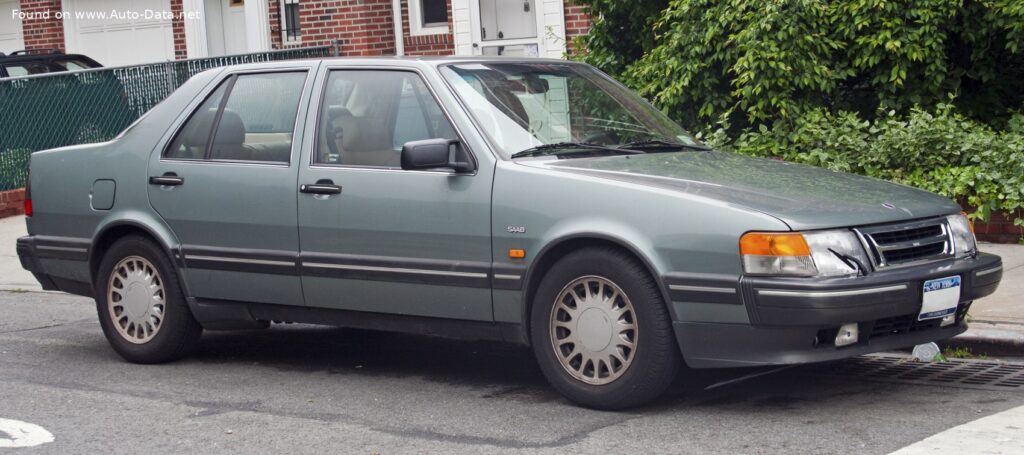
The Saab 9000 2.0 16V Turbo CD, produced between 1988 and 1993, represents a significant evolution in Saab’s model lineup. Positioned as a larger, more sophisticated alternative to the Saab 900, the 9000 aimed to compete directly with executive cars from German manufacturers like BMW and Audi. This front-wheel-drive sedan offered a blend of Scandinavian practicality, turbocharged performance, and distinctive styling, establishing a loyal following, particularly in Europe. While never a massive seller in the United States, the 9000 showcased Saab’s engineering prowess and commitment to driver-focused vehicles.
Saab 9000 2.0 16V Turbo CD: An Overview
The 9000 was Saab’s first entirely in-house designed model since the Saab 99. It moved away from the more compact offerings of the past and embraced a more spacious and comfortable design. The 2.0 16V Turbo CD variant, equipped with a 2.0-liter turbocharged four-cylinder engine, was a popular choice, offering a balance between performance and fuel efficiency. The “CD” designation typically indicated a higher trim level with additional comfort and convenience features. The model’s success lay in its ability to provide a unique driving experience, characterized by its comfortable ride, responsive handling, and distinctive Scandinavian aesthetic.
Engine & Performance
At the heart of the Saab 9000 2.0 16V Turbo CD lies the B202 engine, a 1985 cc (121.13 cu. in.) inline-four cylinder powerplant. This engine is notable for its 16-valve cylinder head and turbocharging, which boosted output to 163 horsepower at 5300 rpm and 257 Nm (189.55 lb.-ft.) of torque at 3000 rpm. The turbocharger provided a significant increase in power and responsiveness, making the 9000 surprisingly quick for its size and class. Power per liter was a respectable 82.1 hp/l. The engine utilized multi-port fuel injection and a double overhead camshaft (DOHC) valvetrain for optimized performance and efficiency. Acceleration from 0 to 100 km/h (0-62 mph) took approximately 8.9 seconds, while the 0-60 mph sprint was achieved in around 8.5 seconds. The car boasted a maximum speed of 215 km/h (133.59 mph). The engine’s weight-to-power ratio was 8.8 kg/Hp, and the weight-to-torque ratio was 5.6 kg/Nm, indicating a good balance between power and weight.
Design & Features
The Saab 9000 was a four-door sedan with a distinctive, aerodynamic design. Its wedge-shaped profile, large glass areas, and relatively upright stance were hallmarks of Saab’s design language during the late 1980s and early 1990s. The interior was designed with a focus on ergonomics and practicality, featuring comfortable seating for five passengers and a spacious trunk. The trunk offered between 625 and 1600 liters (22.07 to 56.5 cu. ft.) of space depending on the rear seats configuration. Safety was also a key consideration, with the 9000 equipped with an Anti-lock Braking System (ABS) as standard or optional equipment, a relatively advanced feature for the time. The car’s hydraulic power steering provided light and precise control, enhancing the driving experience. The 9000’s design prioritized functionality and driver comfort, reflecting Saab’s commitment to creating cars that were both practical and enjoyable to drive.
Technical Specifications
| Brand | Saab |
| Model | 9000 |
| Generation | 9000 |
| Type (Engine) | 2.0 16V Turbo CD (163 Hp) |
| Start of production | 1988 |
| End of production | 1993 |
| Powertrain Architecture | Internal Combustion engine |
| Body type | Sedan |
| Seats | 5 |
| Doors | 4 |
| Fuel consumption (urban) | 12.1 l/100 km (19.4 US mpg, 23.3 UK mpg, 8.3 km/l) |
| Fuel consumption (extra urban) | 7 l/100 km (33.6 US mpg, 40.4 UK mpg, 14.3 km/l) |
| Fuel consumption (combined) | 9.1 l/100 km (25.8 US mpg, 31 UK mpg, 11 km/l) |
| Fuel Type | Petrol (Gasoline) |
| Acceleration 0 – 100 km/h | 8.9 sec |
| Acceleration 0 – 62 mph | 8.9 sec |
| Acceleration 0 – 60 mph | 8.5 sec |
| Maximum speed | 215 km/h (133.59 mph) |
| Weight-to-power ratio | 8.8 kg/Hp |
| Weight-to-torque ratio | 5.6 kg/Nm |
| Power | 163 Hp @ 5300 rpm |
| Torque | 257 Nm @ 3000 rpm (189.55 lb.-ft. @ 3000 rpm) |
| Engine layout | Front, Transverse |
| Engine Model/Code | B202 |
| Engine displacement | 1985 cm3 (121.13 cu. in.) |
| Number of cylinders | 4 |
| Engine configuration | Inline |
| Cylinder Bore | 90 mm (3.54 in.) |
| Piston Stroke | 78 mm (3.07 in.) |
| Compression ratio | 9:1 |
| Number of valves per cylinder | 4 |
| Fuel injection system | Multi-port manifold injection |
| Engine aspiration | Turbocharger |
| Valvetrain | DOHC |
| Engine oil capacity | 4.2 l (4.44 US qt | 3.7 UK qt) |
| Coolant capacity | 9 l (9.51 US qt | 7.92 UK qt) |
| Kerb Weight | 1440 kg (3174.66 lbs.) |
| Max. weight | 1900 kg (4188.78 lbs.) |
| Max load | 460 kg (1014.13 lbs.) |
| Fuel tank capacity | 66 l (17.44 US gal | 14.52 UK gal) |
| Length | 4794 mm (188.74 in.) |
| Width | 1764 mm (69.45 in.) |
| Height | 1420 mm (55.91 in.) |
| Wheelbase | 2672 mm (105.2 in.) |
| Front track | 1522 mm (59.92 in.) |
| Rear track | 1492 mm (58.74 in.) |
| Drivetrain Architecture | Front wheel drive |
| Number of gears | 5 gears, manual transmission |
| Front suspension | Wishbone |
| Rear suspension | Suspension with traction connecting levers |
| Front brakes | Ventilated discs |
| Rear brakes | Disc |
| Assisting systems | ABS (Anti-lock braking system) |
| Steering type | Steering rack and pinion |
| Power steering | Hydraulic Steering |
| Tires size | 205/55 R15 |
| Wheel rims size | 15 |
The Saab 9000 2.0 16V Turbo CD remains a fondly remembered vehicle, representing a high point in Saab’s independent engineering and design. Its blend of performance, practicality, and distinctive styling continues to appeal to enthusiasts today.
