The Renault Megane II 1.6 16V, produced in 2005, represents a significant step forward in Renault’s compact family car lineage. As the second generation of the Megane, this model aimed to improve upon its predecessor in terms of design, comfort, and technology. Primarily sold in Europe, the Megane II competed in the highly contested C-segment, facing rivals like the Volkswagen Golf, Ford Focus, and Opel/Vauxhall Astra. The 1.6 16V variant, producing 112 horsepower, was a popular choice for buyers seeking a balance between fuel efficiency and adequate performance for everyday driving.
Renault Megane II 1.6 16V: An Overview
The Megane II was a crucial model for Renault, embodying the company’s design philosophy of the early 2000s. It offered a more refined and modern alternative to earlier Renault offerings, with a focus on build quality and interior space. The 1.6 16V engine was positioned as an entry-level powertrain, appealing to a broad customer base. While not a performance-oriented model, it provided sufficient power for typical commuting and longer journeys. The hatchback body style was particularly popular, offering practicality and versatility.
Engine & Performance
The heart of the Megane II 1.6 16V is a 1.6-liter inline four-cylinder gasoline engine, designated the K4M. This naturally aspirated engine produces 112 horsepower at 6000 rpm and 152 Nm (112.11 lb.-ft.) of torque at 4200 rpm. The engine features a multi-port fuel injection system and a double overhead camshaft (DOHC) valvetrain with four valves per cylinder. This configuration contributes to a reasonable power output for its displacement, achieving 70.1 horsepower per liter. The engine is transversely mounted at the front of the vehicle, driving the front wheels through a five-speed manual transmission. Performance figures include a 0-100 km/h (0-62 mph) acceleration time of 10.9 seconds and a top speed of 192 km/h (119.3 mph). The 0-60 mph time is calculated at 10.4 seconds. The weight-to-power ratio is 10.5 kg/Hp, and the weight-to-torque ratio is 7.7 kg/Nm.
Design & Features
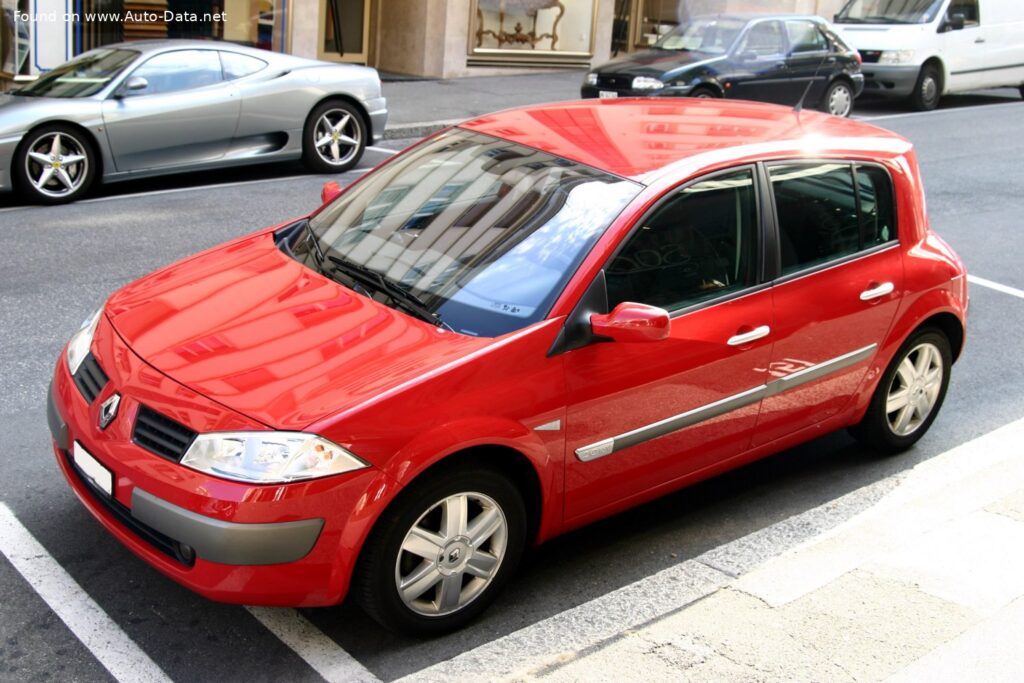
The Renault Megane II adopted a more contemporary design language compared to its predecessor. The hatchback body style, with its five doors and five seats, offered a practical and versatile layout. The exterior design was characterized by rounded lines and a relatively understated aesthetic. Inside, the Megane II offered a reasonably spacious cabin with a focus on ergonomics. Standard features included ABS (Anti-lock Braking System) and electric power steering. The interior materials were typical for the C-segment, aiming for durability and comfort. Trunk space was a key consideration, offering 330 liters (11.65 cu. ft.) with the rear seats up and expanding to 1190 liters (42.02 cu. ft.) with the seats folded down. The Megane II’s suspension utilized an independent McPherson strut setup at the front and a torsion beam arrangement at the rear, providing a balance between ride comfort and handling. Safety features, while not as comprehensive as modern vehicles, included driver and passenger airbags and seatbelt pretensioners.
Technical Specifications
| Brand | Renault |
| Model | Megane |
| Generation | Megane II |
| Type (Engine) | 1.6 16V (112 Hp) |
| Start of production | 2005 |
| End of production | 2005 |
| Powertrain Architecture | Internal Combustion engine |
| Body type | Hatchback |
| Seats | 5 |
| Doors | 5 |
| Fuel consumption (urban) | 9.1 l/100 km (25.8 US mpg, 31 UK mpg, 11 km/l) |
| Fuel consumption (extra urban) | 5.7 l/100 km (41.3 US mpg, 49.6 UK mpg, 17.5 km/l) |
| Fuel consumption (combined) | 6.9 l/100 km (34.1 US mpg, 40.9 UK mpg, 14.5 km/l) |
| CO2 emissions | 164 g/km |
| Fuel Type | Petrol (Gasoline) |
| Acceleration 0 – 100 km/h | 10.9 sec |
| Acceleration 0 – 62 mph | 10.9 sec |
| Acceleration 0 – 60 mph | 10.4 sec |
| Maximum speed | 192 km/h (119.3 mph) |
| Emission standard | Euro 4 |
| Weight-to-power ratio | 10.5 kg/Hp |
| Weight-to-torque ratio | 7.7 kg/Nm |
| Power | 112 Hp @ 6000 rpm |
| Power per litre | 70.1 Hp/l |
| Torque | 152 Nm @ 4200 rpm (112.11 lb.-ft. @ 4200 rpm) |
| Engine layout | Front, Transverse |
| Engine Model/Code | K4M |
| Engine displacement | 1598 cm3 (97.52 cu. in.) |
| Number of cylinders | 4 |
| Engine configuration | Inline |
| Cylinder Bore | 79.5 mm (3.13 in.) |
| Piston Stroke | 80.5 mm (3.17 in.) |
| Compression ratio | 10:1 |
| Number of valves per cylinder | 4 |
| Fuel injection system | Multi-port manifold injection |
| Engine aspiration | Naturally aspirated engine |
| Valvetrain | DOHC |
| Engine oil capacity | 4.8 l (5.07 US qt | 4.22 UK qt) |
| Coolant | 6 l (6.34 US qt | 5.28 UK qt) |
| Kerb Weight | 1175 kg (2590.43 lbs.) |
| Max. weight | 1725 kg (3802.97 lbs.) |
| Max load | 550 kg (1212.54 lbs.) |
| Trunk (boot) space – minimum | 330 l (11.65 cu. ft.) |
| Trunk (boot) space – maximum | 1190 l (42.02 cu. ft.) |
| Fuel tank capacity | 60 l (15.85 US gal | 13.2 UK gal) |
| Max. roof load | 80 kg (176.37 lbs.) |
| Permitted trailer load with brakes (12%) | 1300 kg (2866.01 lbs.) |
| Permitted trailer load without brakes | 650 kg (1433 lbs.) |
| Permitted towbar download | 75 kg (165.35 lbs.) |
| Length | 4209 mm (165.71 in.) |
| Width | 1777 mm (69.96 in.) |
| Height | 1458 mm (57.4 in.) |
| Wheelbase | 2625 mm (103.35 in.) |
| Front track | 1518 mm (59.76 in.) |
| Rear (Back) track | 1514 mm (59.61 in.) |
| Front overhang | 842 mm (33.15 in.) |
| Rear overhang | 742 mm (29.21 in.) |
| Minimum turning circle (turning diameter) | 10.5 m (34.45 ft.) |
| Drive wheel | Front wheel drive |
| Number of gears and type of gearbox | 5 gears, manual transmission |
| Front suspension | Independent type McPherson |
| Rear suspension | Torsion |
| Front brakes | Ventilated discs |
| Rear brakes | Disc |
| Assisting systems | ABS (Anti-lock braking system) |
| Steering type | Steering rack and pinion |
| Power steering | Electric Steering |
| Tires size | 195/65 R15 |
| Wheel rims size | 6J x 15 |
The Renault Megane II 1.6 16V, while not a groundbreaking vehicle, represented a solid offering in the competitive C-segment. Its blend of practicality, fuel efficiency, and reasonable performance made it a popular choice for European drivers seeking a dependable and affordable family car.