
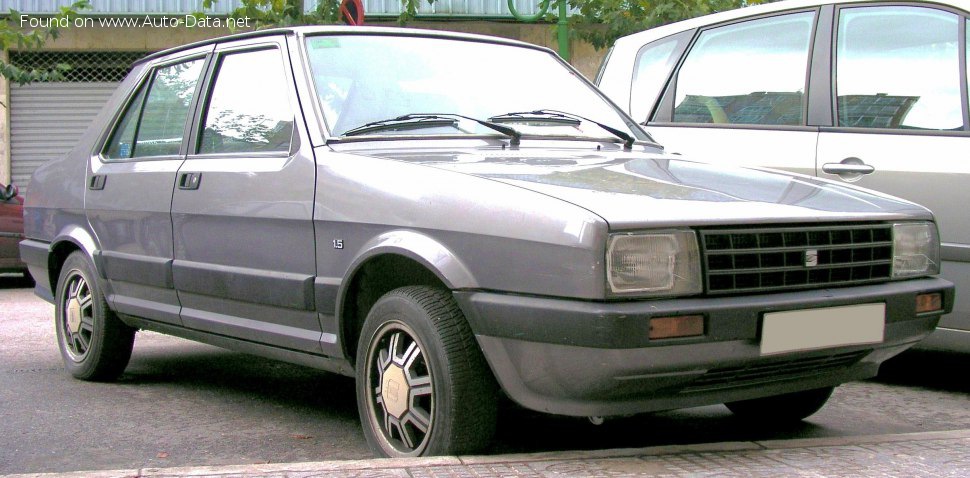
The SEAT Malaga (023A) 1.2 i (71 Hp) was a compact, front-wheel-drive sedan produced by the Spanish automobile manufacturer SEAT between 1989 and 1991. Positioned as an affordable and practical family car, the Malaga represented SEAT’s attempt to modernize its lineup and compete in the increasingly competitive European small car market. While not officially sold in the United States, understanding the Malaga provides insight into the automotive landscape of Europe during the late 1980s and early 1990s, and SEAT’s evolution before its acquisition by the Volkswagen Group. The Malaga was based on the SEAT Ibiza, sharing many of its mechanical components, but offered a more traditional sedan body style to appeal to a broader range of buyers.
SEAT Malaga (023A) 1.2 i: Overview and Market Position
The SEAT Malaga occupied a crucial niche in the Spanish and broader European automotive market. During its production run, it served as a more conventional alternative to the hatchback-focused SEAT Ibiza. Spain, at the time, had a developing automotive industry, and SEAT was a key player, often producing vehicles under license from other manufacturers. The Malaga, however, was a largely in-house design, demonstrating SEAT’s growing engineering capabilities. It aimed to provide a cost-effective and reliable mode of transportation for families and individuals seeking a practical sedan. Its relatively simple design and robust mechanicals made it popular in regions where affordability and ease of maintenance were paramount. The Malaga’s success, though modest by modern standards, was vital for SEAT’s survival and eventual integration into the Volkswagen Group.
Engine & Performance
The 1.2 i version of the SEAT Malaga was powered by a naturally aspirated, inline-four cylinder gasoline engine, designated the 021A.1000. This engine produced 71 horsepower, providing adequate, though not exceptional, performance for its intended purpose. The engine’s modest output was coupled with a five-speed manual transmission, driving the front wheels. Acceleration from 0 to 60 mph took approximately 14 seconds, and 0 to 100 km/h (62 mph) took 14.7 seconds. The top speed was recorded at 154 km/h (95.69 mph). Fuel economy was a key consideration for buyers in this segment, and the Malaga 1.2 i delivered reasonable figures for its era. Combined fuel consumption was rated at 7 liters per 100 kilometers (33.6 US mpg or 40.4 UK mpg). The engine’s simplicity contributed to its reliability, and maintenance costs were relatively low. The weight-to-power ratio of 13.7 kg/Hp indicated a vehicle that prioritized efficiency over outright speed.
Design & Features
The SEAT Malaga featured a traditional three-box sedan body style, offering a separate engine compartment, passenger cabin, and trunk. Its design was functional rather than flamboyant, prioritizing practicality and affordability. The Malaga offered seating for five passengers and provided a trunk capacity of 510 liters (18.01 cubic feet). Interior appointments were basic, reflecting the car’s price point. Features were limited compared to more modern vehicles, but included hydraulic steering for improved maneuverability. Safety features were also rudimentary by today’s standards, consisting primarily of front disc brakes and rear drum brakes. The suspension utilized coil springs at the front and a leaf spring setup at the rear, a common configuration for vehicles of this era. The Malaga’s tires were typically sized 165/70 SR13. The overall design emphasized durability and ease of repair, making it a sensible choice for buyers in markets where vehicle ownership costs were a significant concern.
Technical Specifications
| Brand | Seat |
| Model | Malaga |
| Generation | Malaga (023A) |
| Type (Engine) | 1.2 i (71 Hp) |
| Start of production | 1989 |
| End of production | 1991 |
| Powertrain Architecture | Internal Combustion engine |
| Body type | Sedan |
| Seats | 5 |
| Doors | 4 |
| Fuel consumption (urban) | 9.3 l/100 km (25.3 US mpg) |
| Fuel consumption (extra urban) | 5 l/100 km (47 US mpg) |
| Fuel consumption (combined) | 7 l/100 km (33.6 US mpg) |
| Fuel Type | Petrol (Gasoline) |
| Acceleration 0 – 100 km/h | 14.7 sec |
| Acceleration 0 – 62 mph | 14.7 sec |
| Acceleration 0 – 60 mph | 14 sec |
| Maximum speed | 154 km/h (95.69 mph) |
| Weight-to-power ratio | 13.7 kg/Hp |
| Power | 71 Hp |
| Engine Model/Code | 021A.1000 |
| Engine aspiration | Naturally aspirated engine |
| Engine oil capacity | 3.3 l (3.49 US qt | 2.9 UK qt) |
| Coolant capacity | 7.5 l (7.93 US qt | 6.6 UK qt) |
| Kerb Weight | 975 kg (2149.51 lbs) |
| Max. weight | 1450 kg (3196.7 lbs) |
| Max load | 475 kg (1047.2 lbs) |
| Trunk (boot) space – minimum | 510 l (18.01 cu. ft) |
| Fuel tank capacity | 50 l (13.21 US gal | 11 UK gal) |
| Length | 4275 mm (168.31 in) |
| Width | 1650 mm (64.96 in) |
| Height | 1390 mm (54.72 in) |
| Wheelbase | 2445 mm (96.26 in) |
| Front track | 1420 mm (55.91 in) |
| Rear track | 1390 mm (54.72 in) |
| Drivetrain Architecture | Front wheel drive |
| Number of gears and type of gearbox | 5 gears, manual transmission |
| Front suspension | Coil spring |
| Rear suspension | Leaf spring |
| Front brakes | Disc |
| Rear brakes | Drum |
| Steering type | Steering rack and pinion |
| Power steering | Hydraulic Steering |
| Tires size | 165/70 SR13 |
The SEAT Malaga (023A) 1.2 i, while not a groundbreaking vehicle, played a significant role in SEAT’s history. It represented a step towards greater independence and engineering maturity for the Spanish automaker, and provided a practical and affordable transportation solution for European buyers during a period of economic change. Its legacy lies not in its performance or luxury, but in its contribution to SEAT’s eventual success and integration into the Volkswagen Group.
