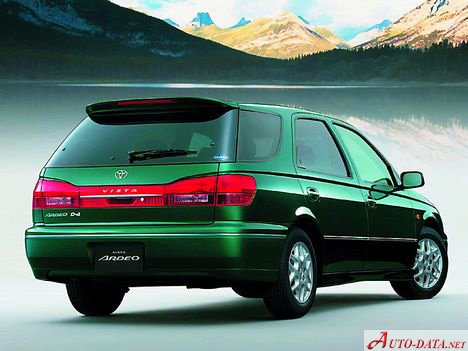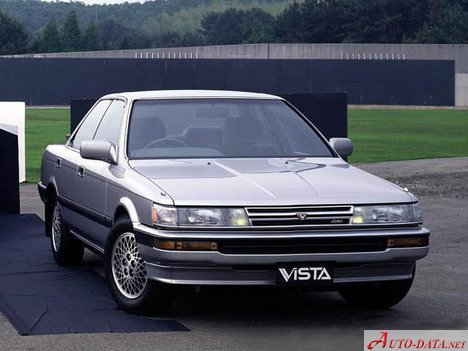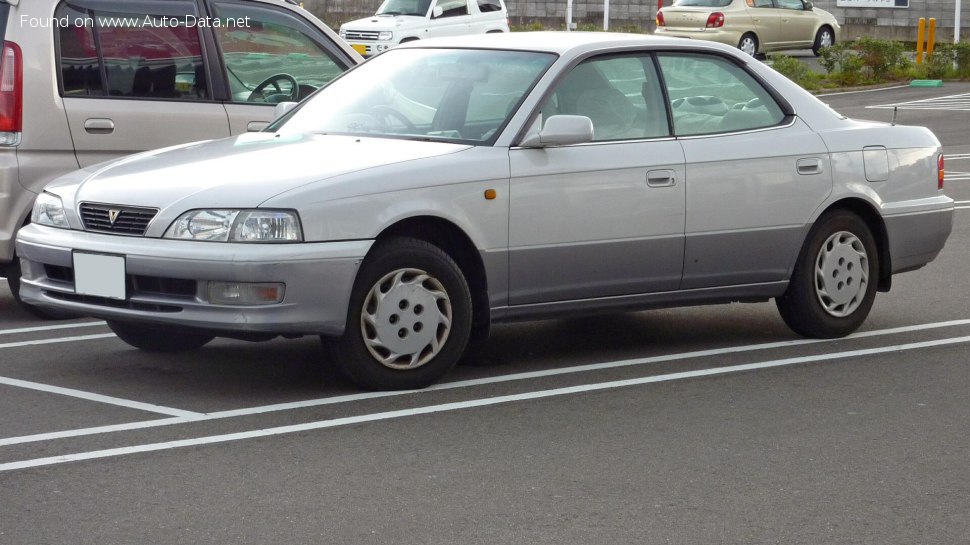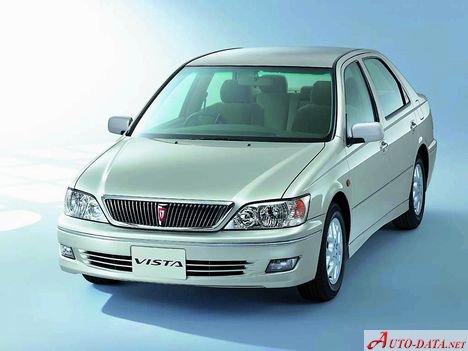
The Toyota Vista (V50), produced between 1998 and 2003, was a mid-size sedan primarily aimed at the Japanese domestic market (JDM). While not officially sold in the United States, the Vista occupied a significant niche in Japan as a comfortable, reliable, and well-equipped family vehicle. It represented Toyota’s offering in a highly competitive segment, often seen as a more upscale alternative to the Corolla and a more practical choice than the smaller Starlet. The V50 generation, specifically the 2.0 i 16V variant, offered a balance of performance and fuel efficiency, making it a popular choice for daily commuting and longer journeys.
Toyota Vista (V50) 2.0 i 16V: An Overview
The Vista, throughout its various generations, was known for its conservative styling and focus on practicality. The V50 continued this tradition, presenting a clean and understated design. It was positioned above the Corolla in Toyota’s lineup, offering more space, refinement, and available features. The 2.0 i 16V model, equipped with a 1.998-liter inline-four engine, was a key variant, providing a noticeable step up in performance compared to the smaller-engined options. The Vista competed with other Japanese sedans like the Honda Accord Inspire and the Nissan Cefiro, all vying for the attention of Japanese families seeking a dependable and comfortable vehicle.
Engine & Performance
The heart of the Toyota Vista (V50) 2.0 i 16V is its 1998 cc (121.93 cu. in.) inline-four cylinder engine. This naturally aspirated powerplant produces 145 horsepower at 6000 rpm and 196 Nm (144.56 lb.-ft.) of torque at 4400 rpm. The engine features a double overhead camshaft (DOHC) valvetrain with four valves per cylinder, contributing to its relatively high power output for its displacement – 72.6 hp per liter. Power is delivered to the front wheels via a four-speed automatic transmission. The Vista 2.0 i 16V achieves a maximum speed of 180 km/h (111.85 mph). The weight-to-power ratio of 9 kg/Hp and weight-to-torque ratio of 6.7 kg/Nm indicate a reasonably efficient powertrain for its time. Fuel consumption is rated at 12 l/100 km (19.6 US mpg) in urban conditions and 7 l/100 km (33.6 US mpg) on the open road.
Design & Features
The Toyota Vista (V50) is a traditional four-door sedan with a comfortable interior designed to accommodate five passengers. Its exterior styling is characterized by clean lines and a relatively conservative aesthetic, typical of Japanese cars from the late 1990s and early 2000s. The V50 offered a spacious cabin with a focus on practicality and comfort. Standard features typically included power windows, power steering (hydraulic), and air conditioning. Safety features, while not as advanced as modern vehicles, included an Anti-lock Braking System (ABS). The interior materials were of good quality for its class, and the overall design prioritized ease of use and a comfortable driving experience. The vehicle’s dimensions – 4670 mm (183.86 in) in length, 1695 mm (66.73 in) in width, and 1510 mm (59.45 in) in height – provided ample space for passengers and luggage. The wheelbase measured 2700 mm (106.3 in), contributing to a stable ride.
Technical Specifications
| Brand | Toyota |
| Model | Vista |
| Generation | Vista (V50) |
| Type (Engine) | 2.0 i 16V (145 Hp) |
| Start of production | 1998 |
| End of production | 2003 |
| Powertrain Architecture | Internal Combustion engine |
| Body type | Sedan |
| Seats | 5 |
| Doors | 4 |
| Fuel consumption (urban) | 12 l/100 km (19.6 US mpg) |
| Fuel consumption (extra urban) | 7 l/100 km (33.6 US mpg) |
| Fuel Type | Petrol (Gasoline) |
| Maximum speed | 180 km/h (111.85 mph) |
| Weight-to-power ratio | 9 kg/Hp |
| Weight-to-torque ratio | 6.7 kg/Nm |
| Power | 145 Hp @ 6000 rpm |
| Power per litre | 72.6 Hp/l |
| Torque | 196 Nm @ 4400 rpm (144.56 lb.-ft. @ 4400 rpm) |
| Engine layout | Front, Transverse |
| Engine displacement | 1998 cm3 (121.93 cu. in.) |
| Number of cylinders | 4 |
| Engine configuration | Inline |
| Cylinder Bore | 86 mm (3.39 in.) |
| Piston Stroke | 86 mm (3.39 in.) |
| Compression ratio | 10:1 |
| Number of valves per cylinder | 4 |
| Fuel injection system | Multi-port manifold injection |
| Engine aspiration | Naturally aspirated engine |
| Valvetrain | DOHC |
| Kerb Weight | 1310 kg (2888.06 lbs.) |
| Fuel tank capacity | 60 l (15.85 US gal | 13.2 UK gal) |
| Length | 4670 mm (183.86 in.) |
| Width | 1695 mm (66.73 in.) |
| Height | 1510 mm (59.45 in.) |
| Wheelbase | 2700 mm (106.3 in.) |
| Front track | 1475 mm (58.07 in.) |
| Rear track | 1460 mm (57.48 in.) |
| Drivetrain Architecture | Front wheel drive |
| Drive wheel | Front wheel drive |
| Number of gears and type of gearbox | 4 gears, automatic transmission |
| Front suspension | Spring Strut |
| Rear suspension | Coil spring |
| Front brakes | Ventilated discs |
| Rear brakes | Disc |
| Assisting systems | ABS (Anti-lock braking system) |
| Steering type | Steering rack and pinion |
| Power steering | Hydraulic Steering |
| Tires size | 185/70 R14 |
The Toyota Vista (V50) 2.0 i 16V, while never officially available in the US market, represents a well-engineered and reliable sedan that was highly regarded in its home market. Its blend of comfort, practicality, and reasonable performance made it a popular choice for Japanese families during its production run. It exemplifies Toyota’s commitment to building durable and dependable vehicles, a reputation that continues to this day.