
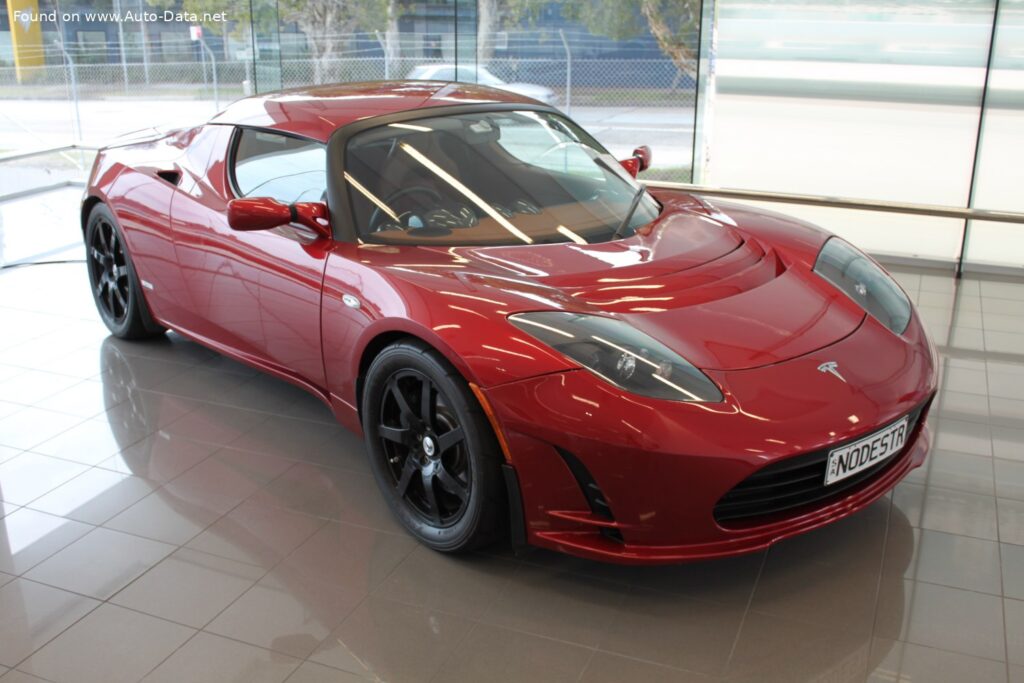
The Tesla Roadster, specifically the first generation (Roadster I) produced between 2008 and 2012, represents a pivotal moment in automotive history. It wasn’t merely an electric vehicle; it was a statement – a demonstration that electric cars could be genuinely desirable, high-performing, and technologically advanced. This two-seat roadster challenged the prevailing perception of EVs as slow, limited-range vehicles, paving the way for Tesla’s subsequent success and the broader adoption of electric mobility. The Roadster I was never intended for mass-market appeal, but rather to prove the viability of electric sports cars and establish Tesla as a serious automotive manufacturer.
Tesla Roadster I: A Groundbreaking Electric Sports Car
The original Tesla Roadster was based on the Lotus Elise chassis, a lightweight and agile platform renowned for its handling characteristics. However, Tesla didn’t simply electrify an existing gasoline car. They replaced the internal combustion engine with a fully electric powertrain, developing their own battery technology and control systems. This undertaking was ambitious, facing numerous engineering hurdles, but ultimately resulted in a vehicle that offered performance comparable to contemporary sports cars, albeit with zero tailpipe emissions.
Engine & Performance
At the heart of the Tesla Roadster I lies a single electric motor, transversely mounted on the rear axle. This motor delivers a peak power output of 292 horsepower, available between 5000 and 6000 rpm. More importantly, it generates a substantial 272.9 lb.-ft. of torque, instantly accessible from 0 to 5400 rpm. This instant torque is a hallmark of electric motors and contributes significantly to the Roadster’s impressive acceleration. The car utilizes a single-speed automatic transmission, simplifying the driving experience and maximizing efficiency. Acceleration from 0 to 60 mph is achieved in a brisk 3.7 seconds (as calculated by Auto-Data.net), and 0-62 mph (0-100 km/h) takes just 3.9 seconds. The top speed is electronically limited to 124.9 mph (201 km/h). The powertrain architecture is a pure Battery Electric Vehicle (BEV), relying entirely on electricity for propulsion. The weight-to-power ratio of 4.2 kg/Hp, or 236.4 Hp/tonne, further emphasizes the car’s performance potential.
Design & Features
The Tesla Roadster I retains the visually striking and low-slung profile of the Lotus Elise upon which it’s based. Its body is a two-door roadster configuration, seating two occupants. While the exterior design is largely dictated by the Elise chassis, Tesla made subtle modifications to improve aerodynamics and incorporate its own design cues. The interior, while minimalist, features modern instrumentation and a focus on driver engagement. Early electric vehicles often lacked the refinement of their gasoline counterparts, but the Roadster I aimed to bridge that gap. Safety features, while limited by the era and the Elise platform, included ABS (Anti-lock Braking System) and a robust chassis structure. The car’s relatively low curb weight of 2722.71 lbs (1235 kg) contributes to its agile handling and responsiveness. The drag coefficient of 0.36 is respectable for a vehicle of its type, aiding in maximizing range and efficiency.
Technical Specifications
| Brand | Tesla |
| Model | Roadster |
| Generation | Roadster I |
| Type (Engine) | 53 kWh (292 Hp) |
| Start of production | 2008 |
| End of production | 2012 |
| Powertrain Architecture | BEV (Electric Vehicle) |
| Body type | Roadster |
| Seats | 2 |
| Doors | 2 |
| Fuel Type | Electricity |
| Acceleration 0 – 100 km/h | 3.9 sec |
| Acceleration 0 – 62 mph | 3.9 sec |
| Acceleration 0 – 60 mph | 3.7 sec |
| Maximum speed | 124.9 mph (201 km/h) |
| Weight-to-power ratio | 4.2 kg/Hp, 236.4 Hp/tonne |
| Gross battery capacity | 53 kWh |
| All-electric range | 244.2 mi (393 km) |
| Electric motor power | 292 Hp @ 5000-6000 rpm |
| Electric motor Torque | 370 Nm @ 0-5400 rpm (272.9 lb.-ft. @ 0-5400 rpm) |
| Electric motor location | Rear axle, Transverse |
| System power | 292 Hp |
| Kerb Weight | 2722.71 lbs (1235 kg) |
| Max. weight | 3273.86 lbs (1485 kg) |
| Max load | 551.16 lbs (250 kg) |
| Length | 155.35 in. (3946 mm) |
| Width including mirrors | 72.87 in. (1851 mm) |
| Height | 44.37 in. (1127 mm) |
| Wheelbase | 92.56 in. (2351 mm) |
| Front track | 57.32 in. (1456 mm) |
| Rear (Back) track | 58.46 in. (1485 mm) |
| Front overhang | 34.29 in. (871 mm) |
| Rear overhang | 28.46 in. (723 mm) |
| Ride height (ground clearance) | 5.12 in. (130 mm) |
| Drag coefficient (Cd) | 0.36 |
| Minimum turning circle (turning diameter) | 36.25 ft (11.05 m) |
| Approach angle | 11° |
| Departure angle | 18° |
| Ramp-over (brakeover) angle | 12.7° |
| Drivetrain Architecture | One electric motor drives the rear wheels |
| Drive wheel | Rear wheel drive |
| Number of gears and type of gearbox | 1 gears, automatic transmission |
| Front suspension | Double wishbone |
| Rear suspension | Double wishbone |
| Front brakes | Ventilated discs |
| Rear brakes | Disc |
| Assisting systems | ABS (Anti-lock braking system) |
| Steering type | Steering rack and pinion |
| Power steering | Electric Steering |
| Tires size | Front wheel tires: 175/55 R16 Rear wheel tires: 225/45 R17 |
| Wheel rims size | Front wheel rims: 6J x 16 Rear wheel rims: 7.5J x 17 |
The Tesla Roadster I, despite its limited production run, left an indelible mark on the automotive landscape. It demonstrated that electric vehicles could be exciting, capable, and desirable, effectively shattering preconceived notions and inspiring a new generation of electric car development. It wasn’t just a car; it was a technological demonstration and a bold vision of the future of transportation.
