
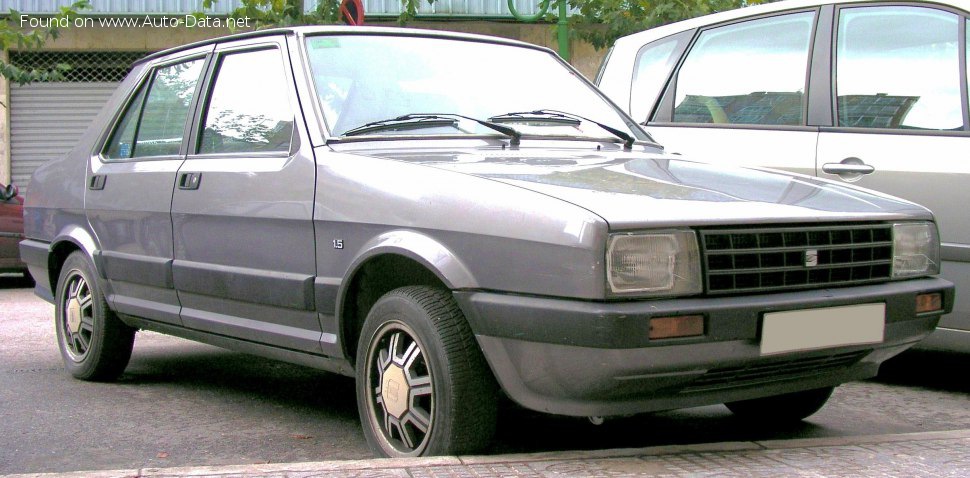
The SEAT Malaga (023A) 1.5, produced from 1984 to 1991, was a compact sedan primarily aimed at the European market. As part of SEAT’s lineup – a Spanish automaker that was, at the time, a collaboration between FIAT and the Spanish government – the Malaga filled a crucial role as an affordable and practical family vehicle. While never officially sold in the United States, understanding the Malaga provides insight into the automotive landscape of 1980s Europe and SEAT’s development as a brand. It represented a step towards modernizing SEAT’s offerings and establishing a distinct identity separate from its reliance on rebadged FIAT models.
SEAT Malaga (023A) 1.5: Overview and Market Position
The Malaga was SEAT’s answer to the growing demand for economical and reliable sedans in Europe. It was based on the SEAT Ronda, itself derived from the FIAT Ritmo, but offered a more traditional three-box sedan body style. This appealed to buyers who preferred a more conventional look compared to the hatchback Ronda. The Malaga competed with vehicles like the Renault 9, Peugeot 305, and Ford Escort, focusing on providing a balance of affordability, fuel efficiency, and practicality. Its relatively simple engineering and robust construction made it a popular choice for families and those seeking a dependable daily driver.
Engine & Performance
The 1.5-liter engine powering the SEAT Malaga (023A) was a naturally aspirated, inline-four cylinder unit. Designated the 021A.2000, it produced 85 horsepower at 5600 rpm and 116 Nm (85.56 lb.-ft.) of torque at 3500 rpm. While not a performance-oriented engine, it provided adequate power for everyday driving. The engine’s power-to-liter ratio was 58.2 hp/l. Fuel delivery was managed by a carburetor, a common feature for vehicles of this era. The Malaga achieved a combined fuel economy of 6.5 liters per 100 kilometers (36.2 US mpg or 43.5 UK mpg), making it relatively economical for its time. Acceleration from 0 to 100 km/h (0-62 mph) took approximately 13 seconds, and it had a top speed of 170 km/h (105.63 mph). The engine was transversely mounted at the front of the vehicle, driving the front wheels through a five-speed manual transmission.
Design & Features
The SEAT Malaga was a traditional four-door sedan with a relatively boxy design, typical of the 1980s. It offered seating for five passengers and a trunk capacity of 510 liters (18.01 cubic feet). The interior was functional and straightforward, prioritizing practicality over luxury. Features were modest by modern standards, but included basic instrumentation, cloth upholstery, and manual windows. Safety features were also limited, reflecting the standards of the time. The Malaga did incorporate disc brakes on the front wheels and drum brakes on the rear, and some models were equipped with an Anti-lock Braking System (ABS), a relatively advanced feature for a vehicle in this segment during the late 1980s. Steering was rack and pinion with hydraulic assistance. The suspension utilized coil springs in the front and a leaf spring setup in the rear, a common configuration for front-wheel-drive cars of this era. The vehicle rode on 165/65 SR14 tires.
Technical Specifications
| Brand | Seat |
| Model | Malaga |
| Generation | Malaga (023A) |
| Type (Engine) | 1.5 (85 Hp) |
| Start of production | November, 1984 |
| End of production | 1991 |
| Powertrain Architecture | Internal Combustion engine |
| Body type | Sedan |
| Seats | 5 |
| Doors | 4 |
| Fuel consumption (urban) | 9 l/100 km (26.1 US mpg, 31.4 UK mpg, 11.1 km/l) |
| Fuel consumption (extra urban) | 4.9 l/100 km (48 US mpg, 57.6 UK mpg, 20.4 km/l) |
| Fuel consumption (combined) | 6.5 l/100 km (36.2 US mpg, 43.5 UK mpg, 15.4 km/l) |
| Fuel Type | Petrol (Gasoline) |
| Acceleration 0 – 100 km/h | 13 sec |
| Acceleration 0 – 62 mph | 13 sec |
| Acceleration 0 – 60 mph | 12.4 sec |
| Maximum speed | 170 km/h (105.63 mph) |
| Power | 85 Hp @ 5600 rpm |
| Power per litre | 58.2 Hp/l |
| Torque | 116 Nm @ 3500 rpm (85.56 lb.-ft. @ 3500 rpm) |
| Engine layout | Front, Transverse |
| Engine Model/Code | 021A.2000 |
| Engine displacement | 1461 cm3 (89.16 cu. in.) |
| Number of cylinders | 4 |
| Engine configuration | Inline |
| Cylinder Bore | 83 mm (3.27 in.) |
| Piston Stroke | 67.5 mm (2.66 in.) |
| Compression ratio | 10.5:1 |
| Number of valves per cylinder | 2 |
| Fuel injection system | Carburettor |
| Engine aspiration | Naturally aspirated engine |
| Engine oil capacity | 4 l (4.23 US qt | 3.52 UK qt) |
| Coolant | 7.5 l (7.93 US qt | 6.6 UK qt) |
| Trunk (boot) space (minimum) | 510 l (18.01 cu. ft.) |
| Fuel tank capacity | 50 l (13.21 US gal | 11 UK gal) |
| Length | 4275 mm (168.31 in.) |
| Width | 1650 mm (64.96 in.) |
| Height | 1390 mm (54.72 in.) |
| Wheelbase | 2445 mm (96.26 in.) |
| Front track | 1420 mm (55.91 in.) |
| Rear (Back) track | 1390 mm (54.72 in.) |
| Drivetrain Architecture | The Internal combustion engine (ICE) drives the front wheels of the vehicle. |
| Drive wheel | Front wheel drive |
| Number of gears and type of gearbox | 5 gears, manual transmission |
| Front suspension | Coil spring |
| Rear suspension | Leaf spring |
| Front brakes | Disc |
| Rear brakes | Drum |
| Assisting systems | ABS (Anti-lock braking system) |
| Steering type | Steering rack and pinion |
| Power steering | Hydraulic Steering |
| Tires size | 165/65 SR14 |
The SEAT Malaga, while not a groundbreaking vehicle, played a significant role in SEAT’s evolution. It provided a practical and affordable transportation option for European families during the 1980s and helped establish SEAT as a viable automaker in a competitive market. Its simple design and robust engineering ensured its longevity and cemented its place as a familiar sight on European roads.
