
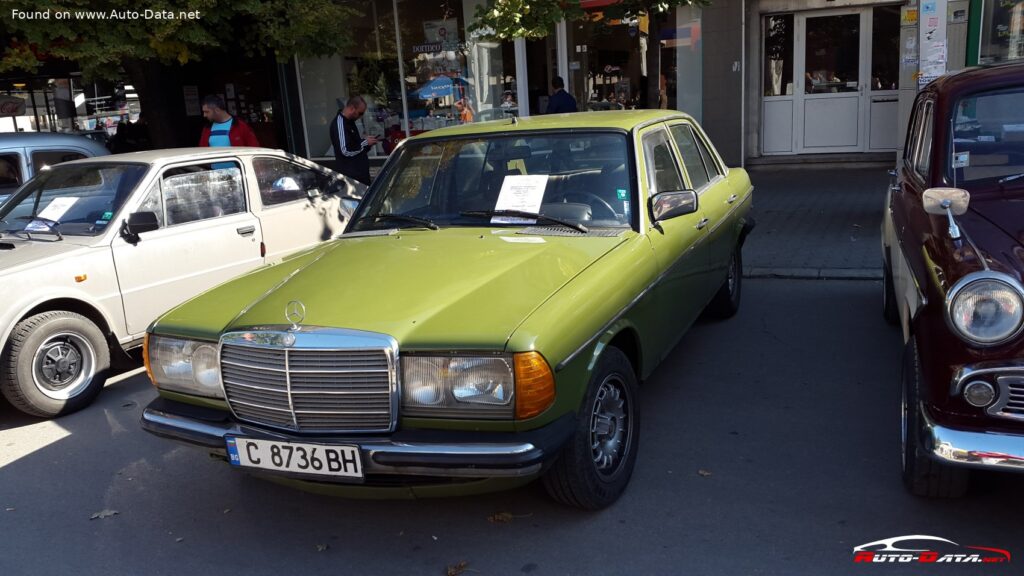
The Mercedes-Benz W123, produced from September 1978 to November 1985, represents a pivotal generation in the lineage of the E-Class, though that designation wouldn’t arrive until later. Positioned as a mid-size luxury sedan, the W123 succeeded the W114 and W115 models, and was designed to offer a blend of comfort, durability, and understated elegance. It quickly became a benchmark for its class, renowned for its build quality and longevity. While sold globally, the W123 found significant success in Europe and North America, establishing Mercedes-Benz as a premier automotive brand. The 300 D variant, powered by a robust diesel engine, was particularly popular for its fuel efficiency and reliability.
The Mercedes-Benz W123 300 D
The W123 300 D, specifically, was a cornerstone of the range, appealing to buyers seeking a refined and economical vehicle. It distinguished itself with its five-cylinder diesel engine, offering a unique character compared to its gasoline-powered counterparts. The “D” designation signified its diesel powertrain, and the “300” indicated its approximate engine displacement. This model was not initially offered in the United States due to stricter emissions regulations at the time, but later versions were adapted to meet American standards, further solidifying the W123’s global appeal.
Engine & Performance
The heart of the W123 300 D is its 3.0-liter (2998 cm3 or 182.95 cu. in.) inline five-cylinder diesel engine, designated OM 617 D 30 / 617.912. This engine produces 88 horsepower at 4400 rpm and 172 Nm (126.86 lb.-ft.) of torque at 2400 rpm. While not a performance-oriented vehicle, the 300 D offered ample torque for comfortable cruising and effortless highway driving. The engine utilizes precombustion chamber injection, a technology common in diesel engines of the era, to improve combustion efficiency. Power per liter is rated at 29.4 Hp/l. Acceleration from 0 to 100 km/h (0-62 mph) takes approximately 19.2 seconds, and 0 to 60 mph is achieved in around 18.2 seconds. The top speed is limited to 150 km/h (93.21 mph). The engine’s longitudinal front-mount configuration contributes to balanced weight distribution. Fuel economy is a strong point, achieving approximately 9.8 l/100 km (24 US mpg) in urban conditions and 8.1 l/100 km (29 US mpg) on the open road.
Design & Features
The W123 is a four-door sedan with a classic, understated design. Its body lines are characterized by clean surfaces and a relatively boxy silhouette, typical of late 1970s and early 1980s automotive styling. The interior is spacious and well-appointed, offering seating for five passengers. The emphasis was on comfort and practicality, with durable materials and a functional layout. Safety features, while not as comprehensive as modern standards, included disc brakes on all four wheels and a robust chassis designed for crash protection. The hydraulic power steering provided ease of maneuverability, and the four-speed automatic transmission offered smooth and convenient gear changes. The W123’s design prioritized longevity and reliability, making it a popular choice for high-mileage drivers. The vehicle’s dimensions are 4725 mm (186.02 in.) in length, 1786 mm (70.31 in.) in width, and 1438 mm (56.61 in.) in height, with a wheelbase of 2795 mm (110.04 in.).
Technical Specifications
| Brand | Mercedes-Benz |
| Model | W123 |
| Generation | W123 |
| Type (Engine) | 300 D (88 Hp) Automatic |
| Start of production | September, 1978 |
| End of production | November, 1985 |
| Powertrain Architecture | Internal Combustion engine |
| Body type | Sedan |
| Seats | 5 |
| Doors | 4 |
| Fuel consumption (urban) | 9.8 l/100 km (24 US mpg) |
| Fuel consumption (extra urban) | 8.1 l/100 km (29 US mpg) |
| Fuel Type | Diesel |
| Acceleration 0 – 100 km/h | 19.2 sec |
| Acceleration 0 – 62 mph | 19.2 sec |
| Acceleration 0 – 60 mph | 18.2 sec |
| Maximum speed | 150 km/h (93.21 mph) |
| Weight-to-power ratio | 16.5 kg/Hp |
| Weight-to-torque ratio | 8.4 kg/Nm |
| Power | 88 Hp @ 4400 rpm |
| Torque | 172 Nm @ 2400 rpm (126.86 lb.-ft. @ 2400 rpm) |
| Engine layout | Front, Longitudinal |
| Engine Model/Code | OM 617 D 30 / 617.912 |
| Engine displacement | 2998 cm3 (182.95 cu. in.) |
| Number of cylinders | 5 |
| Engine configuration | Inline |
| Cylinder Bore | 90.9 mm (3.58 in.) |
| Piston Stroke | 92.4 mm (3.64 in.) |
| Compression ratio | 21.5:1 |
| Number of valves per cylinder | 2 |
| Fuel injection system | Precombustion chamber injection |
| Engine aspiration | Naturally aspirated |
| Valvetrain | SOHC |
| Engine oil capacity | 8 l (8.45 US qt | 7.04 UK qt) |
| Coolant capacity | 11 l (11.62 US qt | 9.68 UK qt) |
| Kerb Weight | 1450 kg (3196.7 lbs.) |
| Max. weight | 1970 kg (4343.11 lbs.) |
| Max load | 520 kg (1146.4 lbs.) |
| Fuel tank capacity | 65 l (17.17 US gal | 14.3 UK gal) |
| Length | 4725 mm (186.02 in.) |
| Width | 1786 mm (70.31 in.) |
| Height | 1438 mm (56.61 in.) |
| Wheelbase | 2795 mm (110.04 in.) |
| Front track | 1488 mm (58.58 in.) |
| Rear track | 1446 mm (56.93 in.) |
| Drivetrain Architecture | Rear wheel drive |
| Number of gears | 4 |
| Gearbox type | Automatic transmission |
| Front suspension | Double wishbone |
| Rear suspension | Trailing arm |
| Front brakes | Disc |
| Rear brakes | Disc |
| Steering type | Cone worm with recirculation balls |
| Power steering | Hydraulic |
| Wheel rims size | 5.5J x 14 |
The Mercedes-Benz W123 300 D remains a highly sought-after classic car, appreciated for its robust engineering, comfortable ride, and timeless design. Its enduring popularity is a testament to the quality and reliability that have long been hallmarks of the Mercedes-Benz brand.
