
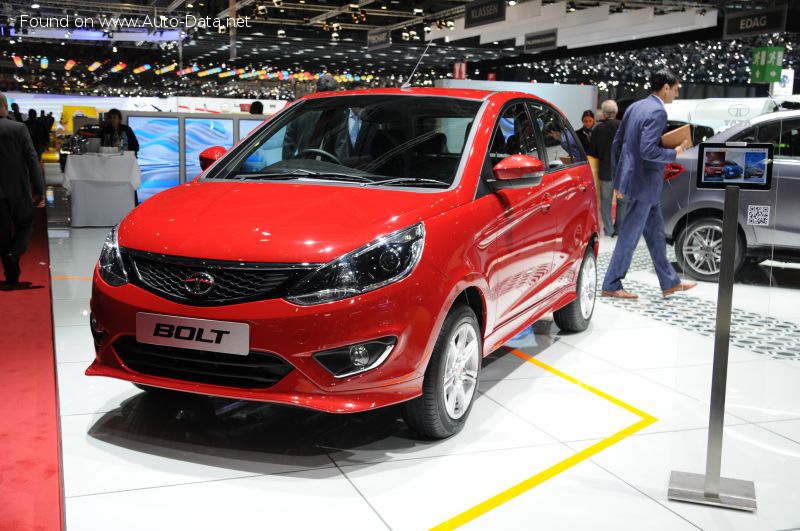
The Tata Bolt 1.3 T (75 Hp) is a subcompact hatchback produced by the Indian manufacturer Tata Motors from 2014 to 2019. Designed as a successor to the Tata Vista, the Bolt represented a significant step forward for Tata in terms of design, features, and overall refinement. While not officially sold in the United States, the Bolt was a key model for Tata in the Indian market, competing with established players like the Maruti Suzuki Swift and Hyundai Grand i10. It aimed to offer a compelling package of affordability, fuel efficiency, and practicality for the growing Indian middle class.
The Tata Bolt 1.3 T: A Detailed Overview
The Bolt was part of Tata’s ‘Horizon Next’ strategy, a plan to revitalize the brand and introduce more appealing vehicles. The 1.3 T variant, powered by a turbocharged diesel engine, was positioned as a performance-oriented option within the Bolt lineup. It offered a balance between fuel economy and adequate power for everyday driving conditions. The vehicle was primarily targeted at urban commuters and small families seeking a reliable and economical mode of transportation.
Engine & Performance
The heart of the Tata Bolt 1.3 T is a 1.3-liter inline-four cylinder diesel engine. This engine, turbocharged and intercooled, produces 75 horsepower at 4,000 rpm and 190 Nm (140.14 lb.-ft.) of torque between 1750 and 3000 rpm. The turbocharger and intercooler work in tandem to improve combustion efficiency and boost power output. The engine utilizes a diesel commonrail fuel injection system for precise fuel delivery and optimized emissions. Power is sent to the front wheels via a five-speed manual transmission.
Performance figures indicate a 0-100 km/h (0-62 mph) acceleration time of 15.2 seconds, and a 0-60 mph time of 14.4 seconds. The Bolt 1.3 T has a maximum speed of 150 km/h (93.21 mph). The weight-to-power ratio is 15.1 kg/Hp, while the weight-to-torque ratio is 6 kg/Nm. Fuel economy is a strong point, with urban consumption rated at 5.1 l/100 km (46.1 US mpg), and extra-urban consumption at 4.4 l/100 km (53.5 US mpg). These figures contribute to a relatively low cost of ownership.
Design & Features
The Tata Bolt features a hatchback body style with five doors and seating for five passengers. Its design, while not groundbreaking, represented a noticeable improvement over previous Tata models. The front end incorporates a prominent grille and swept-back headlights, while the profile is characterized by clean lines and a relatively compact footprint. The interior of the Bolt 1.3 T is functional and reasonably well-appointed for its price point.
Key features included power steering (electric), front disc brakes, and rear drum brakes. The Bolt offered a decent level of equipment, including air conditioning, power windows, and a basic audio system. Safety features were relatively limited by modern standards, but typically included driver and passenger airbags. The trunk space is rated at 210 liters (7.42 cu. ft.), which is adequate for everyday use but may be limited for larger items. The vehicle’s dimensions are: length 3825 mm (150.59 in.), width 1695 mm (66.73 in.), and height 1562 mm (61.5 in.). Ride height (ground clearance) is 165 mm (6.5 in.).
Technical Specifications
| Brand | Tata |
| Model | Bolt |
| Generation | Bolt |
| Type (Engine) | 1.3 T (75 Hp) |
| Start of production | 2014 |
| End of production | April, 2019 |
| Powertrain Architecture | Internal Combustion engine |
| Body type | Hatchback |
| Seats | 5 |
| Doors | 5 |
| Fuel consumption (urban) | 5.1 l/100 km (46.1 US mpg) |
| Fuel consumption (extra urban) | 4.4 l/100 km (53.5 US mpg) |
| Fuel Type | Diesel |
| Acceleration 0 – 100 km/h | 15.2 sec |
| Acceleration 0 – 62 mph | 15.2 sec |
| Acceleration 0 – 60 mph | 14.4 sec |
| Maximum speed | 150 km/h (93.21 mph) |
| Weight-to-power ratio | 15.1 kg/Hp |
| Weight-to-torque ratio | 6 kg/Nm |
| Power | 75 Hp @ 4000 rpm |
| Torque | 190 Nm @ 1750-3000 rpm (140.14 lb.-ft.) |
| Engine displacement | 1248 cm3 (76.16 cu. in.) |
| Number of cylinders | 4 |
| Engine configuration | Inline |
| Number of valves per cylinder | 4 |
| Fuel injection system | Diesel Commonrail |
| Engine aspiration | Turbocharger, Intercooler |
| Valvetrain | DOHC |
| Engine oil capacity | 3.2 l (3.38 US qt | 2.82 UK qt) |
| Coolant capacity | 7.5 l (7.93 US qt | 6.6 UK qt) |
| Kerb Weight | 1132-1160 kg (2495.63 – 2557.36 lbs.) |
| Trunk (boot) space | 210 l (7.42 cu. ft.) |
| Fuel tank capacity | 44 l (11.62 US gal | 9.68 UK gal) |
| Length | 3825 mm (150.59 in.) |
| Width | 1695 mm (66.73 in.) |
| Height | 1562 mm (61.5 in.) |
| Wheelbase | 2470 mm (97.24 in.) |
| Ride height (ground clearance) | 165 mm (6.5 in.) |
| Minimum turning circle | 10.2 m (33.46 ft.) |
| Drivetrain | Front wheel drive |
| Number of gears | 5 gears, manual transmission |
| Front suspension | Independent, McPherson with coil spring and anti-roll bar |
| Rear suspension | Semi-independent, coil spring |
| Front brakes | Disc |
| Rear brakes | Drum |
| Steering type | Steering rack and pinion |
| Power steering | Electric |
| Tires size | 175/65 R14 |
| Wheel rims size | 14 |
The Tata Bolt 1.3 T, while not a performance car by any stretch, offered a practical and economical transportation solution for the Indian market. Its turbocharged diesel engine provided a reasonable balance of power and fuel efficiency, making it a popular choice for daily commutes and family trips. Although it wasn’t sold in the US, it represents an interesting example of automotive engineering tailored to the specific needs and conditions of a developing market.
