
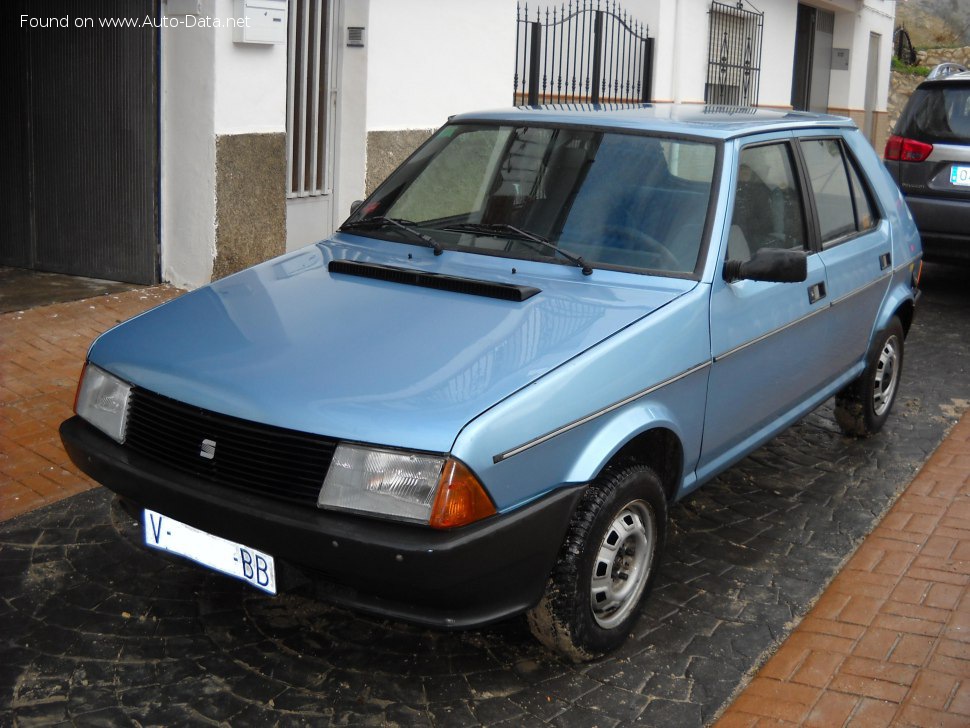
The SEAT Ronda is a small, front-wheel-drive hatchback that was produced by the Spanish automobile manufacturer SEAT between 1982 and 1986. Positioned as an affordable and practical family car, the Ronda was a significant model for SEAT, representing a move towards more modern designs and engineering. It was primarily sold in European markets, particularly Spain, and played a crucial role in SEAT’s domestic success during a period of economic and automotive change. The Ronda was based on the Fiat Ritmo, a result of SEAT’s collaboration with Fiat, which at the time held a significant stake in the Spanish automaker. The 1.2-liter version, designated as the Ronda (022A) 1.2 (60/63 Hp), was a popular entry-level offering, focusing on fuel efficiency and low running costs.
SEAT Ronda (022A) 1.2: A European Compact
The SEAT Ronda occupied the subcompact or supermini segment in Europe, competing with vehicles like the Renault 5, Peugeot 205, and Fiat Uno. Unlike many of its competitors, the Ronda offered a relatively spacious interior and a practical hatchback design, making it appealing to families. It was not officially sold in the United States due to differing automotive regulations and market preferences. However, understanding its position in the European market is key to appreciating its design and engineering choices. The Ronda aimed to provide a balance between affordability, practicality, and a degree of modern styling, a formula that proved successful in its target markets.
Origins and Collaboration with Fiat
SEAT’s history is intertwined with that of Fiat. For many years, SEAT essentially manufactured Fiat models under license in Spain. The Ronda was a direct derivative of the Fiat Ritmo (sold as the Strade in some markets), but with distinct styling cues and adaptations to suit Spanish tastes and manufacturing capabilities. This collaboration allowed SEAT to benefit from Fiat’s engineering expertise while establishing its own brand identity. The Ronda represented a step towards greater independence for SEAT, as it incorporated more original design elements compared to earlier licensed models.
Engine & Performance
The Ronda (022A) 1.2 was powered by a 1.2-liter, naturally aspirated inline-four cylinder gasoline engine, internally designated as the 021 A 1000. This engine produced 63 horsepower (Hp), providing adequate, though not particularly sporty, performance for everyday driving. The engine’s focus was on fuel efficiency and reliability rather than outright speed. The engine was paired with a four-speed manual transmission, which was standard across the range. The front-wheel-drive configuration contributed to good traction in most conditions. Acceleration was modest, with a 0-60 mph time estimated to be around 14-16 seconds, reflecting the car’s emphasis on practicality and economy. The engine’s relatively small displacement and simple design made it easy to maintain and repair, contributing to the Ronda’s appeal as a low-cost vehicle.
The 1.2-liter engine was known for its durability and relatively low fuel consumption, which was a significant factor for buyers in the early 1980s, particularly in the context of fluctuating fuel prices. While not a performance car, the Ronda 1.2 offered sufficient power for navigating city streets and undertaking longer journeys at moderate speeds. The engine’s characteristics made it well-suited to the demands of everyday driving, prioritizing reliability and economy over exhilarating performance.
Design & Features
The SEAT Ronda featured a five-door hatchback body style, offering good accessibility and practicality. The design, while influenced by the Fiat Ritmo, incorporated distinct SEAT styling elements, including a more angular front end and a revised rear end. The interior was functional and relatively spacious for a car of its size, offering seating for five passengers. The dashboard layout was simple and straightforward, with clearly labeled controls. Safety features were limited by the standards of the time, typically including seatbelts and a collapsible steering column.
The Ronda’s hatchback configuration provided a versatile cargo area, which could be expanded by folding down the rear seats. The car’s relatively compact dimensions made it easy to maneuver in urban environments. Interior trim levels varied depending on the market and optional extras, but generally focused on providing a durable and practical environment. The Ronda’s design reflected the prevailing trends of the early 1980s, emphasizing practicality and affordability over luxury or high performance. The car’s overall aesthetic was clean and functional, appealing to buyers seeking a reliable and economical mode of transportation.
Technical Specifications
| General Information | |
| Brand | SEAT |
| Model | Ronda |
| Generation | Ronda (022A) |
| Type (Engine) | 1.2 (60/63 Hp) |
| Start of production | 1984 |
| End of production | 1986 |
| Powertrain Architecture | Internal Combustion engine |
| Body type | Hatchback |
| Seats | 5 |
| Doors | 5 |
| Performance Specs | |
| Fuel Type | Petrol (Gasoline) |
| Power | 63 Hp |
| Engine Specs | |
| Engine Model/Code | 021 A 1000 |
| Engine aspiration | Naturally aspirated engine |
| Space, Volume and weights | |
| Fuel tank capacity | 50 l / 13.21 US gal | 11 UK gal |
