
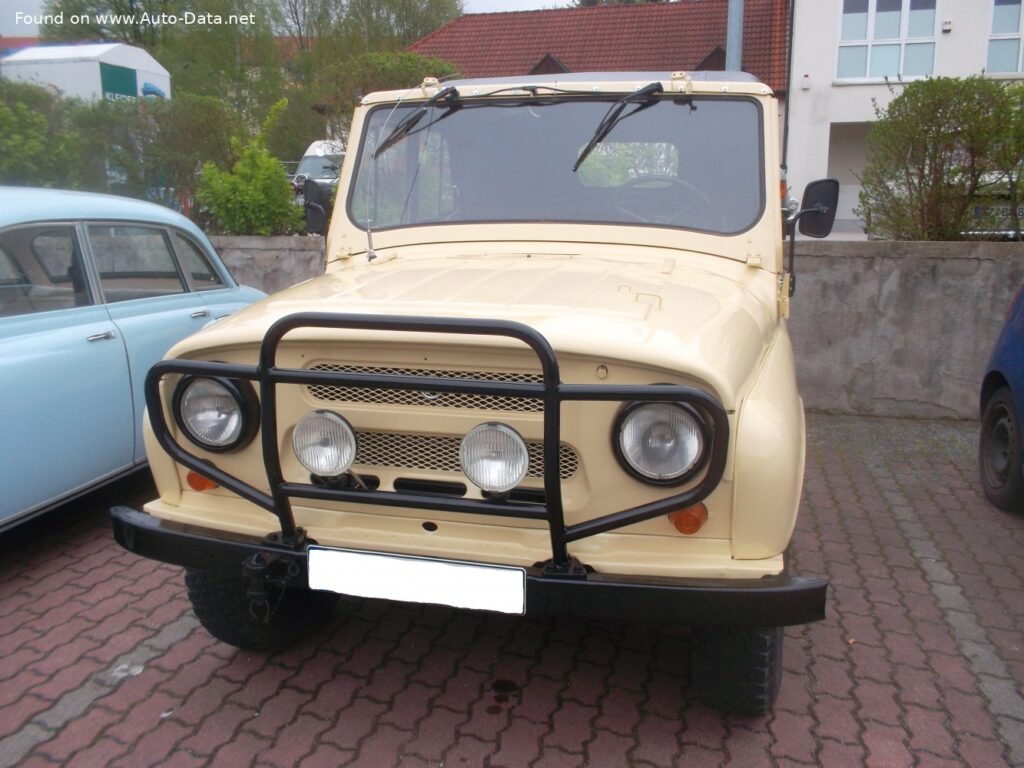
The UAZ 469B is a utility vehicle originating from the Soviet Union, produced from 1973 to 1985. A direct descendant of the original UAZ-469, designed in the 1950s, the 469B represented a refinement of a vehicle intended for military and civilian use in challenging terrain. While never officially sold in the United States, the UAZ 469 and its variants gained a cult following among off-road enthusiasts and collectors due to its robust construction, simple mechanics, and exceptional all-terrain capability. It served as the Soviet equivalent to the American Jeep and the British Land Rover, fulfilling a similar role in providing reliable transportation across vast and often unforgiving landscapes. The “B” designation indicates a modernized version of the original 469, featuring improvements to the engine and some interior refinements.
UAZ 469B: A Legacy of Rugged Utility
The UAZ 469B was more than just a vehicle; it was a symbol of Soviet engineering and practicality. Designed for both military and civilian applications, it was built to withstand harsh conditions and provide reliable transportation where other vehicles struggled. Its simple, body-on-frame construction and robust drivetrain made it exceptionally durable and easy to maintain, even in remote areas with limited access to specialized repair facilities. The 469B found widespread use in agriculture, forestry, construction, and as a general-purpose vehicle for both government agencies and private citizens within the Soviet Union and its satellite states.
Engine & Performance
The UAZ 469B was powered by the ZMZ-451MI inline-four cylinder, naturally aspirated gasoline engine, displacing 2.4 liters (149.2 cubic inches). This engine produced 73 horsepower at 4000 rpm and 163 Nm (120.22 lb.-ft.) of torque between 2200-2500 rpm. While not a powerhouse by modern standards, the engine’s torque characteristics were well-suited to off-road driving, providing sufficient low-end grunt for navigating difficult terrain. The engine featured an overhead valve (OHV) valvetrain and utilized a carburetor for fuel delivery. The power-to-weight ratio of 21.1 kg/Hp and a torque-to-weight ratio of 9.4 kg/Nm contributed to its respectable performance, allowing it to reach a maximum speed of 100 km/h (62.14 mph). Fuel economy was modest, at 12 liters per 100 kilometers (19.6 US mpg).
Design & Features
The UAZ 469B is characterized by its utilitarian, boxy design. It’s a five-door, seven-seat vehicle with a body-on-frame construction. The design prioritized functionality over aesthetics, resulting in a vehicle that was exceptionally durable and capable. The body is constructed of stamped steel panels, and the vehicle features a relatively high ground clearance of 220 mm (8.66 inches), enabling it to overcome obstacles with ease. The approach angle of 50° and departure angle of 40° further enhanced its off-road prowess.
Inside, the 469B offered basic but functional accommodations. The interior was spartan, with minimal creature comforts. Seats were typically covered in vinyl, and the dashboard was simple and straightforward. The focus was on providing a durable and practical interior that could withstand the rigors of off-road use. Safety features were limited by the standards of the time, consisting primarily of a robust chassis and a simple braking system. The vehicle’s four-wheel drive system, coupled with its high ground clearance and generous approach/departure angles, were its primary safety features in challenging environments.
Technical Specifications
| Brand | UAZ |
| Model | 469 |
| Generation | 469B |
| Type (Engine) | 2.4 (73 Hp) 4×4 |
| Start of production | 1973 |
| End of production | 1985 |
| Powertrain Architecture | Internal Combustion engine |
| Body type | Off-road vehicle |
| Seats | 7 |
| Doors | 5 |
| Fuel consumption (combined) | 12 l/100 km (19.6 US mpg, 23.5 UK mpg, 8.3 km/l) |
| Fuel Type | Petrol (Gasoline) |
| Maximum speed | 100 km/h (62.14 mph) |
| Weight-to-power ratio | 21.1 kg/Hp |
| Weight-to-torque ratio | 9.4 kg/Nm |
| Power | 73 Hp @ 4000 rpm |
| Power per litre | 29.9 Hp/l |
| Torque | 163 Nm @ 2200-2500 rpm (120.22 lb.-ft. @ 2200-2500 rpm) |
| Engine layout | Front, Longitudinal |
| Engine Model/Code | ZMZ-451MI |
| Engine displacement | 2445 cm3 (149.2 cu. in.) |
| Number of cylinders | 4 |
| Engine configuration | Inline |
| Cylinder Bore | 92 mm (3.62 in.) |
| Piston Stroke | 92 mm (3.62 in.) |
| Compression ratio | 6.7:1 |
| Number of valves per cylinder | 2 |
| Fuel injection system | Carburettor |
| Engine aspiration | Naturally aspirated engine |
| Valvetrain | OHV |
| Engine oil capacity | 5.8 l (6.13 US qt | 5.1 UK qt) |
| Coolant | 13 l (13.74 US qt | 11.44 UK qt) |
| Kerb Weight | 1540 kg (3395.12 lbs.) |
| Max. weight | 2290 kg (5048.59 lbs.) |
| Max load | 750 kg (1653.47 lbs.) |
| Permitted trailer load without brakes | 850 kg (1873.93 lbs.) |
| Length | 4025 mm (158.46 in.) |
| Width | 1785 mm (70.28 in.) |
| Height | 2015 mm (79.33 in.) |
| Wheelbase | 2380 mm (93.7 in.) |
| Front track | 1442 mm (56.77 in.) |
| Rear track | 1442 mm (56.77 in.) |
| Front overhang | 680 mm (26.77 in.) |
| Rear overhang | 965 mm (37.99 in.) |
| Ride height (ground clearance) | 220 mm (8.66 in.) |
| Minimum turning circle | 13 m (42.65 ft.) |
| Approach angle | 50° |
| Departure angle | 40° |
| Climb angle | 31° |
| Wading depth | 700 mm (27.56 in.) |
| Drivetrain Architecture | All wheel drive (4×4). ICE drives rear wheels, front wheels engaged via clutch. |
| Number of gears and type of gearbox | 4 gears, manual transmission |
| Front suspension | Rigid axle, Leaf spring |
| Rear suspension | Rigid axle, Leaf spring |
| Front brakes | Drum |
| Rear brakes | Drum |
| Steering type | Cone worm with recirculation balls |
| Tires size | 215/90 R15 |
| Wheel rims size | 15 |
The UAZ 469B remains a popular vehicle among enthusiasts and collectors, celebrated for its simplicity, durability, and off-road capability. It represents a significant chapter in automotive history, embodying the engineering principles and design philosophies of the Soviet era. Its enduring appeal lies in its ability to tackle challenging terrain and its reputation as a reliable and robust workhorse.
