
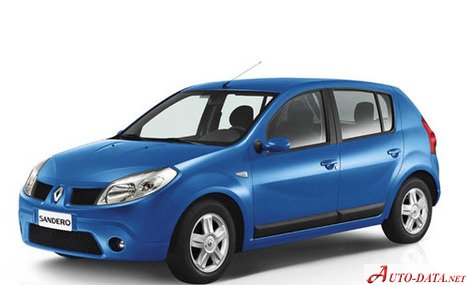
The Renault Sandero 1.4i (75 Hp), produced between 2007 and 2011, is a subcompact hatchback primarily aimed at the European market as an affordable and practical vehicle. While not officially sold in the United States, understanding its specifications provides insight into the popular small car segment globally. The Sandero filled a crucial role for Renault, offering a budget-friendly alternative in a competitive market, particularly in Eastern Europe and South America. It represented Renault’s attempt to provide a no-frills, reliable vehicle focused on value for money.
Renault Sandero 1.4i: Overview and Market Position
The Sandero, named after a Romanian literary figure, was initially conceived as a Dacia model – Dacia being Renault’s Romanian subsidiary. It was later rebadged and sold under the Renault brand in many markets, particularly where the Dacia brand had limited recognition. The 1.4i variant, equipped with a 75 horsepower engine, was a mainstay of the lineup, offering a balance between fuel efficiency and acceptable performance for everyday driving. The Sandero competed with vehicles like the Peugeot 206, Citroën C3, and Volkswagen Polo in its segment.
Engine & Performance
The Renault Sandero 1.4i is powered by a 1.4-liter inline four-cylinder gasoline engine, designated the K7J. This naturally aspirated engine produces 75 horsepower at 5500 rpm and 112 Nm (82.61 lb.-ft.) of torque at 3000 rpm. While not a performance-oriented engine, it provides adequate power for urban and highway driving. The engine’s power-to-liter ratio is 54 Hp/l. Acceleration from 0 to 100 km/h (0-62 mph) takes approximately 13 seconds, and 0 to 60 mph is achieved in around 12.4 seconds. The Sandero 1.4i has a maximum speed of 161 km/h (100.04 mph). Fuel economy is a strong point, with combined fuel consumption rated at 7 liters per 100 kilometers (33.6 US mpg or 40.4 UK mpg). Urban fuel consumption is 9.6 l/100 km (24.5 US mpg), while extra-urban consumption is a more economical 5.4 l/100 km (43.6 US mpg).
Design & Features
The Renault Sandero is a five-door hatchback with a relatively simple and functional design. Its styling is practical rather than flamboyant, prioritizing interior space and affordability. The interior offers seating for five passengers and provides a reasonable amount of legroom and headroom for its class. The trunk offers 320 liters (11.3 cu. ft.) of space with the rear seats up, expanding to 1200 liters (42.38 cu. ft.) when the rear seats are folded down. Safety features for the 2007-2011 model year are basic by modern standards, typically including driver and passenger airbags and seatbelts. The Sandero’s focus was on providing a reliable and affordable mode of transportation, and features were kept to a minimum to maintain a competitive price point. The vehicle utilizes a McPherson independent suspension in the front and a semi-independent coil spring suspension in the rear, providing a comfortable, if not particularly sporty, ride.
Technical Specifications
| Brand | Renault |
| Model | Sandero |
| Generation | Sandero |
| Type (Engine) | 1.4i (75 Hp) |
| Start of production | 2007 |
| End of production | 2011 |
| Powertrain Architecture | Internal Combustion engine |
| Body type | Hatchback |
| Seats | 5 |
| Doors | 5 |
| Fuel consumption (urban) | 9.6 l/100 km (24.5 US mpg) |
| Fuel consumption (extra urban) | 5.4 l/100 km (43.6 US mpg) |
| Fuel consumption (combined) | 7 l/100 km (33.6 US mpg) |
| Fuel Type | Petrol (Gasoline) |
| Acceleration 0 – 100 km/h | 13 sec |
| Acceleration 0 – 62 mph | 13 sec |
| Acceleration 0 – 60 mph | 12.4 sec |
| Maximum speed | 161 km/h (100.04 mph) |
| Power | 75 Hp @ 5500 rpm |
| Torque | 112 Nm @ 3000 rpm (82.61 lb.-ft. @ 3000 rpm) |
| Engine layout | Front, Transverse |
| Engine Model/Code | K7J |
| Engine displacement | 1390 cm3 (84.82 cu. in.) |
| Number of cylinders | 4 |
| Engine configuration | Inline |
| Cylinder Bore | 79.5 mm (3.13 in.) |
| Piston Stroke | 70 mm (2.76 in.) |
| Compression ratio | 9.5:1 |
| Number of valves per cylinder | 2 |
| Fuel injection system | Multi-port manifold injection |
| Engine aspiration | Naturally aspirated |
| Engine oil capacity | 3.3 l (3.49 US qt | 2.9 UK qt) |
| Coolant capacity | 4.5 l (4.76 US qt | 3.96 UK qt) |
| Trunk (boot) space – minimum | 320 l (11.3 cu. ft.) |
| Trunk (boot) space – maximum | 1200 l (42.38 cu. ft.) |
| Fuel tank capacity | 50 l (13.21 US gal | 11 UK gal) |
| Length | 4020 mm (158.27 in.) |
| Width | 1746 mm (68.74 in.) |
| Height | 1534 mm (60.39 in.) |
| Wheelbase | 2588 mm (101.89 in.) |
| Front track | 1480 mm (58.27 in.) |
| Rear track | 1469 mm (57.83 in.) |
| Drivetrain Architecture | Front wheel drive |
| Number of gears | 5 gears, manual transmission |
| Front suspension | Independent type McPherson |
| Rear suspension | Semi-independent, coil spring |
| Front brakes | Disc |
| Rear brakes | Drum |
| Tires size | 165/80 R14 |
| Wheel rims size | 14 |
The Renault Sandero 1.4i, while not a groundbreaking vehicle, served as a practical and affordable option for buyers in its target markets. Its simple design, fuel-efficient engine, and spacious interior made it a popular choice for families and individuals seeking a reliable and economical hatchback. Its legacy lies in providing accessible transportation and establishing Renault’s presence in the budget car segment.
