
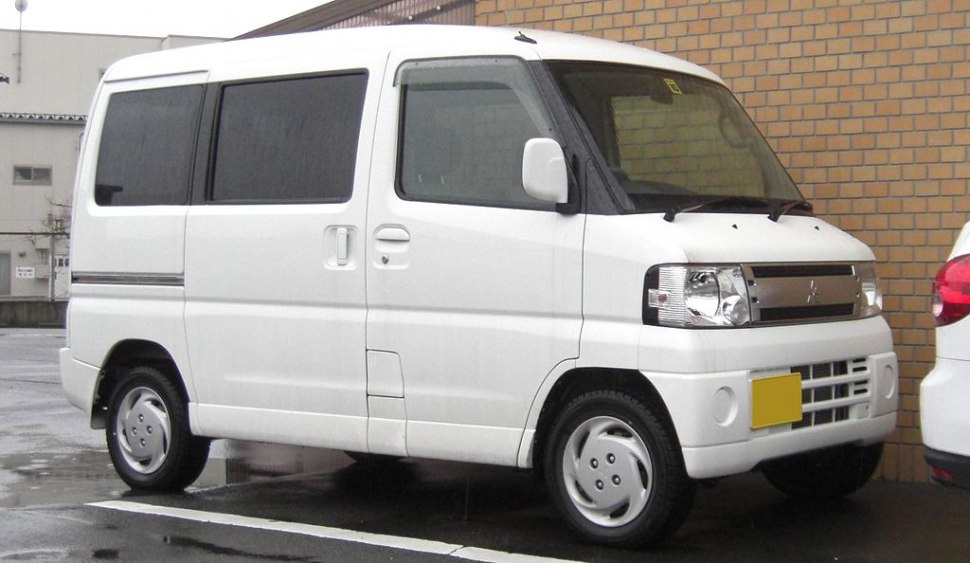
The Mitsubishi Town Box is a microvan produced by Mitsubishi Motors from 1999 to 2011. Primarily sold in Japan, it falls into the “kei car” category, a segment of vehicles designed to meet specific size and engine displacement regulations for tax and insurance benefits within Japan. The Town Box, along with its twin, the Nissan Otti, catered to a market seeking a practical, compact, and affordable vehicle for urban commuting and small family needs. While not officially sold in the United States, understanding the Town Box provides insight into the unique automotive landscape of Japan and the engineering challenges of maximizing space and efficiency within strict dimensional constraints. This article details the 0.7 i 20V RX variant, equipped with a 64 horsepower engine.
Mitsubishi Town Box: A Kei Car Overview
The Town Box was conceived as a direct response to the growing demand for small, versatile vehicles in Japan’s densely populated cities. The “kei car” classification dictates maximum dimensions and engine size, fostering innovation in packaging and engine technology. Mitsubishi aimed to create a vehicle that offered the interior space of a larger car, but with the maneuverability and fuel efficiency of a smaller one. The Town Box achieved this through a tall, boxy design and a highly optimized engine. Its role in the Japanese market was to provide an economical and practical transportation solution for individuals and small families, particularly those living in urban environments where parking space is limited.
Engine & Performance
The 0.7 i 20V RX Town Box is powered by a 659cc (40.21 cubic inches) inline-four cylinder gasoline engine. This engine, despite its small displacement, produces 64 horsepower at 6500 rpm and 98 Nm (72.28 lb-ft) of torque at 3000 rpm. The engine features a multi-port fuel injection system and, notably, a turbocharger. The turbocharger is crucial for boosting power output within the kei car regulations. The power-to-weight ratio is 14.7 kg/Hp, or 68.1 Hp/tonne, indicating a reasonably sprightly performance for its size and intended use. The engine is transversely mounted at the front of the vehicle, driving the front wheels through a four-speed automatic transmission. While not designed for high-speed performance, the engine provides sufficient power for navigating urban streets and moderate highway driving. The engine’s 97.1 Hp/l specific output demonstrates the effectiveness of the turbocharging and engine tuning.
Design & Features
The Mitsubishi Town Box is a five-door minivan characterized by its tall, boxy silhouette – a design necessitated by the kei car regulations. This shape maximizes interior space within the limited exterior dimensions. The vehicle seats four passengers comfortably. The interior is designed for practicality, with a focus on maximizing usable space. Features included sliding rear doors for easy access in tight parking spaces, and a relatively spacious cargo area for a vehicle of its size. Safety features, while basic by modern standards, included an Anti-lock Braking System (ABS). The Town Box prioritized functionality and affordability over luxurious appointments. The exterior styling was simple and utilitarian, reflecting its intended purpose as a no-frills transportation solution. The vehicle’s dimensions – 3395 mm (133.66 in) in length, 1475 mm (58.07 in) in width, and 1905 mm (75 in) in height – highlight its compact footprint.
Technical Specifications
| Brand | Mitsubishi |
| Model | Town BOX |
| Generation | Town Box |
| Type (Engine) | 0.7 i 20V RX (64 Hp) |
| Start of production | 1999 year |
| End of production | 2011 year |
| Powertrain Architecture | Internal Combustion engine |
| Body type | Minivan |
| Seats | 4 |
| Doors | 5 |
| Fuel Type | Petrol (Gasoline) |
| Weight-to-power ratio | 14.7 kg/Hp |
| Weight-to-torque ratio | 9.6 kg/Nm |
| Power | 64 Hp @ 6500 rpm |
| Power per litre | 97.1 Hp/l |
| Torque | 98 Nm @ 3000 rpm |
| Torque (lb.-ft.) | 72.28 lb.-ft. @ 3000 rpm |
| Engine layout | Front, Transverse |
| Engine displacement | 659 cm3 |
| Engine displacement (cu. in.) | 40.21 cu. in. |
| Number of cylinders | 4 |
| Engine configuration | Inline |
| Cylinder Bore | 60 mm |
| Cylinder Bore (in.) | 2.36 in. |
| Piston Stroke | 58.3 mm |
| Piston Stroke (in.) | 2.3 in. |
| Compression ratio | 8.5:1 |
| Number of valves per cylinder | 5 |
| Fuel injection system | Multi-port manifold injection |
| Engine aspiration | Turbocharger |
| Kerb Weight | 940 kg |
| Kerb Weight (lbs.) | 2072.35 lbs. |
| Max. weight | 1160 kg |
| Max. weight (lbs.) | 2557.36 lbs. |
| Max load | 220 kg |
| Max load (lbs.) | 485.02 lbs. |
| Fuel tank capacity | 30 l |
| Fuel tank capacity (US gal) | 7.93 US gal |
| Fuel tank capacity (UK gal) | 6.6 UK gal |
| Length | 3395 mm |
| Length (in.) | 133.66 in. |
| Width | 1475 mm |
| Width (in.) | 58.07 in. |
| Height | 1905 mm |
| Height (in.) | 75 in. |
| Wheelbase | 2390 mm |
| Wheelbase (in.) | 94.09 in. |
| Front track | 1290 mm |
| Front track (in.) | 50.79 in. |
| Rear (Back) track | 1290 mm |
| Rear (Back) track (in.) | 50.79 in. |
| Drivetrain Architecture | The Internal combustion engine (ICE) drives the front wheels of the vehicle. |
| Drive wheel | Front wheel drive |
| Number of gears and type of gearbox | 4 gears, automatic transmission |
| Front suspension | Coil spring |
| Rear suspension | Coil spring |
| Front brakes | Ventilated discs |
| Rear brakes | Drum |
| Assisting systems | ABS (Anti-lock braking system) |
| Steering type | Steering rack and pinion |
| Power steering | Hydraulic Steering |
| Tires size | 165/65 R13 |
The Mitsubishi Town Box, while not a vehicle commonly seen outside of Japan, represents a significant example of automotive engineering tailored to specific market needs. Its compact size, efficient engine, and practical design made it a popular choice for Japanese consumers, demonstrating the ingenuity and adaptability of the Japanese automotive industry.
