
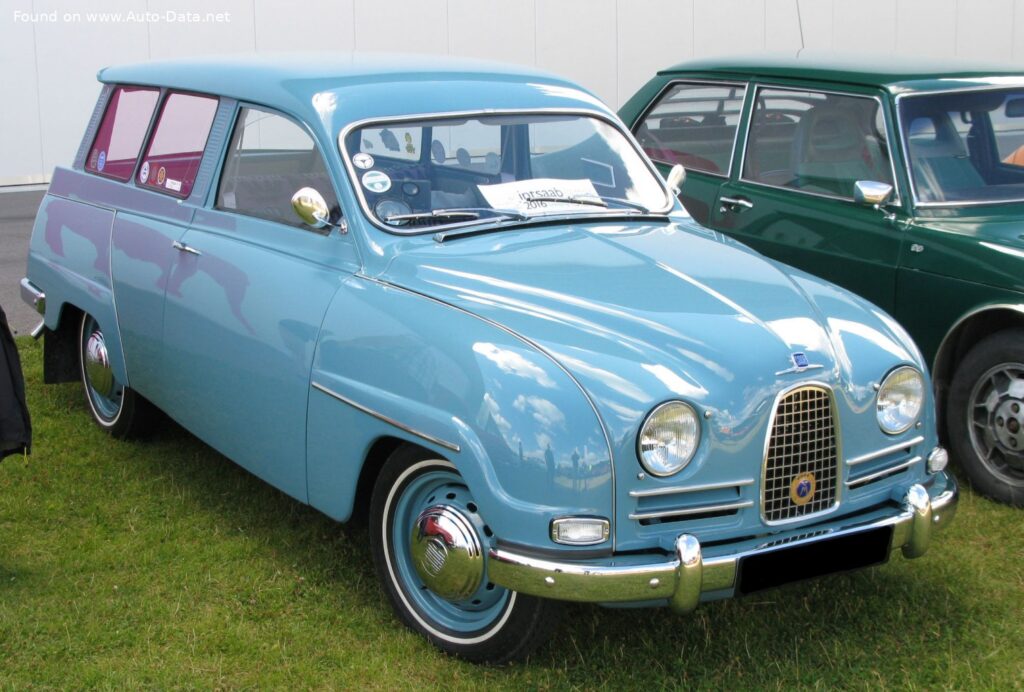
The Saab 95, specifically the 0.8-liter variant producing 38 horsepower, represents a pivotal moment in the Swedish automaker’s history. Produced from 1959 to 1966, this model was not widely sold in the United States, but it became a significant vehicle in the European market, particularly in Sweden and other Nordic countries. The 95 was Saab’s first station wagon (estate) and established the company’s reputation for building practical, innovative, and somewhat unconventional vehicles. It was a direct response to the growing demand for family-oriented cars with increased cargo capacity, and it laid the groundwork for Saab’s future success in the estate car segment.
The Saab 95 0.8: A Pioneering Estate Car
The Saab 95 distinguished itself from many contemporary vehicles with its aerodynamic design, influenced by aircraft engineering – a hallmark of Saab’s early automotive development. Its focus wasn’t on outright speed, but on providing a safe, reliable, and spacious vehicle for families. The 0.8-liter engine, while modest in power by today’s standards, was considered adequate for the car’s intended purpose and the road conditions prevalent in its primary markets. The 95’s enduring appeal lies in its unique blend of practicality, durability, and distinctive Swedish design.
Engine & Performance
The heart of the Saab 95 0.8 is a 841 cm³ (51.32 cu. in.) inline three-cylinder, two-stroke engine. This engine produced 38 horsepower at 4250 rpm and 81 Nm (59.74 lb.-ft.) of torque at 3000 rpm. The power-to-weight ratio was 23.8 kg/Hp, or approximately 42 Hp/tonne. While the engine’s output seems low by modern standards, it was a relatively advanced design for its time, utilizing a two-stroke cycle which, while offering a high power-to-weight ratio, also required careful oil mixing with the fuel. The engine’s configuration was longitudinal, positioned at the front of the vehicle. The Saab 95 0.8 could achieve a maximum speed of 120 km/h (74.56 mph). Fuel economy was rated at 9.3 l/100 km (25.3 US mpg, 30.4 UK mpg, 10.8 km/l) in extra-urban driving conditions. The engine featured a carburettor fuel injection system and an overhead camshaft (OHC) valvetrain.
Design & Features
The Saab 95 was a three-door station wagon (estate) capable of seating up to seven passengers, a remarkable feat for a vehicle of its size. The body style was a defining characteristic, offering a large cargo area accessible through a rear tailgate. The design prioritized practicality and space utilization. The car’s aerodynamic shape, with its sloping roofline and relatively streamlined profile, was notable for the era. Safety features, while limited by the standards of the 1960s, included disc brakes on the front wheels and drum brakes on the rear. The steering system employed a steering rack and pinion for improved handling. The interior was functional and focused on durability, reflecting the car’s intended use as a family vehicle. The 95’s design was a departure from the more conventional styling of many of its competitors, establishing a unique visual identity for Saab.
Technical Specifications
| Brand | Saab |
| Model | 95 |
| Generation | 95 |
| Type (Engine) | 0.8 (38 Hp) |
| Start of production | 1959 |
| End of production | 1966 |
| Powertrain Architecture | Internal Combustion engine |
| Body type | Station wagon (estate) |
| Seats | 7 |
| Doors | 3 |
| Fuel consumption (extra urban) | 9.3 l/100 km (25.3 US mpg, 30.4 UK mpg, 10.8 km/l) |
| Fuel Type | Mixture of two stroke engine |
| Maximum speed | 120 km/h (74.56 mph) |
| Weight-to-power ratio | 23.8 kg/Hp |
| Weight-to-torque ratio | 11.2 kg/Nm |
| Power | 38 Hp @ 4250 rpm |
| Power per litre | 45.2 Hp/l |
| Torque | 81 Nm @ 3000 rpm (59.74 lb.-ft. @ 3000 rpm) |
| Engine layout | Front, Longitudinal |
| Engine displacement | 841 cm3 (51.32 cu. in.) |
| Number of cylinders | 3 |
| Engine configuration | Inline |
| Cylinder Bore | 70 mm (2.76 in.) |
| Piston Stroke | 73 mm (2.87 in.) |
| Compression ratio | 8.5:1 |
| Fuel injection system | Carburettor |
| Engine aspiration | Naturally aspirated |
| Valvetrain | OHC |
| Coolant | 7.5 l (7.93 US qt | 6.6 UK qt) |
| Kerb Weight | 905 kg (1995.18 lbs.) |
| Fuel tank capacity | 43 l (11.36 US gal | 9.46 UK gal) |
| Length | 4015 mm (158.07 in.) |
| Width | 1575 mm (62.01 in.) |
| Height | 1470 mm (57.87 in.) |
| Wheelbase | 2490 mm (98.03 in.) |
| Front track | 1220 mm (48.03 in.) |
| Rear track | 1220 mm (48.03 in.) |
| Drivetrain Architecture | Internal Combustion engine (ICE) drives the front wheels |
| Drive wheel | Front wheel drive |
| Number of gears | 4 gears, manual transmission |
| Front suspension | Coil spring |
| Rear suspension | Coil spring |
| Front brakes | Disc |
| Rear brakes | Drum |
| Steering type | Steering rack and pinion |
The Saab 95 0.8, while not a performance car, was a significant achievement in automotive engineering and design. It established Saab as a maker of practical, innovative, and uniquely styled vehicles. Its legacy continues to influence automotive design and engineering today, particularly in the realm of station wagons and family-oriented vehicles. The 95’s enduring appeal is a testament to its thoughtful design and its ability to meet the needs of families in a practical and stylish manner.
