
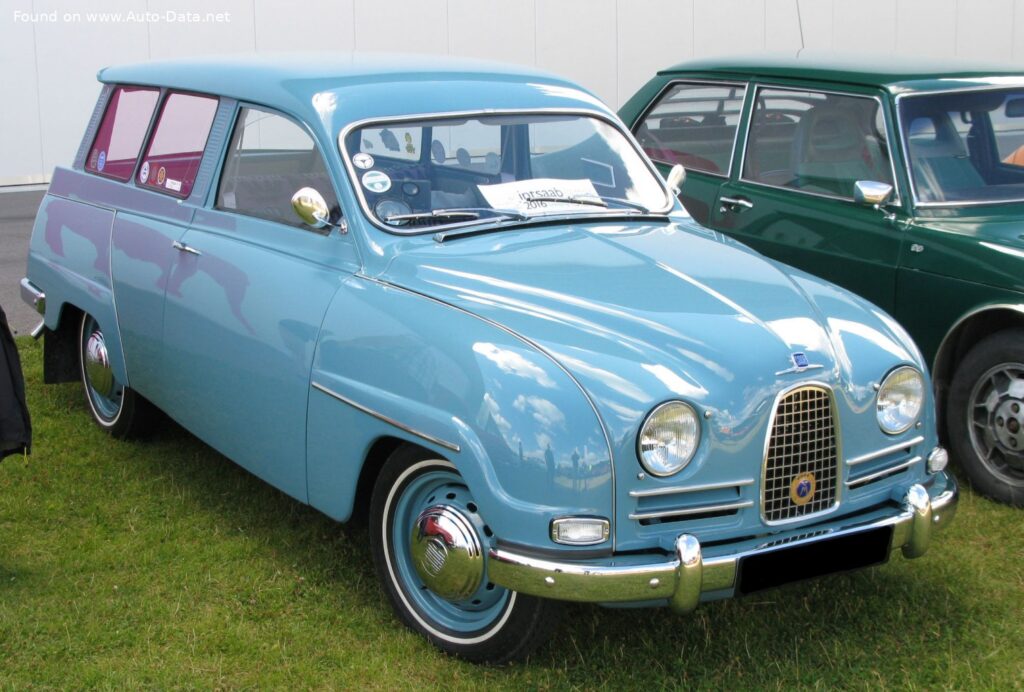
The Saab 95 is a compact executive car produced by the Swedish manufacturer Saab between 1976 and 1977. Representing the second generation of the 95 model line, this iteration built upon the innovative design of its predecessor, further solidifying Saab’s reputation for practicality and distinctive styling. The 95 occupied a unique niche in the European market, offering a blend of station wagon versatility with Saab’s characteristic focus on driver comfort and safety. While not officially sold in the United States, the Saab 95, particularly this 1.5 V4 variant, is a significant example of Swedish automotive engineering and design philosophy of the era.
The Saab 95 1.5 V4: A Detailed Overview
The 1976-1977 Saab 95 1.5 V4 was a continuation of Saab’s commitment to producing vehicles that prioritized functionality and a unique driving experience. It was a period where Saab was establishing its identity as a manufacturer that didn’t simply follow trends, but rather forged its own path. The 95, with its distinctive silhouette and focus on passenger space, was a key component of this strategy. This model year featured a relatively modest engine output, but it was designed for efficient and reliable transportation, catering to families and individuals who valued practicality over outright performance.
Engine & Performance
The Saab 95 1.5 V4 was powered by a 1.5-liter, four-cylinder engine sourced from Ford. This engine, designated the Ford V-4, produced 65 horsepower at 4,600 rpm and 115 Nm (84.82 lb.-ft.) of torque at 2,500 rpm. While not a powerhouse by modern standards, this engine provided adequate performance for the vehicle’s intended purpose. The engine’s transverse mounting, a relatively uncommon configuration at the time, contributed to the car’s front-wheel-drive layout and improved handling characteristics. The power-to-weight ratio was 14.9 kg/Hp, or 66.9 Hp/tonne, and the torque-to-weight ratio was 8.4 kg/Nm, or 118.4 Nm/tonne. The engine utilized a carburetor fuel injection system and a compression ratio of 9:1. The engine displaced 1498 cm3 (91.41 cu. in.) and featured a cylinder bore of 90 mm (3.54 in.) and a piston stroke of 58.86 mm (2.32 in.).
Design & Features
The Saab 95 was a three-door station wagon (estate) with seating for up to seven passengers, a remarkable feat for a car of its size. Its distinctive design, characterized by a sloping roofline and a relatively high waistline, set it apart from many of its contemporaries. The body was designed with practicality in mind, offering a generous cargo area that could be expanded by folding down the rear seats. Safety was also a key consideration, with features such as disc brakes on the front wheels and drum brakes on the rear. The steering system employed a rack and pinion setup, providing responsive and precise handling. The interior was functional and comfortable, with a focus on providing a pleasant driving experience. The 95’s design prioritized maximizing interior space within a relatively compact footprint, making it a popular choice for families.
Technical Specifications
| Brand | Saab |
| Model | 95 |
| Generation | 95 |
| Type (Engine) | 1.5 V4 (65 Hp) |
| Start of production | 1976 |
| End of production | 1977 |
| Powertrain Architecture | Internal Combustion engine |
| Body type | Station wagon (estate) |
| Seats | 7 |
| Doors | 3 |
| Fuel Type | Petrol (Gasoline) |
| Weight-to-power ratio | 14.9 kg/Hp |
| Weight-to-torque ratio | 8.4 kg/Nm |
| Power | 65 Hp @ 4600 rpm |
| Power per litre | 43.4 Hp/l |
| Torque | 115 Nm @ 2500 rpm |
| Torque (lb.-ft.) | 84.82 lb.-ft. @ 2500 rpm |
| Engine layout | Front, Transverse |
| Engine Model/Code | Ford V-4 |
| Engine displacement | 1498 cm3 |
| Engine displacement (cu. in.) | 91.41 cu. in. |
| Number of cylinders | 4 |
| Engine configuration | V-engine |
| Cylinder Bore | 90 mm |
| Cylinder Bore (in.) | 3.54 in. |
| Piston Stroke | 58.86 mm |
| Piston Stroke (in.) | 2.32 in. |
| Compression ratio | 9:1 |
| Number of valves per cylinder | 2 |
| Fuel injection system | Carburettor |
| Engine aspiration | Naturally aspirated engine |
| Engine oil capacity | 3.3 l |
| Engine oil capacity (US qt) | 3.49 US qt |
| Engine oil capacity (UK qt) | 2.9 UK qt |
| Coolant | 7.1 l |
| Coolant (US qt) | 7.5 US qt |
| Coolant (UK qt) | 6.25 UK qt |
| Kerb Weight | 971 kg |
| Kerb Weight (lbs.) | 2140.69 lbs. |
| Fuel tank capacity | 43 l |
| Fuel tank capacity (US gal) | 11.36 US gal |
| Fuel tank capacity (UK gal) | 9.46 UK gal |
| Length | 4410 mm |
| Length (in.) | 173.62 in. |
| Width | 1588 mm |
| Width (in.) | 62.52 in. |
| Height | 1492 mm |
| Height (in.) | 58.74 in. |
| Wheelbase | 2498 mm |
| Wheelbase (in.) | 98.35 in. |
| Front track | 1226 mm |
| Front track (in.) | 48.27 in. |
| Rear track | 1220 mm |
| Rear track (in.) | 48.03 in. |
| Drivetrain Architecture | Internal Combustion engine (ICE) drives the front wheels |
| Drive wheel | Front wheel drive |
| Number of gears | 4 |
| Type of gearbox | Manual transmission |
| Front suspension | Coil spring |
| Rear suspension | Coil spring |
| Front brakes | Disc |
| Rear brakes | Drum |
| Steering type | Steering rack and pinion |
The Saab 95 1.5 V4, while a relatively short-lived model, remains a significant vehicle in Saab’s history. It represents a period of innovation and a commitment to building cars that were both practical and distinctive. Its unique design and focus on passenger space continue to be appreciated by enthusiasts today, solidifying its place as a classic example of Swedish automotive engineering.
