
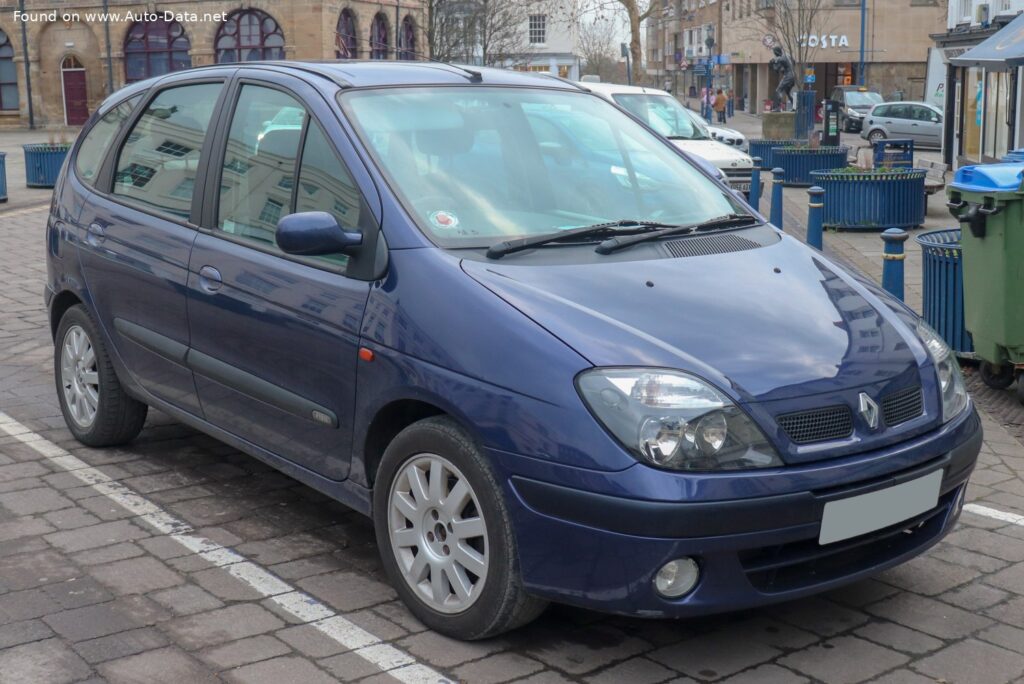
The Renault Scenic I (Phase II) 1.6i, produced between 1999 and 2000, represents a significant evolution in the compact minivan segment. As the first model in the Scenic line, it pioneered the concept of a modern, people-carrying vehicle focused on practicality and family needs. While not initially sold in the United States, the Scenic became a cornerstone of Renault’s European lineup, offering a compelling alternative to traditional station wagons and larger MPVs. The Phase II update brought refinements to the original design, enhancing both aesthetics and functionality. This model aimed to provide a versatile and comfortable transportation solution for small families, emphasizing interior space and user-friendly features.
Renault Scenic I (Phase II): A Detailed Overview
The Scenic I (Phase II) 1.6i was designed to address the growing demand for multi-purpose vehicles in Europe. It distinguished itself from competitors through its innovative interior packaging, modular seating arrangements, and a focus on driver and passenger comfort. The Phase II revisions included subtle styling updates, improved interior materials, and enhancements to the vehicle’s safety features. The 1.6-liter engine option provided a balance between fuel efficiency and adequate performance for everyday driving. The Scenic’s success paved the way for subsequent generations, solidifying Renault’s position as a leader in the compact minivan market.
Engine & Performance
The Renault Scenic I (Phase II) 1.6i is powered by a 1.6-liter inline four-cylinder gasoline engine, designated the K7M. This naturally aspirated engine produces 90 horsepower at 5250 rpm and 131 Nm (96.62 lb.-ft.) of torque at 2500 rpm. The engine features a multi-port fuel injection system and a double overhead camshaft (DOHC) valvetrain, contributing to its relatively efficient operation. Power is delivered to the front wheels via a five-speed manual transmission. Performance figures include a 0-100 km/h (0-62 mph) acceleration time of 13.7 seconds and a maximum speed of 170 km/h (105.63 mph). The engine’s power-to-weight ratio is 12.3 kg/Hp, and the torque-to-weight ratio is 8.4 kg/Nm. While not a performance-oriented vehicle, the 1.6i engine provides sufficient power for typical urban and highway driving conditions.
Design & Features
The Renault Scenic I (Phase II) is a five-door minivan designed to accommodate five passengers. Its body style emphasizes practicality and space efficiency. The interior is characterized by its modular seating system, allowing for flexible configurations to maximize cargo capacity or passenger comfort. Key features include a spacious cabin, a relatively large trunk (410 liters minimum, expanding to 1800 liters with the rear seats folded), and a user-friendly dashboard layout. Safety features for the time included an Anti-lock Braking System (ABS). The vehicle’s dimensions are 4168 mm (164.09 in) in length, 1719 mm (67.68 in) in width, and 1609 mm (63.35 in) in height. The wheelbase measures 2580 mm (101.57 in). The suspension system consists of a spring strut setup at the front and a torsion beam at the rear, providing a comfortable ride quality. Hydraulic power steering assists with maneuverability. The vehicle rides on 175/75 R14 tires mounted on 5J x 14 inch wheel rims.
Technical Specifications
| Brand | Renault |
| Model | Scenic |
| Generation | Scenic I (Phase II) |
| Type (Engine) | 1.6i (90 Hp) |
| Start of production | 1999 |
| End of production | 2000 |
| Powertrain Architecture | Internal Combustion engine |
| Body type | Minivan |
| Seats | 5 |
| Doors | 5 |
| Fuel consumption (urban) | 11 l/100 km (21.4 US mpg, 25.7 UK mpg, 9.1 km/l) |
| Fuel consumption (extra urban) | 6.6 l/100 km (35.6 US mpg, 42.8 UK mpg, 15.2 km/l) |
| Fuel consumption (combined) | 8.2 l/100 km (28.7 US mpg, 34.4 UK mpg, 12.2 km/l) |
| Fuel Type | Petrol (Gasoline) |
| Acceleration 0 – 100 km/h | 13.7 sec |
| Acceleration 0 – 62 mph | 13.7 sec |
| Acceleration 0 – 60 mph | 13 sec |
| Maximum speed | 170 km/h (105.63 mph) |
| Weight-to-power ratio | 12.3 kg/Hp |
| Weight-to-torque ratio | 8.4 kg/Nm |
| Power | 90 Hp @ 5250 rpm |
| Torque | 131 Nm @ 2500 rpm (96.62 lb.-ft. @ 2500 rpm) |
| Engine layout | Front, Transverse |
| Engine Model/Code | K7M |
| Engine displacement | 1598 cm3 (97.52 cu. in.) |
| Number of cylinders | 4 |
| Engine configuration | Inline |
| Cylinder Bore | 79.5 mm (3.13 in.) |
| Piston Stroke | 80.5 mm (3.17 in.) |
| Compression ratio | 9.5:1 |
| Number of valves per cylinder | 2 |
| Fuel injection system | Multi-port manifold injection |
| Engine aspiration | Naturally aspirated engine |
| Valvetrain | DOHC |
| Engine oil capacity | 4.5 l (4.76 US qt | 3.96 UK qt) |
| Coolant | 6 l (6.34 US qt | 5.28 UK qt) |
| Kerb Weight | 1105 kg (2436.11 lbs.) |
| Max. weight | 1585 kg (3494.33 lbs.) |
| Max load | 480 kg (1058.22 lbs.) |
| Trunk (boot) space – minimum | 410 l (14.48 cu. ft.) |
| Trunk (boot) space – maximum | 1800 l (63.57 cu. ft.) |
| Fuel tank capacity | 60 l (15.85 US gal | 13.2 UK gal) |
| Length | 4168 mm (164.09 in.) |
| Width | 1719 mm (67.68 in.) |
| Height | 1609 mm (63.35 in.) |
| Wheelbase | 2580 mm (101.57 in.) |
| Front track | 1446 mm (56.93 in.) |
| Rear (Back) track | 1458 mm (57.4 in.) |
| Drivetrain Architecture | Front wheel drive |
| Number of gears and type of gearbox | 5 gears, manual transmission |
| Front suspension | Spring Strut |
| Rear suspension | Torsion |
| Front brakes | Ventilated discs |
| Rear brakes | Drum |
| Assisting systems | ABS (Anti-lock braking system) |
| Steering type | Steering rack and pinion |
| Power steering | Hydraulic Steering |
| Tires size | 175/75 R14 |
| Wheel rims size | 5J x 14 |
The Renault Scenic I (Phase II) 1.6i remains a notable example of early compact minivan design. Its focus on practicality, space, and user-friendly features established a benchmark for subsequent models in the segment. While not known for blistering performance, it provided a reliable and comfortable transportation solution for families in Europe during its production run.
