
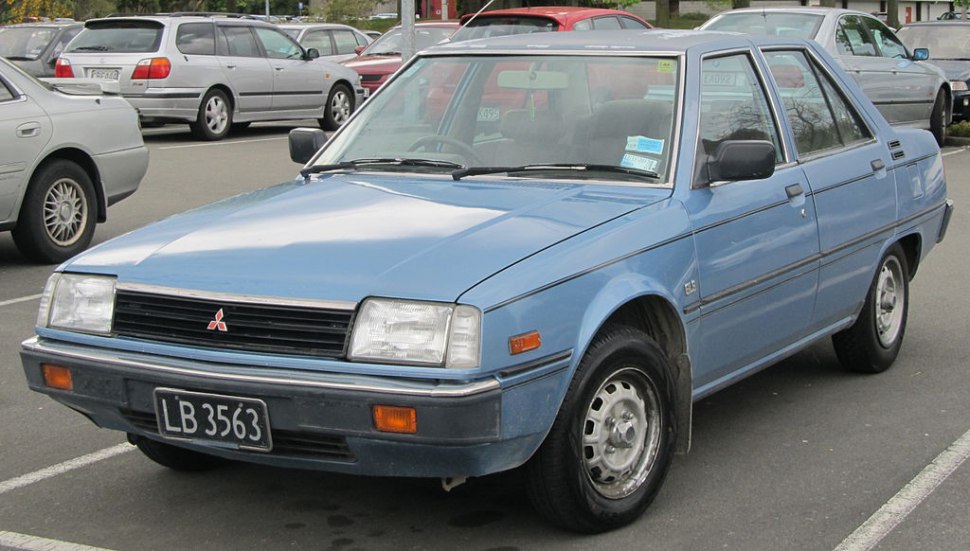
The Mitsubishi Tredia (A21_) 1600 Turbo, produced between 1982 and 1985, was a compact sedan aimed at the burgeoning global market for fuel-efficient and affordable transportation. While not officially sold in the United States, the Tredia represented Mitsubishi’s efforts to establish a stronger foothold in Europe and other international markets. It occupied a segment similar to the Ford Escort or Volkswagen Jetta of the era, offering a practical and relatively sporty alternative to more basic economy cars. The “1600 Turbo” designation refers to its 1.6-liter turbocharged engine, a feature that set it apart from many competitors and provided a noticeable performance boost.
Mitsubishi Tredia (A21_) 1600 Turbo: An Overview
The Tredia was part of Mitsubishi’s broader strategy to diversify its model lineup and appeal to a wider range of consumers. It was designed to be a comfortable and reliable family car, offering a good balance between performance, economy, and practicality. The A21 series Tredia was a significant step for Mitsubishi, incorporating more modern design elements and engineering compared to its predecessors. The turbocharged variant, like the one detailed here, was positioned as the more performance-oriented option within the Tredia range.
Engine & Performance
The heart of the Tredia 1600 Turbo is its 4G32T 1.6-liter inline-four cylinder engine. This engine, displacing 1597 cm³ (97.45 cubic inches), produced 114 horsepower at 5500 rpm and 170 Nm (125.39 lb.-ft.) of torque at 3500 rpm. The inclusion of a turbocharger was a key feature, significantly increasing power output compared to naturally aspirated versions of the same engine. This resulted in a power-to-weight ratio of 8.6 kg/Hp and a torque-to-weight ratio of 5.7 kg/Nm, providing brisk acceleration for its class. The engine utilized a single overhead camshaft (SOHC) valvetrain with two valves per cylinder and a compression ratio of 8.5:1. Fuel delivery was managed by a carburetor, a common technology for the time, though less efficient than later fuel injection systems. The engine’s transverse front-wheel-drive layout contributed to improved handling and space efficiency. The Tredia 1600 Turbo could achieve a maximum speed of 183 km/h (113.71 mph).
Design & Features
The Mitsubishi Tredia A21_ was a traditional four-door sedan, offering seating for five passengers. Its design was typical of early 1980s automotive styling – boxy, yet with a relatively streamlined profile. The car’s dimensions were 4280 mm (168.5 in) in length, 1660 mm (65.35 in) in width, and 1370 mm (53.94 in) in height. The wheelbase measured 2445 mm (96.26 in). While not boasting a luxurious interior, the Tredia offered a functional and reasonably comfortable cabin. Features were modest by modern standards, but included hydraulic power steering and disc brakes on the front wheels, with drum brakes at the rear. Safety features were limited compared to contemporary vehicles, reflecting the standards of the early 1980s. The Tredia’s focus was on providing reliable transportation at an affordable price point. The car’s kerb weight of 975 kg (2149.51 lbs) contributed to its relatively nimble handling. The fuel tank capacity was 50 liters (13.21 US gallons), providing a reasonable driving range.
Technical Specifications
| Brand | Mitsubishi |
| Model | Tredia |
| Generation | Tredia (A21_) |
| Type (Engine) | 1600 Turbo (114 Hp) |
| Start of production | 1982 |
| End of production | 1985 |
| Powertrain Architecture | Internal Combustion engine |
| Body type | Sedan |
| Seats | 5 |
| Doors | 4 |
| Fuel consumption (urban) | 9.3 l/100 km (25.3 US mpg) |
| Fuel consumption (extra urban) | 6.3 l/100 km (37.3 US mpg) |
| Fuel Type | Petrol (Gasoline) |
| Maximum speed | 183 km/h (113.71 mph) |
| Weight-to-power ratio | 8.6 kg/Hp |
| Weight-to-torque ratio | 5.7 kg/Nm |
| Power | 114 Hp @ 5500 rpm |
| Torque | 170 Nm @ 3500 rpm (125.39 lb.-ft. @ 3500 rpm) |
| Engine layout | Front, Transverse |
| Engine Model/Code | 4G32T |
| Engine displacement | 1597 cm3 (97.45 cu. in.) |
| Number of cylinders | 4 |
| Engine configuration | Inline |
| Cylinder Bore | 76.9 mm (3.03 in.) |
| Piston Stroke | 86 mm (3.39 in.) |
| Compression ratio | 8.5:1 |
| Number of valves per cylinder | 2 |
| Fuel injection system | Carburettor |
| Engine aspiration | Turbocharger |
| Valvetrain | SOHC |
| Engine oil capacity | 3.5 l (3.7 US qt | 3.08 UK qt) |
| Kerb Weight | 975 kg (2149.51 lbs.) |
| Max. weight | 1460 kg (3218.75 lbs.) |
| Max load | 485 kg (1069.24 lbs.) |
| Fuel tank capacity | 50 l (13.21 US gal | 11 UK gal) |
| Max. roof load | 80 kg (176.37 lbs.) |
| Permitted trailer load with brakes (12%) | 1100 kg (2425.08 lbs.) |
| Permitted trailer load without brakes | 450 kg (992.08 lbs.) |
| Permitted towbar download | 75 kg (165.35 lbs.) |
| Length | 4280 mm (168.5 in.) |
| Width | 1660 mm (65.35 in.) |
| Height | 1370 mm (53.94 in.) |
| Wheelbase | 2445 mm (96.26 in.) |
| Front track | 1410 mm (55.51 in.) |
| Rear track | 1375 mm (54.13 in.) |
| Drive wheel | Front wheel drive |
| Number of gears and type of gearbox | 5 gears, manual transmission |
| Front suspension | Independent, type McPherson with coil spring and anti-roll bar |
| Rear suspension | Trailing arm |
| Front brakes | Disc |
| Rear brakes | Drum |
| Steering type | Steering rack and pinion |
| Power steering | Hydraulic Steering |
| Tires size | 185/70 R13 |
| Wheel rims size | 5J x 13 |
The Mitsubishi Tredia 1600 Turbo, while not a performance icon, represented a solid and well-engineered offering in its segment. Its turbocharged engine provided a competitive edge, and its overall design prioritized practicality and reliability. Though largely absent from the North American market, it played a role in establishing Mitsubishi’s reputation for building dependable and affordable vehicles in other parts of the world.
