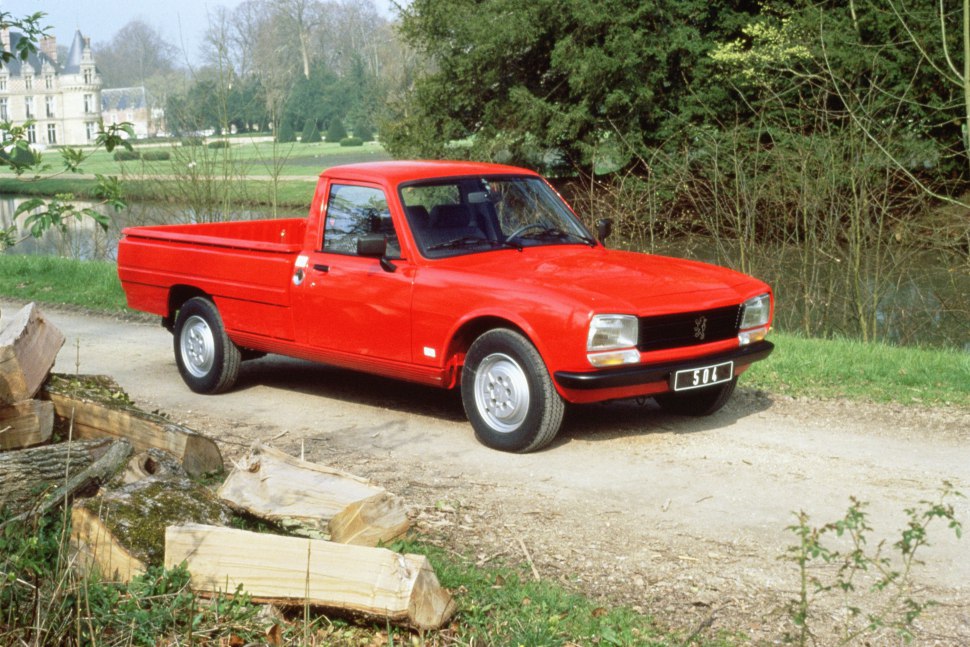
The Peugeot 504 Pick-up, specifically the 2.3 D variant producing 69 horsepower, represents a robust and utilitarian extension of the highly successful Peugeot 504 passenger car line. Introduced in 1980 and continuing production through 1989, this pick-up truck was primarily aimed at markets in Africa, South America, and parts of Asia, where its durability, simplicity, and load-carrying capacity were highly valued. While not officially sold in the United States, the 504 Pick-up became a workhorse vehicle in numerous developing economies, earning a reputation for reliability and longevity. It filled a crucial niche for commercial users and individuals needing a dependable vehicle for both work and personal transport. The 504 Pick-up was a direct response to the demand for a rugged, diesel-powered vehicle capable of handling challenging terrains and heavy loads, often in areas with limited infrastructure.
Peugeot 504 Pick-up: A Legacy of Durability
The 504 Pick-up wasn’t conceived as a luxury vehicle; its design philosophy centered on practicality and resilience. It leveraged the existing 504 platform, known for its robust construction, and adapted it to a commercial application. This approach allowed Peugeot to offer a relatively affordable and dependable pick-up truck, particularly attractive in regions where cost-effectiveness was paramount. The vehicle’s success stemmed from its ability to withstand harsh conditions and provide consistent performance with minimal maintenance. The 2.3-liter diesel engine, while modest in horsepower, offered excellent torque and fuel efficiency, making it ideal for long distances and heavy hauling. The 504 Pick-up’s enduring popularity in its target markets is a testament to its well-engineered design and suitability for its intended purpose.
Engine & Performance
The heart of the Peugeot 504 Pick-up 2.3 D is the 134 XD2 engine, a 2.3-liter naturally aspirated diesel engine. This engine produces 69 horsepower, a figure that reflects the priorities of the vehicle’s target market – reliability and fuel economy over outright speed. The engine’s strength lies in its torque output, providing ample pulling power for carrying substantial loads. The diesel engine’s inherent durability and relative simplicity made it easy to maintain and repair, even in remote locations with limited access to specialized tools or technicians. The engine is coupled with a manual transmission, typically a four-speed unit, chosen for its robustness and direct control. Performance is geared towards utility rather than acceleration; the 504 Pick-up is designed to steadily and reliably transport goods and people over long distances. The vehicle’s suspension, while relatively basic, is designed to handle rough terrain and heavy loads, contributing to its overall durability. The drivetrain is a rear-wheel drive configuration, common for pick-up trucks of this era, providing good traction and load-carrying capacity.
Design & Features
The Peugeot 504 Pick-up’s design is fundamentally utilitarian. It features a traditional pick-up body style with a separate cab and cargo bed. The cab offers basic seating for two or three occupants, depending on the configuration. Interior appointments are sparse, focusing on functionality rather than luxury. The dashboard is straightforward, with essential gauges and controls. The cargo bed is typically constructed from steel and is designed to withstand heavy loads and rough handling. The vehicle’s exterior styling is largely based on the 504 sedan, with a squared-off rear end to accommodate the cargo bed. Safety features are limited by the standards of the time, typically consisting of basic seatbelts and a robust chassis. The 504 Pick-up’s design prioritizes practicality and durability over aesthetic considerations. Its simple, robust construction and functional features made it a popular choice for commercial users and individuals in developing countries. The vehicle’s relatively low weight and compact dimensions also contributed to its maneuverability in challenging terrains. While lacking the modern conveniences found in contemporary pick-up trucks, the 504 Pick-up offered a dependable and affordable transportation solution for its target market.
The 504 Pick-up’s longevity in production is a testament to its adaptability. While the basic design remained consistent throughout its production run, minor updates were implemented over the years to improve reliability and address specific market needs. These updates often involved improvements to the engine, suspension, and braking systems. The vehicle’s continued popularity in its target markets also led to the development of a thriving aftermarket for spare parts and accessories, further extending its lifespan and reducing the cost of ownership.
Technical Specifications
| Brand | Peugeot |
| Model | 504 |
| Generation | 504 Pick-up |
| Type (Engine) | 2.3 D (69 Hp) |
| Start of production | 1980 |
| End of production | 1989 |
| Powertrain Architecture | Internal Combustion engine |
| Body type | Pick-up |
| Fuel Type | Diesel |
| Power | 69 Hp |
| Engine Model/Code | 134 XD2 |
| Engine aspiration | Naturally aspirated engine |
| Engine oil capacity | 5 l (5.28 US qt | 4.4 UK qt) |
| Coolant capacity | 10 l (10.57 US qt | 8.8 UK qt) |
In conclusion, the Peugeot 504 Pick-up 2.3 D (69 Hp) represents a significant chapter in Peugeot’s history, demonstrating the company’s ability to adapt its existing platforms to meet the specific needs of diverse markets. While not a vehicle widely recognized in the United States, its impact on transportation in Africa, South America, and Asia was substantial. Its durability, simplicity, and fuel efficiency made it a valuable asset for commercial users and individuals alike, cementing its legacy as a reliable and dependable workhorse.