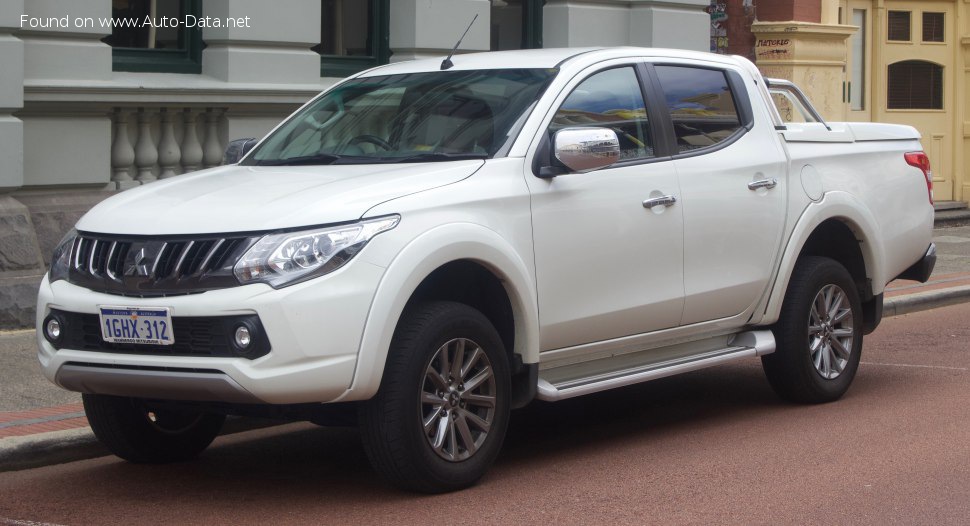
The Mitsubishi Triton V Club Cab Chassis (facelift 2019) represents a mid-cycle refresh of the fifth-generation Triton, a compact pickup truck primarily sold in Asia, Australia, Europe, and Latin America. While not officially sold in the United States, the Triton (marketed as the Mitsubishi Forte in some regions) occupies a significant niche as a versatile and robust workhorse. This particular iteration, produced from 2019 to 2023, focuses on refining the existing platform with updated styling, improved safety features, and enhanced powertrain efficiency. The Club Cab configuration offers a compromise between passenger space and cargo bed length, making it suitable for both commercial and personal use. The 2.4L D4 engine option, paired with a four-wheel-drive system, provides a balance of power and fuel economy for a variety of applications.
Mitsubishi Triton V Club Cab Chassis (facelift 2019): Overview
The Triton, known for its durability and off-road capability, has been a mainstay in Mitsubishi’s global lineup since its introduction in 1978. The fifth generation, launched in 2015, brought a more refined design and improved technology. The 2019 facelift further enhanced these qualities, addressing customer feedback and aligning the vehicle with contemporary market demands. The Club Cab body style provides two smaller rear doors for easier access to the rear seats, making it more practical than a standard single-cab pickup while still offering a generous cargo bed. This model is designed to appeal to buyers who need a capable truck for work and leisure, without the size and expense of a full-size pickup.
Engine & Performance
The heart of the 2019 Mitsubishi Triton V Club Cab Chassis is the 4N15 2.4-liter inline-four cylinder diesel engine. This powerplant delivers 181 horsepower at 3500 rpm and 430 Newton-meters (317.15 lb-ft) of torque at 2500 rpm. The engine utilizes a turbocharger with an intercooler to boost performance and efficiency. A diesel commonrail fuel injection system ensures precise fuel delivery, contributing to both power output and reduced emissions. The engine’s power-to-weight ratio is 9.8 kg/Hp, or 102 Hp/tonne, providing adequate acceleration for everyday driving and hauling. The torque-to-weight ratio of 4.1 kg/Nm, or 242.4 Nm/tonne, highlights the truck’s ability to handle heavy loads. Power is transmitted to all four wheels through a six-speed manual transmission, offering the driver full control over gear selection. Fuel economy is rated at 7.9 liters per 100 kilometers (29.8 US mpg or 35.8 UK mpg), and CO2 emissions are 208 grams per kilometer.
Design & Features
The Mitsubishi Triton V Club Cab Chassis is a four-door pickup truck with a distinctively styled exterior. The 2019 facelift brought subtle but noticeable changes to the front fascia, including a revised grille and headlight design. The body-on-frame construction provides a robust and durable platform, capable of withstanding demanding work conditions. The Club Cab configuration features two smaller rear doors, offering easier access to the rear seats compared to a traditional single-cab pickup. Inside, the cabin is designed with practicality in mind, featuring durable materials and a functional layout. Standard features include air conditioning, power steering, and an anti-lock braking system (ABS). The vehicle’s dimensions are as follows: a width of 1815 mm (71.46 in), a height of 1780 mm (70.08 in), and a wheelbase of 3000 mm (118.11 in). Ground clearance is a respectable 205 mm (8.07 in), enhancing its off-road capability. The Triton boasts approach, ramp-over, and departure angles of 30°, 25°, and a corresponding angle, respectively, further aiding in navigating challenging terrain.
Technical Specifications
| Brand | Mitsubishi |
| Model | Triton |
| Generation | Triton V Club Cab Chassis (facelift 2019) |
| Type (Engine) | 2.4L D4 (181 Hp) 4WD |
| Start of production | 2019 |
| End of production | 2023 |
| Powertrain Architecture | Internal Combustion engine |
| Body type | Pick-up |
| Seats | 5 |
| Doors | 4 |
| Fuel consumption (combined) | 7.9 l/100 km (29.8 US mpg, 35.8 UK mpg, 12.7 km/l) |
| CO2 emissions | 208 g/km |
| Fuel Type | Diesel |
| Weight-to-power ratio | 9.8 kg/Hp, 102 Hp/tonne |
| Weight-to-torque ratio | 4.1 kg/Nm, 242.4 Nm/tonne |
| Power | 181 Hp @ 3500 rpm |
| Power per litre | 74.1 Hp/l |
| Torque | 430 Nm @ 2500 rpm (317.15 lb.-ft. @ 2500 rpm) |
| Engine layout | Front, Longitudinal |
| Engine Model/Code | 4N15 |
| Engine displacement | 2442 cm3 (149.02 cu. in.) |
| Number of cylinders | 4 |
| Engine configuration | Inline |
| Cylinder Bore | 86 mm (3.39 in.) |
| Piston Stroke | 105.1 mm (4.14 in.) |
| Number of valves per cylinder | 4 |
| Fuel injection system | Diesel Commonrail |
| Engine aspiration | Turbocharger, Intercooler |
| Valvetrain | MIVEC |
| Engine oil capacity | 6.7 l (7.08 US qt | 5.9 UK qt) |
| Coolant | 7.7 l (8.14 US qt | 6.78 UK qt) |
| Kerb Weight | 1774 kg (3911 lbs.) |
| Max. weight | 2900 kg (6393.41 lbs.) |
| Max load | 1126 kg (2482.41 lbs.) |
| Fuel tank capacity | 75 l (19.81 US gal | 16.5 UK gal) |
| Permitted trailer load with brakes (12%) | 3000 kg (6613.87 lbs.) |
| Permitted trailer load without brakes | 750 kg (1653.47 lbs.) |
| Permitted towbar download | 300 kg (661.39 lbs.) |
| Width | 1815 mm (71.46 in.) |
| Height | 1780 mm (70.08 in.) |
| Wheelbase | 3000 mm (118.11 in.) |
| Ride height (ground clearance) | 205 mm (8.07 in.) |
| Drive wheel | All wheel drive (4×4) |
| Number of gears and type of gearbox | 6 gears, manual transmission |
| Front suspension | Double wishbone |
| Rear suspension | Leaf spring |
| Front brakes | Ventilated discs, 294 mm |
| Rear brakes | Drum |
| Assisting systems | ABS (Anti-lock braking system) |
| Steering type | Steering rack and pinion |
| Power steering | Electric Steering |
| Tires size | 245/75 R16 111S |
| Wheel rims size | 7J x 16 |