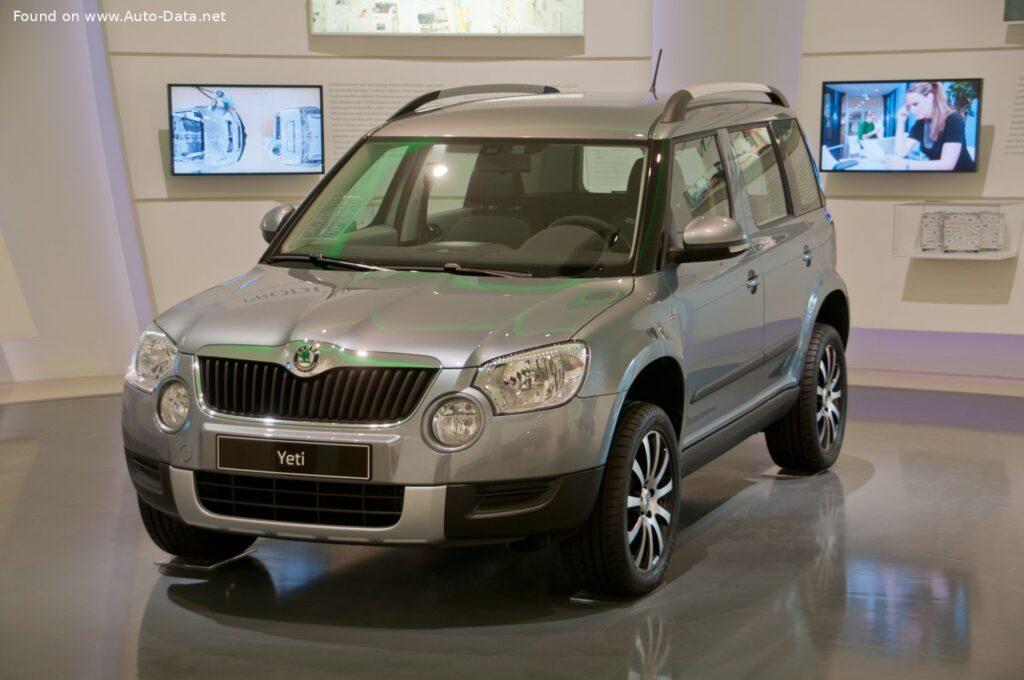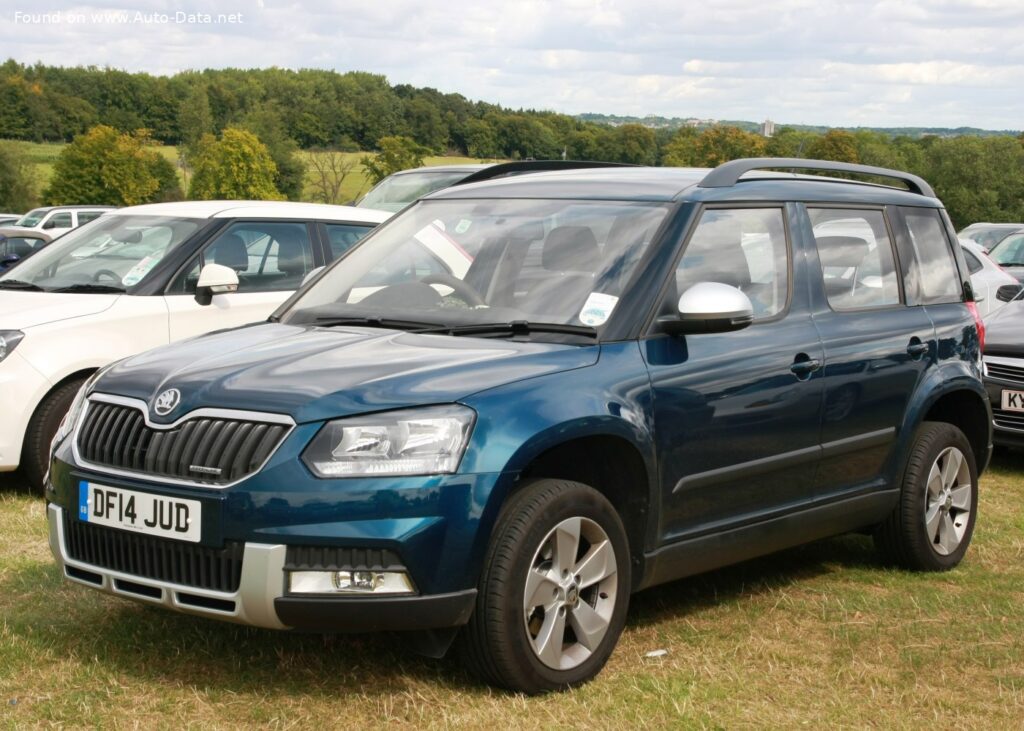
The Skoda Yeti, particularly the facelifted version introduced in 2013, represents a significant offering in the compact SUV segment, primarily aimed at the European market. While not officially sold in the United States, the Yeti gained recognition for its practical design, spacious interior, and robust build quality. Positioned as a versatile vehicle for both urban and light off-road use, the Yeti competed with models like the Nissan Qashqai and Kia Sportage in Europe. The 2.0 TDI (150 Hp) SCR variant, produced from 2015 to 2017, combined a fuel-efficient diesel engine with Selective Catalytic Reduction (SCR) technology to meet stringent Euro 6 emission standards.
Skoda Yeti (Facelift 2013) 2.0 TDI SCR: An Overview
The Yeti facelift, launched in 2013, brought cosmetic and technological updates to the original Yeti, which debuted in 2009. These changes included revised front and rear styling, improved interior materials, and the introduction of updated infotainment systems. The 2.0 TDI SCR engine option, available from 2015, was a key component of Skoda’s strategy to offer environmentally conscious vehicles. The SCR system utilizes AdBlue (Diesel Exhaust Fluid) to reduce nitrogen oxide (NOx) emissions, ensuring compliance with the increasingly strict European emission regulations. This model year represents a refinement of the original Yeti concept, focusing on efficiency and reduced environmental impact.
Engine & Performance
The heart of the 2015-2017 Skoda Yeti 2.0 TDI SCR is a 1,968 cc (120.09 cu. in.) inline-four cylinder diesel engine. This engine produces 150 horsepower (Hp) at 3,500 rpm and a substantial 340 Newton-meters (250.77 lb.-ft.) of torque between 1,750 and 3,000 rpm. The engine features a turbocharger with an intercooler, enhancing both power and efficiency. Power is delivered to the front wheels via a six-speed manual transmission. Acceleration from 0 to 100 km/h (0-62 mph) takes 9 seconds, while the 0-60 mph sprint is achieved in 8.6 seconds. The Yeti 2.0 TDI SCR boasts a top speed of 199 km/h (123.65 mph). Fuel economy is a strong point, with combined cycle consumption rated at 4.8 liters per 100 kilometers (49 US mpg or 58.9 UK mpg). The engine’s power-to-weight ratio is 9.4 kg/Hp, and its torque-to-weight ratio is 4.2 kg/Nm.
Design & Features
The Skoda Yeti is a five-door SUV with a distinctive, boxy design that maximizes interior space. The facelifted model features a more refined front fascia with a redesigned grille and headlights. The interior is characterized by its practicality and functionality, offering comfortable seating for five passengers. The Yeti’s rear seats are adjustable and can be folded down to increase cargo capacity. Trunk space ranges from a minimum of 415 liters (14.66 cu. ft.) to a maximum of 1,665 liters (58.8 cu. ft.) with the rear seats folded. Standard features typically included ABS, power steering, and a range of safety equipment designed to meet Euro 6 safety standards. The Yeti’s relatively high ground clearance (180 mm / 7.09 in.) and all-season tires contribute to its capability on varied terrain. The vehicle’s approach, departure, and ramp-over angles (19°, 26.7°, and 19.6° respectively) further enhance its off-road credentials.
Technical Specifications
| Brand | Skoda |
| Model | Yeti |
| Generation | Yeti (facelift 2013) |
| Type (Engine) | 2.0 TDI (150 Hp) SCR |
| Start of production | May, 2015 |
| End of production | 2017 |
| Powertrain Architecture | Internal Combustion engine |
| Body type | SUV |
| Seats | 5 |
| Doors | 5 |
| Fuel consumption (urban) | 5.6 l/100 km (42 US mpg, 50.4 UK mpg, 17.9 km/l) |
| Fuel consumption (extra urban) | 4.3 l/100 km (54.7 US mpg, 65.7 UK mpg, 23.3 km/l) |
| Fuel consumption (combined) | 4.8 l/100 km (49 US mpg, 58.9 UK mpg, 20.8 km/l) |
| CO2 emissions | 126 g/km |
| Fuel Type | Diesel |
| Acceleration 0 – 100 km/h | 9 sec |
| Acceleration 0 – 62 mph | 9 sec |
| Acceleration 0 – 60 mph | 8.6 sec |
| Maximum speed | 199 km/h (123.65 mph) |
| Emission standard | Euro 6 |
| Weight-to-power ratio | 9.4 kg/Hp |
| Weight-to-torque ratio | 4.2 kg/Nm |
| Power | 150 Hp @ 3500 rpm |
| Torque | 340 Nm @ 1750-3000 rpm (250.77 lb.-ft. @ 1750-3000 rpm) |
| Engine layout | Front, Transverse |
| Engine Model/Code | EA288 / CUUB |
| Engine displacement | 1968 cm3 (120.09 cu. in.) |
| Number of cylinders | 4 |
| Engine configuration | Inline |
| Cylinder Bore | 81 mm (3.19 in.) |
| Piston Stroke | 95.5 mm (3.76 in.) |
| Compression ratio | 16.2:1 |
| Number of valves per cylinder | 4 |
| Fuel injection system | Diesel Commonrail |
| Engine aspiration | Turbocharger, Intercooler |
| Valvetrain | DOHC |
| Engine oil capacity | 4.7 l (4.97 US qt | 4.14 UK qt) |
| Coolant | 8 l (8.45 US qt | 7.04 UK qt) |
| Kerb Weight | 1411 kg (3110.72 lbs.) |
| Max. weight | 2031 kg (4477.59 lbs.) |
| Max load | 620 kg (1366.87 lbs.) |
| Trunk (boot) space – minimum | 415 l (14.66 cu. ft.) |
| Trunk (boot) space – maximum | 1665 l (58.8 cu. ft.) |
| Fuel tank capacity | 55 l (14.53 US gal | 12.1 UK gal) |
| Max. roof load | 100 kg (220.46 lbs.) |
| Permitted trailer load with brakes (12%) | 1800 kg (3968.32 lbs.) |
| Permitted trailer load without brakes | 740 kg (1631.42 lbs.) |
| Permitted towbar download | 80 kg (176.37 lbs.) |
| Length | 4222 mm (166.22 in.) |
| Width | 1793 mm (70.59 in.) |
| Width including mirrors | 1956 mm (77.01 in.) |
| Height | 1691 mm (66.57 in.) |
| Wheelbase | 2578 mm (101.5 in.) |
| Front track | 1541 mm (60.67 in.) |
| Rear (Back) track | 1537 mm (60.51 in.) |
| Ride height (ground clearance) | 180 mm (7.09 in.) |
| Drag coefficient (Cd) | 0.36 |
| Minimum turning circle (turning diameter) | 10.32 m (33.86 ft.) |
| Number of gears and type of gearbox | 6 gears, manual transmission |
| Front brakes | Ventilated discs |
| Rear brakes | Disc |
| Tires size | 215/60 R16; 225/50 R17 |