
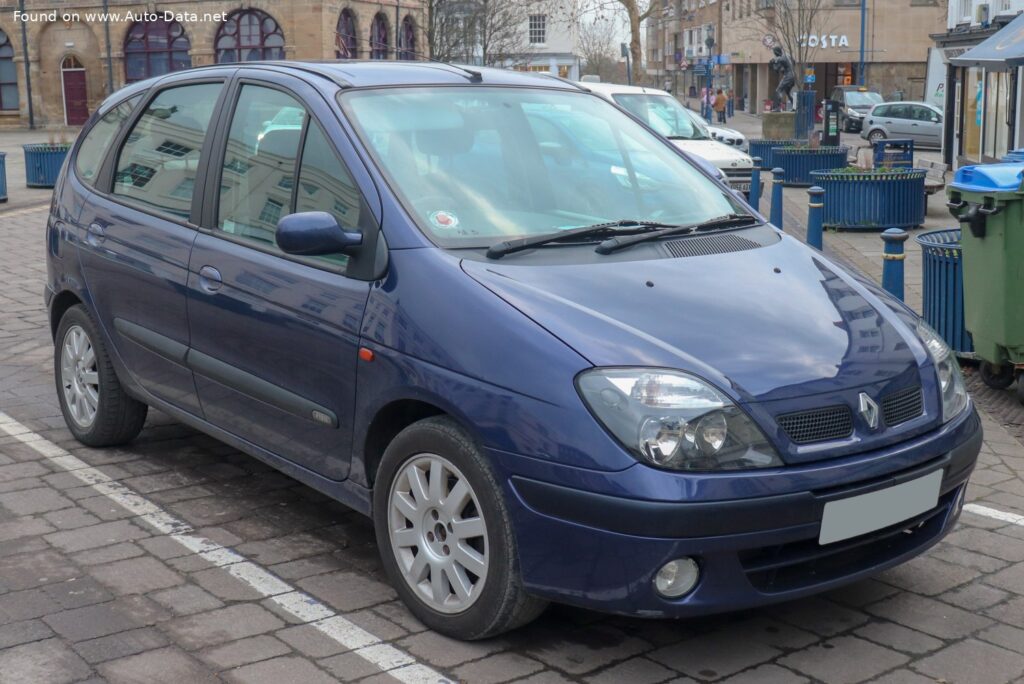
The Renault Scenic I (Phase II) 2.0i (JA0G), produced between 1999 and 2000, represents a significant evolution of Renault’s foray into the compact minivan segment. Introduced initially in 1996, the Scenic was a pioneering vehicle, often credited with popularizing the modern multi-purpose vehicle (MPV) concept in Europe. The Phase II update brought refinements to the original design, focusing on improved interior quality, enhanced safety features, and subtle styling changes. While not officially sold in the United States, the Scenic I held a prominent position in the European market, offering a practical and family-oriented alternative to traditional hatchbacks and sedans. It competed with vehicles like the Opel Zafira, Citroën Xantia, and Volkswagen Touran, establishing a new benchmark for space and versatility in a relatively compact package.
Renault Scenic I (Phase II) 2.0i (JA0G): A Detailed Overview
The Scenic I Phase II aimed to address the growing demand for vehicles that could comfortably accommodate families while remaining manageable in urban environments. Its innovative design, featuring a spacious interior and modular seating arrangement, quickly gained popularity. The 2.0i (JA0G) variant, powered by a 114 horsepower engine, offered a balance between performance and fuel efficiency, making it a popular choice for those seeking a practical and reliable family vehicle. The Phase II updates included improvements to the dashboard layout, upgraded interior materials, and the availability of new safety features, further enhancing the Scenic’s appeal.
Engine & Performance
The heart of the Scenic I (Phase II) 2.0i (JA0G) is the Renault F3R engine, a 2.0-liter inline four-cylinder gasoline engine. This naturally aspirated engine produces 114 horsepower, providing adequate power for everyday driving and occasional highway journeys. The engine utilizes a multi-port fuel injection system, contributing to efficient fuel delivery and smooth operation. Coupled with a five-speed manual transmission, the 2.0i model achieves a 0-60 mph (0-96 km/h) acceleration time of approximately 11.2 seconds, and a 0-62 mph (0-100 km/h) time of 11.8 seconds. The top speed is rated at 114.95 mph (185 km/h). Fuel economy figures are respectable for its class and era, with urban consumption at 8.6 liters per 100 kilometers (27.4 US mpg), and extra-urban consumption at 6.1 liters per 100 kilometers (38.6 US mpg). The engine’s transverse front-engine layout contributes to improved handling and stability.
Design & Features
The Renault Scenic I (Phase II) is a five-door minivan designed with practicality and family needs in mind. Its compact dimensions make it easy to maneuver in city traffic, while the spacious interior offers ample room for passengers and luggage. The vehicle comfortably seats five occupants. A key feature of the Scenic is its modular seating system, allowing for flexible configuration of the rear seats to maximize cargo space. The Phase II update included minor cosmetic changes, such as revised front and rear bumpers, updated grille design, and new interior trim options. Safety features, while limited by the standards of the time, were improved with the inclusion of an Anti-lock Braking System (ABS) as standard equipment. The vehicle’s McPherson strut front suspension and torsion beam rear suspension provide a comfortable ride quality, balancing handling and passenger comfort. The 15-inch wheel rims, fitted with 195/60 R15 tires, contribute to the vehicle’s overall stability and grip.
Technical Specifications
| Brand | Renault |
| Model | Scenic |
| Generation | Scenic I (Phase II) |
| Type (Engine) | 2.0i (JA0G) (114 Hp) |
| Start of production | 1999 |
| End of production | 2000 |
| Powertrain Architecture | Internal Combustion engine |
| Body type | Minivan |
| Seats | 5 |
| Doors | 5 |
| Fuel consumption (urban) | 8.6 l/100 km (27.4 US mpg) |
| Fuel consumption (extra urban) | 6.1 l/100 km (38.6 US mpg) |
| Fuel Type | Petrol (Gasoline) |
| Acceleration 0 – 100 km/h | 11.8 sec |
| Acceleration 0 – 62 mph | 11.8 sec |
| Acceleration 0 – 60 mph | 11.2 sec |
| Maximum speed | 185 km/h (114.95 mph) |
| Power | 114 Hp |
| Engine layout | Front, Transverse |
| Engine Model/Code | F3R |
| Number of cylinders | 4 |
| Engine configuration | Inline |
| Fuel injection system | Multi-port manifold injection |
| Engine aspiration | Naturally aspirated engine |
| Engine oil capacity | 6.5 l (6.87 US qt | 5.72 UK qt) |
| Coolant capacity | 7 l (7.4 US qt | 6.16 UK qt) |
| Fuel tank capacity | 60 l (15.85 US gal | 13.2 UK gal) |
| Drivetrain Architecture | Front wheel drive |
| Number of gears and type of gearbox | 5 gears, manual transmission |
| Front suspension | Independent, type McPherson with coil spring and anti-roll bar |
| Rear suspension | Torsion |
| Front brakes | Ventilated discs |
| Rear brakes | Drum |
| Assisting systems | ABS (Anti-lock braking system) |
| Steering type | Steering rack and pinion |
| Tires size | 195/60 R15 |
| Wheel rims size | 15 |
The Renault Scenic I (Phase II) 2.0i (JA0G) remains a noteworthy vehicle in the history of MPVs. Its innovative design, practical features, and reasonable performance made it a popular choice for families in Europe. While not available in the US market, it represents a significant step forward in the development of versatile and family-friendly vehicles, paving the way for future generations of MPVs.
