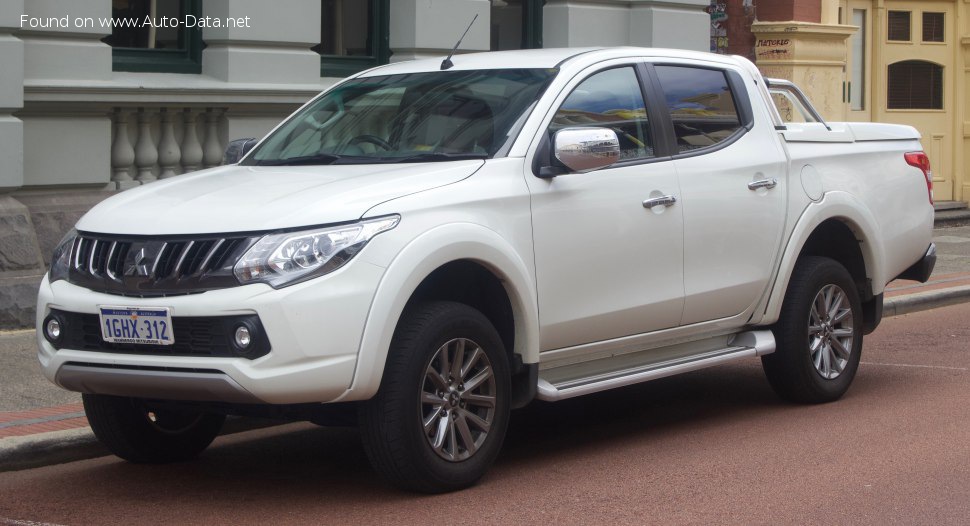
The Mitsubishi Triton V Double Cab Chassis (facelift 2019), known as the Mitsubishi L200 in many international markets, is a mid-size pickup truck produced by Mitsubishi Motors. This iteration, released in 2019 and continuing through 2023, represents a significant refresh of the fifth-generation Triton (introduced in 2015). While not directly sold in the United States, the Triton/L200 is a popular workhorse and family vehicle in regions like Europe, Australia, New Zealand, Asia, and Latin America, competing with models like the Toyota Hilux, Nissan Navara, and Ford Ranger. The facelift brought updated styling, enhanced safety features, and refinements to the powertrain, solidifying its position as a versatile and reliable pickup.
Mitsubishi Triton V Double Cab Chassis (facelift 2019)
The Triton V Double Cab Chassis (facelift 2019) is characterized by its robust build, practical design, and focus on functionality. It caters to buyers needing a capable vehicle for both commercial and personal use, offering a blend of load-carrying capacity, off-road ability, and passenger comfort. The “Double Cab Chassis” designation indicates a four-door configuration with a separate chassis, allowing for customization and the addition of specialized equipment or a flatbed. The 2019 facelift aimed to modernize the vehicle’s appearance and improve its overall appeal in a competitive segment.
Engine & Performance
Powering the 2019 Mitsubishi Triton V Double Cab Chassis is a 2.4-liter (2442 cm3) inline-four cylinder diesel engine, designated the 4N15. This engine produces 181 horsepower at 3500 rpm and 430 Newton-meters (317.15 lb.-ft.) of torque at 2500 rpm. The engine utilizes a turbocharger with an intercooler and Mitsubishi’s MIVEC (Mitsubishi Innovative Valve timing Electronic Control) variable valve timing system to optimize performance and fuel efficiency. The engine is longitudinally mounted, contributing to a balanced weight distribution. Power is delivered to all four wheels via a six-speed manual transmission and a robust four-wheel-drive system. The weight-to-power ratio is 10 kg/Hp, and the weight-to-torque ratio is 4.2 kg/Nm, indicating a responsive and capable powertrain. Fuel consumption is rated at 7.9 liters per 100 kilometers (29.8 US mpg), with CO2 emissions of 208 g/km.
Design & Features
The Triton V Double Cab Chassis features a traditional pickup truck body style with a separate chassis construction. It offers seating for five passengers across two rows. The four-door configuration provides relatively easy access to the rear seats, enhancing its practicality for family use. The exterior design of the 2019 facelift incorporates a revised front grille, updated headlights, and redesigned bumpers, giving it a more modern and aggressive appearance. The vehicle’s dimensions are 1815 mm (71.46 in) wide, 1780 mm (70.08 in) high, and has a wheelbase of 3000 mm (118.11 in). Ground clearance is a respectable 205 mm (8.07 in), aiding in off-road capability. Approach and ramp-over angles are 30° and 25° respectively.
Safety features include an Anti-lock Braking System (ABS). The Triton’s suspension consists of a double wishbone setup at the front and a leaf spring configuration at the rear, providing a balance between ride comfort and load-carrying capacity. The vehicle is equipped with electric power steering for ease of maneuverability. Standard tire size is 245/70 R16 111S, mounted on 7J x 16 inch wheel rims. The Triton’s robust chassis allows for a maximum payload of 1087-1093 kg (2396.42 – 2409.65 lbs) and a maximum towing capacity of 3100 kg (6834.33 lbs) with brakes, and 750 kg (1653.47 lbs) without brakes. A permitted towbar download of 310 kg (683.43 lbs) is also specified.
Technical Specifications
| Brand | Mitsubishi |
| Model | Triton |
| Generation | Triton V Double Cab Chassis (facelift 2019) |
| Type (Engine) | 2.4L D4 (181 Hp) 4WD |
| Start of production | 2019 |
| End of production | 2023 |
| Powertrain Architecture | Internal Combustion engine |
| Body type | Pick-up |
| Seats | 5 |
| Doors | 4 |
| Fuel consumption (combined) | 7.9 l/100 km |
| Fuel consumption (US mpg) | 29.8 US mpg |
| Fuel consumption (UK mpg) | 35.8 UK mpg |
| CO2 emissions | 208 g/km |
| Fuel Type | Diesel |
| Weight-to-power ratio | 10 kg/Hp |
| Weight-to-torque ratio | 4.2 kg/Nm |
| Power | 181 Hp @ 3500 rpm |
| Torque | 430 Nm @ 2500 rpm (317.15 lb.-ft. @ 2500 rpm) |
| Engine layout | Front, Longitudinal |
| Engine Model/Code | 4N15 |
| Engine displacement | 2442 cm3 (149.02 cu. in.) |
| Number of cylinders | 4 |
| Engine configuration | Inline |
| Cylinder Bore | 86 mm (3.39 in.) |
| Piston Stroke | 105.1 mm (4.14 in.) |
| Number of valves per cylinder | 4 |
| Fuel injection system | Diesel Commonrail |
| Engine aspiration | Turbocharger, Intercooler |
| Valvetrain | MIVEC |
| Engine oil capacity | 6.7 l (7.08 US qt | 5.9 UK qt) |
| Coolant capacity | 7.7 l (8.14 US qt | 6.78 UK qt) |
| Kerb Weight | 1807-1813 kg (3983.75 – 3996.98 lbs.) |
| Max. weight | 2900 kg (6393.41 lbs.) |
| Max load | 1087-1093 kg (2396.42 – 2409.65 lbs.) |
| Fuel tank capacity | 75 l (19.81 US gal | 16.5 UK gal) |
| Permitted trailer load with brakes (12%) | 3100 kg (6834.33 lbs.) |
| Permitted trailer load without brakes | 750 kg (1653.47 lbs.) |
| Permitted towbar download | 310 kg (683.43 lbs.) |
| Width | 1815 mm (71.46 in.) |
| Height | 1780 mm (70.08 in.) |
| Wheelbase | 3000 mm (118.11 in.) |
| Ride height (ground clearance) | 205 mm (8.07 in.) |
| Drive wheel | All wheel drive (4×4) |
| Number of gears and type of gearbox | 6 gears, manual transmission |
| Front suspension | Double wishbone |
| Rear suspension | Leaf spring |
| Front brakes | Ventilated discs, 294 mm |
| Rear brakes | Drum |
| Assisting systems | ABS (Anti-lock braking system) |
| Steering type | Steering rack and pinion |
| Power steering | Electric Steering |
| Tires size | 245/70 R16 111S |
| Wheel rims size | 7J x 16 |