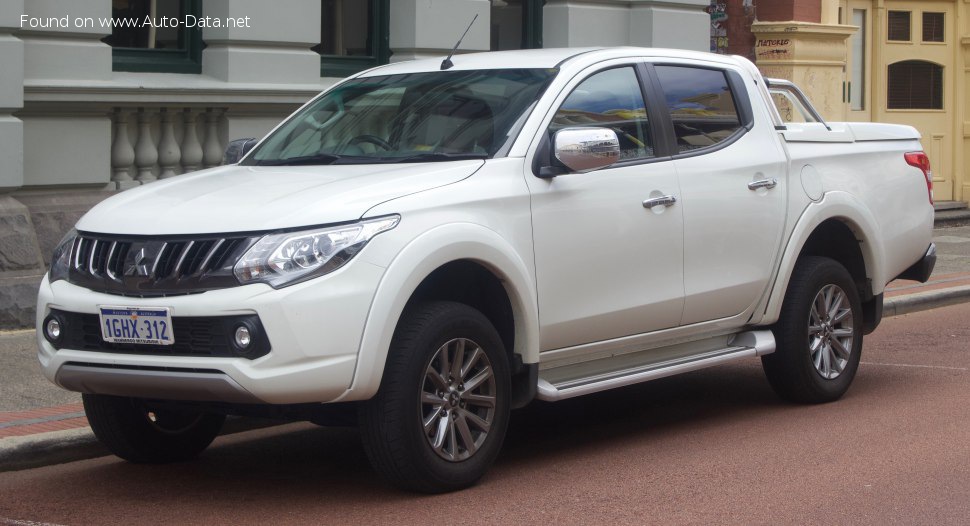
The Mitsubishi Triton V Single Cab Chassis (facelift 2019) represents a significant iteration of Mitsubishi’s globally popular pickup truck. While not widely sold in the United States, the Triton – known as the Mitsubishi L200 in many international markets – is a mainstay in Asia, Australia, Europe, and Latin America, prized for its robust build, practicality, and off-road capability. This particular version, the facelifted fifth-generation model produced from 2019 to 2023, focuses on refining the existing platform with updated styling, improved technology, and continued emphasis on durability. It caters to buyers needing a workhorse vehicle capable of handling demanding tasks and challenging terrain.
Mitsubishi Triton V Single Cab Chassis: An Overview
The Triton V Single Cab Chassis is positioned as a commercial-focused vehicle, offering a stripped-down, utilitarian approach compared to the double-cab variants. The single-cab configuration prioritizes cargo space and payload capacity, making it ideal for businesses, farmers, and individuals requiring a versatile and rugged transportation solution. The 2019 facelift brought subtle but noticeable changes to the exterior, including revised front fascia styling and updated interior trim. The core mechanical components, however, remained largely consistent with the preceding models, retaining the Triton’s reputation for reliability and toughness.
Engine & Performance
Powering the Triton V Single Cab Chassis is a 2.4-liter (2442 cm3 or 149.02 cu. in.) inline-four cylinder diesel engine, designated the 4N15. This engine produces 181 horsepower (Hp) at 3500 rpm and 430 Newton-meters (317.15 lb.-ft.) of torque at 2500 rpm. The engine utilizes a turbocharger with an intercooler and Mitsubishi’s MIVEC variable valve timing system to optimize performance and efficiency. Power is delivered to all four wheels via a six-speed automatic transmission, providing a balance of responsiveness and ease of use. The weight-to-power ratio stands at 9.3 kg/Hp, while the weight-to-torque ratio is 3.9 kg/Nm. Fuel consumption is rated at 8.6 liters per 100 kilometers (27.4 US mpg or 32.8 UK mpg), with CO2 emissions of 225 g/km.
Design & Features
The Triton V Single Cab Chassis features a traditional pickup truck body style with a two-door configuration and a dedicated cargo bed. The single-cab layout allows for a longer bed, maximizing cargo-carrying capacity. The vehicle’s design emphasizes functionality and durability, with a robust chassis and a utilitarian interior. Key features include a double wishbone front suspension and a leaf spring rear suspension, designed to handle heavy loads and rough terrain. Braking is provided by ventilated discs at the front and drums at the rear, supplemented by an Anti-lock Braking System (ABS). The Triton boasts a ground clearance of 205 mm (8.07 in), an approach angle of 30°, and a ramp-over angle of 25°, enhancing its off-road capabilities. The vehicle’s dimensions are 1815 mm (71.46 in) wide and 1785 mm (70.28 in) high, with a wheelbase of 3000 mm (118.11 in). The Triton is equipped with electric power steering for improved maneuverability.
Technical Specifications
| Brand | Mitsubishi |
| Model | Triton |
| Generation | Triton V Single Cab Chassis (facelift 2019) |
| Type (Engine) | 2.4L D4 (181 Hp) 4WD Automatic |
| Start of production | 2019 |
| End of production | 2023 |
| Powertrain Architecture | Internal Combustion engine |
| Body type | Pick-up |
| Seats | 2 |
| Doors | 2 |
| Fuel consumption (combined) | 8.6 l/100 km (27.4 US mpg, 32.8 UK mpg, 11.6 km/l) |
| CO2 emissions | 225 g/km |
| Fuel Type | Diesel |
| Weight-to-power ratio | 9.3 kg/Hp |
| Weight-to-torque ratio | 3.9 kg/Nm |
| Power | 181 Hp @ 3500 rpm |
| Torque | 430 Nm @ 2500 rpm (317.15 lb.-ft. @ 2500 rpm) |
| Engine layout | Front, Longitudinal |
| Engine Model/Code | 4N15 |
| Engine displacement | 2442 cm3 (149.02 cu. in.) |
| Number of cylinders | 4 |
| Engine configuration | Inline |
| Cylinder Bore | 86 mm (3.39 in.) |
| Piston Stroke | 105.1 mm (4.14 in.) |
| Number of valves per cylinder | 4 |
| Fuel injection system | Diesel Commonrail |
| Engine aspiration | Turbocharger, Intercooler |
| Valvetrain | MIVEC |
| Engine oil capacity | 6.7 l (7.08 US qt | 5.9 UK qt) |
| Coolant capacity | 7.7 l (8.14 US qt | 6.78 UK qt) |
| Kerb Weight | 1679 kg (3701.56 lbs.) |
| Max. weight | 2900 kg (6393.41 lbs.) |
| Max load | 1221 kg (2691.84 lbs.) |
| Fuel tank capacity | 75 l (19.81 US gal | 16.5 UK gal) |
| Permitted trailer load (braked) | 3000 kg (6613.87 lbs.) |
| Permitted trailer load (unbraked) | 750 kg (1653.47 lbs.) |
| Permitted towbar download | 300 kg (661.39 lbs.) |
| Width | 1815 mm (71.46 in.) |
| Height | 1785 mm (70.28 in.) |
| Wheelbase | 3000 mm (118.11 in.) |
| Ride height (ground clearance) | 205 mm (8.07 in.) |
| Drive wheel | All wheel drive (4×4) |
| Number of gears | 6 |
| Gearbox type | Automatic transmission |
| Front suspension | Double wishbone |
| Rear suspension | Leaf spring |
| Front brakes | Ventilated discs, 294 mm |
| Rear brakes | Drum |
| Assisting systems | ABS (Anti-lock braking system) |
| Steering type | Steering rack and pinion |
| Power steering | Electric |
| Tires size | 245/65 R17 111S |
| Wheel rims size | 7.5J x 17 |
The Mitsubishi Triton V Single Cab Chassis (facelift 2019) remains a compelling option for those seeking a dependable and capable pickup truck, particularly in markets where it is a dominant force. Its blend of rugged construction, efficient diesel engine, and practical features makes it well-suited for a wide range of commercial and personal applications.