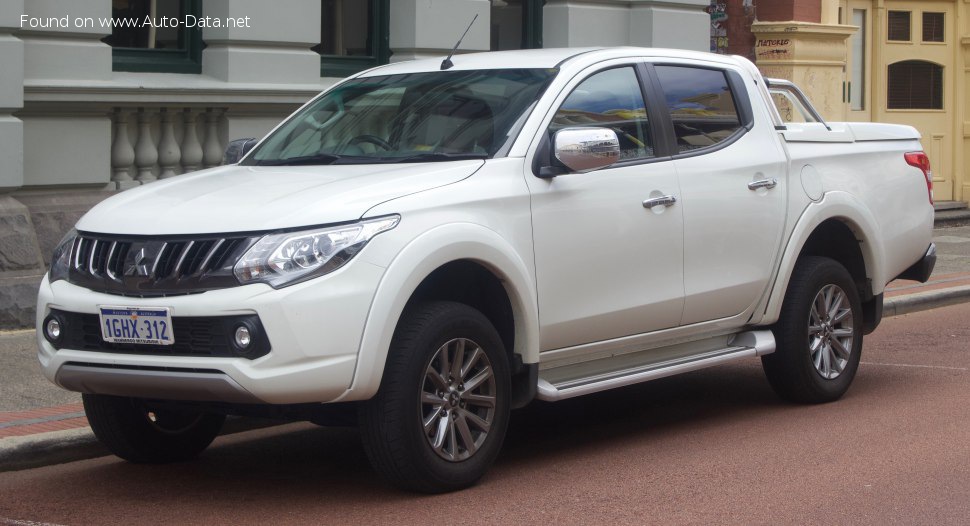
The Mitsubishi Triton V Single Cab Chassis (facelift 2019) represents a work-focused iteration of Mitsubishi’s globally recognized pickup truck. While not directly sold in the United States, the Triton – known as the Mitsubishi L200 in many international markets – is a significant player in the Asia-Pacific region, Europe, and Latin America. This particular version, the Single Cab Chassis, is designed for commercial use, prioritizing payload capacity and durability over passenger comfort. The 2019 facelift brought updated styling and minor mechanical refinements to the fifth-generation Triton, which was originally launched in 2015. This model caters to businesses and individuals requiring a robust and reliable vehicle for hauling and towing, offering a practical alternative to larger, more expensive trucks.
Mitsubishi Triton V Single Cab Chassis: Overview
The Triton V Single Cab Chassis (facelift 2019) is a two-door, two-seat pickup truck built on a body-on-frame chassis. It’s positioned as a utilitarian vehicle, intended for commercial applications such as agriculture, construction, and small business operations. The “Chassis” designation indicates that the vehicle is typically sold without a pre-installed bed, allowing owners to customize it with a flatbed, service body, or other specialized equipment. The facelift introduced in 2019 included cosmetic updates to the front fascia, interior trim, and safety features, enhancing its appeal in competitive markets. The truck’s rear-wheel-drive configuration and manual transmission further emphasize its focus on functionality and cost-effectiveness.
Engine & Performance
Powering the Mitsubishi Triton V Single Cab Chassis (facelift 2019) is a 2.4-liter inline-four cylinder gasoline engine, designated the S4. This naturally aspirated engine produces 128 horsepower at 5,250 rpm and 194 Nm (143.09 lb.-ft.) of torque at 4,000 rpm. While not a high-performance engine, it provides adequate power for typical work-related tasks. The engine features a multi-port fuel injection system and a single overhead camshaft (SOHC) valvetrain. The engine’s power-to-weight ratio is 11.2 kg/Hp, and its torque-to-weight ratio is 7.4 kg/Nm. The truck’s combined fuel consumption is rated at 11.4 liters per 100 kilometers (20.6 US mpg), with CO2 emissions of 265 g/km. A five-speed manual transmission is the only gearbox option, delivering power to the rear wheels. The longitudinal engine layout contributes to a balanced weight distribution, enhancing stability when carrying heavy loads.
Design & Features
The Triton V Single Cab Chassis boasts a practical and robust design. Its two-door configuration prioritizes cargo space and utility over passenger comfort. The vehicle’s body-on-frame construction provides exceptional durability and allows for a high payload capacity of 1,284 kg (2,830.74 lbs.). The truck’s dimensions are 1,815 mm (71.46 in) wide, 1,775 mm (69.88 in) high, and has a wheelbase of 3,000 mm (118.11 in). Ground clearance is a substantial 200 mm (7.87 in), enabling it to navigate rough terrain. Approach and ramp-over angles are 30° and 25° respectively, further enhancing its off-road capability. Standard features include an anti-lock braking system (ABS) and electric power steering. The 75-liter (19.81 US gal) fuel tank provides a reasonable driving range. The Triton is designed to be a blank canvas for customization, with a maximum permissible trailer load of 1,800 kg (3,968.32 lbs) with brakes and 750 kg (1,653.47 lbs) without brakes.
Technical Specifications
| Brand | Mitsubishi |
| Model | Triton |
| Generation | Triton V Single Cab Chassis (facelift 2019) |
| Type (Engine) | 2.4L S4 (128 Hp) |
| Start of production | 2019 |
| End of production | 2023 |
| Powertrain Architecture | Internal Combustion engine |
| Body type | Pick-up |
| Seats | 2 |
| Doors | 2 |
| Fuel consumption (combined) | 11.4 l/100 km (20.6 US mpg, 24.8 UK mpg, 8.8 km/l) |
| CO2 emissions | 265 g/km |
| Fuel Type | Petrol (Gasoline) |
| Weight-to-power ratio | 11.2 kg/Hp |
| Weight-to-torque ratio | 7.4 kg/Nm |
| Power | 128 Hp @ 5250 rpm |
| Torque | 194 Nm @ 4000 rpm (143.09 lb.-ft. @ 4000 rpm) |
| Engine layout | Front, Longitudinal |
| Engine displacement | 2351 cm3 (143.47 cu. in.) |
| Number of cylinders | 4 |
| Engine configuration | Inline |
| Cylinder Bore | 86.5 mm (3.41 in.) |
| Piston Stroke | 100 mm (3.94 in.) |
| Number of valves per cylinder | 4 |
| Fuel injection system | Multi-port manifold injection |
| Engine aspiration | Naturally aspirated engine |
| Valvetrain | SOHC |
| Kerb Weight | 1436 kg (3165.84 lbs.) |
| Max. weight | 2720 kg (5996.57 lbs.) |
| Max load | 1284 kg (2830.74 lbs.) |
| Fuel tank capacity | 75 l (19.81 US gal | 16.5 UK gal) |
| Permitted trailer load with brakes (12%) | 1800 kg (3968.32 lbs.) |
| Permitted trailer load without brakes | 750 kg (1653.47 lbs.) |
| Width | 1815 mm (71.46 in.) |
| Height | 1775 mm (69.88 in.) |
| Wheelbase | 3000 mm (118.11 in.) |
| Ride height (ground clearance) | 200 mm (7.87 in.) |
| Approach angle | 30° |
| Ramp-over (brakeover) angle | 25° |
| Drivetrain Architecture | Rear wheel drive, Internal Combustion engine |
| Drive wheel | Rear wheel drive |
| Number of gears and type of gearbox | 5 gears, manual transmission |
| Front suspension | Double wishbone |
| Rear suspension | Leaf spring |
| Front brakes | Ventilated discs, 294 mm |
| Rear brakes | Drum |
| Assisting systems | ABS (Anti-lock braking system) |
| Steering type | Steering rack and pinion |
| Power steering | Electric Steering |
| Wheel rims size | 6J x 16 |
In conclusion, the Mitsubishi Triton V Single Cab Chassis (facelift 2019) 2.4L S4 (128 Hp) is a no-nonsense pickup truck designed for practicality and durability. While it may not offer the refinement or power of some competitors, its robust construction, ample payload capacity, and customizable chassis make it a valuable asset for businesses and individuals requiring a reliable workhorse. Its success in markets outside of North America demonstrates the continued demand for simple, functional pickup trucks that prioritize utility over luxury.