
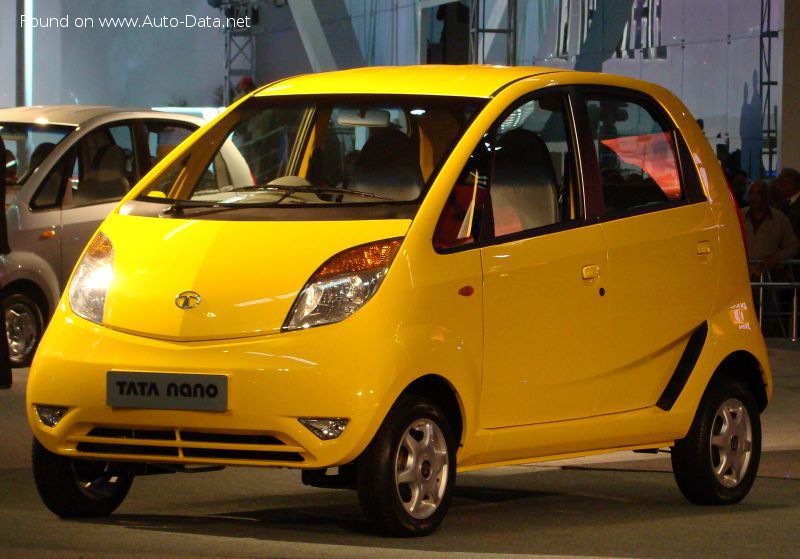
The Tata Nano is a rear-engined, four-door hatchback that was produced by the Indian manufacturer Tata Motors from 2008 to 2015. Conceived with the intention of providing affordable transportation for the masses, the Nano aimed to revolutionize the Indian automotive market. It gained international attention for its extremely low price point, initially targeted at around $2,500 USD. While the Nano ultimately didn’t achieve the sales volumes initially projected, it remains a significant vehicle in automotive history, representing a bold attempt to democratize car ownership. This article focuses on the 0.6-liter version, available with both petrol and Compressed Natural Gas (CNG) fuel options, producing 38 horsepower on petrol and 33 horsepower on CNG.
The Tata Nano 0.6: A Revolutionary Concept
The Tata Nano was a radical departure from conventional automotive design and manufacturing processes. Its development was driven by the vision of Ratan Tata, then chairman of Tata Motors, who sought to create a safe, reliable, and affordable car for Indian families who typically traveled by motorcycle or scooter. The vehicle was designed to be simple, robust, and easy to maintain, with a focus on minimizing production costs. The 0.6-liter engine was central to this goal, offering a balance between fuel efficiency and affordability. The CNG variant was offered to cater to markets with established CNG infrastructure, further reducing running costs.
Engine & Performance
The Tata Nano 0.6 is powered by a 624cc (38.08 cubic inches) inline two-cylinder engine. This naturally aspirated engine produces 38 horsepower at 5250 rpm when running on petrol, and 33 horsepower at 5500 rpm when fueled by Compressed Natural Gas (CNG). Torque output is 51 Nm (37.62 lb-ft) at 4000 rpm on petrol, decreasing to 45 Nm when running on CNG. The engine utilizes a multi-port manifold fuel injection system and a single overhead camshaft (SOHC) valvetrain with two valves per cylinder. Power per liter is 60.9 hp/l on petrol and 52.9 hp/l on CNG. The engine is transversely mounted at the rear of the vehicle, driving the rear wheels through a four-speed manual transmission. Acceleration from 0 to 100 km/h (0-62 mph) takes 12.6 seconds, with a top speed of 105 km/h (65.24 mph). The weight-to-power ratio is 19.3 kg/Hp, and the weight-to-torque ratio is 14.4 kg/Nm.
Design & Features
The Tata Nano is a five-door hatchback with a relatively small footprint, designed to navigate congested urban environments. Its rear-engine layout contributes to its compact dimensions and provides a surprisingly spacious interior for its size. The Nano was designed with a focus on maximizing interior space while minimizing weight. The interior is basic but functional, offering seating for four passengers. Key features included a relatively large glass area for good visibility, and a surprisingly generous trunk space ranging from 80 liters (2.83 cubic feet) with the rear seats up to 500 liters (17.66 cubic feet) with the rear seats folded down. Safety features were limited, reflecting the vehicle’s price point, with drum brakes on all four wheels and a basic steering rack and pinion system. The Nano’s design prioritized affordability and practicality over luxury or advanced features.
Technical Specifications
| Brand | Tata |
| Model | Nano |
| Generation | Nano |
| Type (Engine) | 0.6 (38/33 Hp) CNG |
| Start of production | 2008 |
| End of production | 2015 |
| Powertrain Architecture | Internal Combustion engine |
| Body type | Hatchback |
| Seats | 4 |
| Doors | 5 |
| Fuel consumption (combined) | 2.8 l/100 km (84 US mpg / 100.9 UK mpg / 35.7 km/l) |
| Fuel Type | Petrol / CNG |
| Acceleration 0 – 100 km/h | 12.6 sec |
| Acceleration 0 – 62 mph | 12.6 sec |
| Acceleration 0 – 60 mph | 12 sec |
| Maximum speed | 105 km/h (65.24 mph) |
| Weight-to-power ratio | 19.3 kg/Hp |
| Weight-to-torque ratio | 14.4 kg/Nm |
| Power | 38 Hp @ 5250 rpm (Petrol) / 33 Hp @ 5500 rpm (CNG) |
| Power per litre | 60.9 Hp/l (Petrol) / 52.9 Hp/l (CNG) |
| Torque | 51 Nm @ 4000 rpm (Petrol) / 45 Nm @ 3500 rpm (CNG) |
| Engine layout | Rear, Transverse |
| Engine displacement | 624 cm3 (38.08 cu. in.) |
| Number of cylinders | 2 |
| Engine configuration | Inline |
| Cylinder Bore | 73.5 mm (2.89 in.) |
| Piston Stroke | 73.5 mm (2.89 in.) |
| Compression ratio | 10.3:1 |
| Number of valves per cylinder | 2 |
| Fuel injection system | Multi-port manifold injection |
| Engine aspiration | Naturally aspirated |
| Valvetrain | SOHC |
| Engine oil capacity | 2.2 l (2.32 US qt | 1.94 UK qt) |
| Coolant | 2.4 l (2.54 US qt | 2.11 UK qt) |
| Kerb Weight | 735-745 kg (1620.4 – 1642.44 lbs.) |
| Trunk (boot) space – minimum | 80 l (2.83 cu. ft.) |
| Trunk (boot) space – maximum | 500 l (17.66 cu. ft.) |
| Fuel tank capacity | 15 l (3.96 US gal | 3.3 UK gal) |
| Length | 3099 mm (122.01 in.) |
| Width | 1495 mm (58.86 in.) |
| Width including mirrors | 1620 mm (63.78 in.) |
| Height | 1652 mm (65.04 in.) |
| Wheelbase | 2230 mm (87.8 in.) |
| Front track | 1325 mm (52.17 in.) |
| Rear (Back) track | 1315 mm (51.77 in.) |
| Front overhang | 464 mm (18.27 in.) |
| Rear overhang | 405 mm (15.94 in.) |
| Ride height (ground clearance) | 180 mm (7.09 in.) |
| Minimum turning circle | 8.0 m (26.25 ft.) |
| Drivetrain Architecture | Rear wheel drive |
| Drive wheel | Rear wheel drive |
| Number of gears | 4 gears, manual transmission |
| Front suspension | Independent, McPherson with coil spring and anti-roll bar |
| Rear suspension | Semi-independent, coil spring |
| Front brakes | Drum |
| Rear brakes | Drum |
| Steering type | Steering rack and pinion |
| Tires size | 135/70 R12; 155/65 R12 |
| Wheel rims size | 12 |
Despite its initial promise, the Tata Nano faced numerous challenges, including safety concerns, quality control issues, and a lack of marketing. Production ceased in 2015, but the Nano remains a fascinating case study in automotive engineering and a testament to the ambition of providing affordable mobility to a vast population. It demonstrated the complexities of achieving low-cost manufacturing without compromising on essential aspects of vehicle quality and safety.
