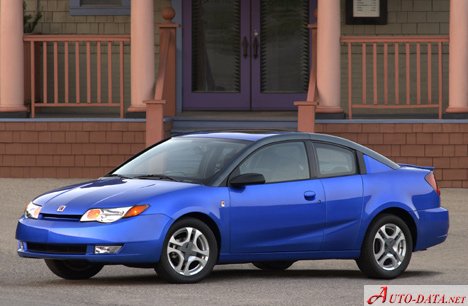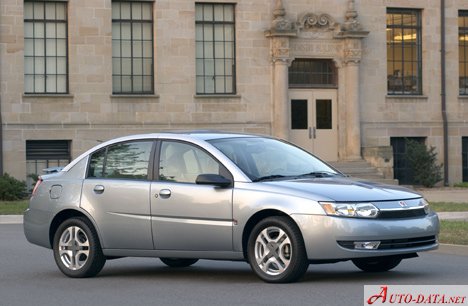
The Saturn ION was a compact car manufactured by Saturn, a General Motors (GM) division, from 2002 to 2007. Positioned as a replacement for the Saturn SL and SC series, the ION represented Saturn’s attempt to modernize its lineup and appeal to a broader customer base. Available primarily in the North American market, the ION was offered in both sedan and coupe body styles, with the sedan being the more popular configuration. The 2.2i 16V Ecotec model, equipped with a 140 horsepower engine and automatic transmission, was a common variant, aiming to balance fuel efficiency with adequate performance for daily commuting.
Saturn ION 2.2 i 16V Ecotec: An Overview
The Saturn ION occupied the compact car segment, competing with vehicles like the Honda Civic, Toyota Corolla, and Ford Focus. It was notable for its polymer body panels – a signature feature of Saturn vehicles intended to reduce weight and improve dent resistance – and its relatively spacious interior for its class. The 2.2i model specifically featured a 2.2-liter inline-four engine, part of GM’s Ecotec family, known for its focus on fuel economy and refinement. While the ION didn’t achieve the same level of sales success as some of its competitors, it played a role in Saturn’s brand identity during its final years before the brand was discontinued in 2010.
Engine & Performance
The heart of the Saturn ION 2.2i is a 2.2-liter (2198 cm3 or 134.13 cu. in.) inline-four cylinder engine. This engine, belonging to GM’s Ecotec family, produces 140 horsepower at 5800 rpm and 145 Nm (106.95 lb.-ft.) of torque at 4400 rpm. The engine utilizes a multi-port fuel injection system and a double overhead camshaft (DOHC) valvetrain with four valves per cylinder. This configuration contributes to a power output of 63.7 horsepower per liter. Power is delivered to the front wheels via a five-speed automatic transmission. Performance figures include a 0-60 mph (0-97 km/h) acceleration time of approximately 9.7 seconds and a 0-100 km/h (0-62 mph) time of 10.2 seconds. The vehicle has a maximum speed of 175 km/h (108.74 mph). The weight-to-power ratio is 8.7 kg/Hp, and the weight-to-torque ratio is 8.4 kg/Nm.
Design & Features
The Saturn ION 2.2i is a four-door sedan designed to accommodate five passengers. A key design element of the ION, and Saturn vehicles in general, was the use of polymer (plastic) body panels mounted on a steel space frame. This construction method was intended to reduce weight, improve corrosion resistance, and offer improved dent resistance compared to traditional steel bodywork. The ION’s interior prioritized practicality and space, offering a reasonable amount of legroom and headroom for passengers. Standard safety features for the era included an Anti-lock Braking System (ABS). The vehicle’s steering system is a rack and pinion type with hydraulic power assistance. The ION rides on 14-inch wheels fitted with 185/70 R14 tires. Trunk space is rated at 454 liters (16.03 cu. ft.).
Technical Specifications
| Brand | Saturn |
| Model | ION |
| Generation | ION |
| Type (Engine) | 2.2 i 16V Ecotec (140 Hp) Automatic |
| Start of production | 2002 |
| End of production | March, 2007 |
| Powertrain Architecture | Internal Combustion engine |
| Body type | Sedan |
| Seats | 5 |
| Doors | 4 |
| Fuel consumption (urban) | 9.8 l/100 km (24 US mpg, 28.8 UK mpg, 10.2 km/l) |
| Fuel consumption (extra urban) | 7.4 l/100 km (31.8 US mpg, 38.2 UK mpg, 13.5 km/l) |
| Fuel Type | Petrol (Gasoline) |
| Acceleration 0 – 100 km/h | 10.2 sec |
| Acceleration 0 – 62 mph | 10.2 sec |
| Acceleration 0 – 60 mph | 9.7 sec |
| Maximum speed | 175 km/h (108.74 mph) |
| Weight-to-power ratio | 8.7 kg/Hp |
| Weight-to-torque ratio | 8.4 kg/Nm |
| Power | 140 Hp @ 5800 rpm |
| Power per litre | 63.7 Hp/l |
| Torque | 145 Nm @ 4400 rpm (106.95 lb.-ft. @ 4400 rpm) |
| Engine layout | Front, Transverse |
| Engine displacement | 2198 cm3 (134.13 cu. in.) |
| Number of cylinders | 4 |
| Engine configuration | Inline |
| Cylinder Bore | 86 mm (3.39 in.) |
| Piston Stroke | 94.6 mm (3.72 in.) |
| Compression ratio | 10:1 |
| Number of valves per cylinder | 4 |
| Fuel injection system | Multi-port manifold injection |
| Engine aspiration | Naturally aspirated |
| Valvetrain | DOHC |
| Engine oil capacity | 4.8 l (5.07 US qt | 4.22 UK qt) |
| Kerb Weight | 1221 kg (2691.84 lbs.) |
| Trunk (boot) space | 454 l (16.03 cu. ft.) |
| Fuel tank capacity | 50 l (13.21 US gal | 11 UK gal) |
| Length | 4686 mm (184.49 in.) |
| Width | 1707 mm (67.2 in.) |
| Height | 1458 mm (57.4 in.) |
| Wheelbase | 2621 mm (103.19 in.) |
| Front track | 1494 mm (58.82 in.) |
| Rear track | 1483 mm (58.39 in.) |
| Drivetrain Architecture | Front wheel drive |
| Number of gears | 5 |
| Gearbox type | Automatic transmission |
| Front suspension | Coil spring |
| Rear suspension | Coil spring |
| Front brakes | Ventilated discs |
| Rear brakes | Drum |
| Assisting systems | ABS (Anti-lock braking system) |
| Steering type | Steering rack and pinion |
| Power steering | Hydraulic |
| Tires size | 185/70 R14 |
| Wheel rims size | 14 |
The Saturn ION 2.2i, while not a groundbreaking vehicle, represented a step forward for the brand in terms of design and technology. Its focus on fuel efficiency and practicality made it a reasonable choice for budget-conscious buyers in the early 2000s. However, it ultimately faced stiff competition and was discontinued along with the Saturn brand itself.