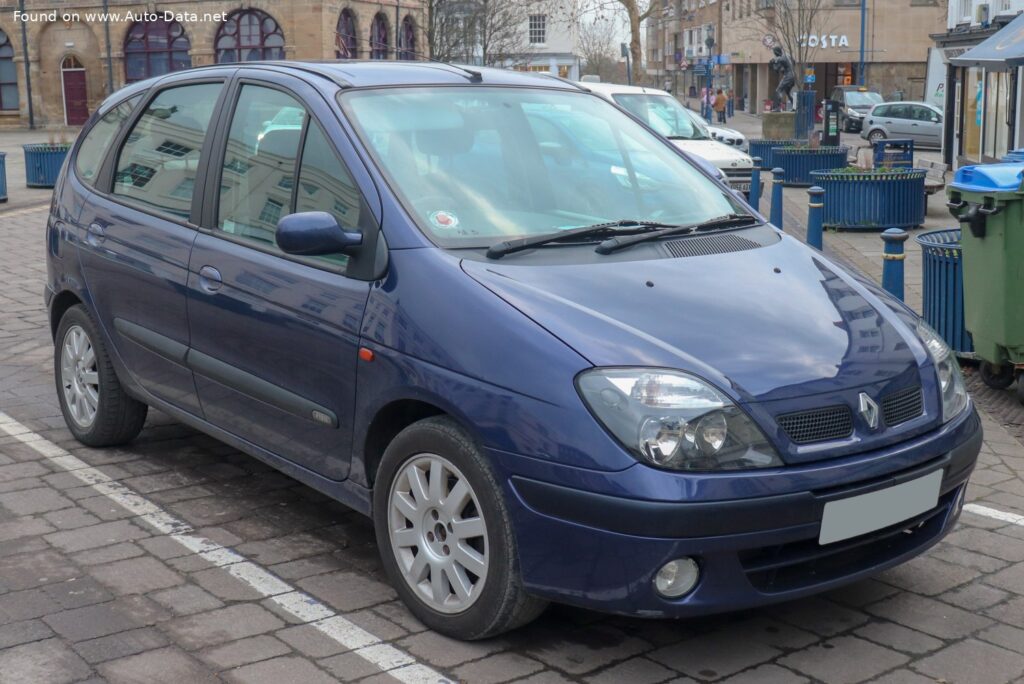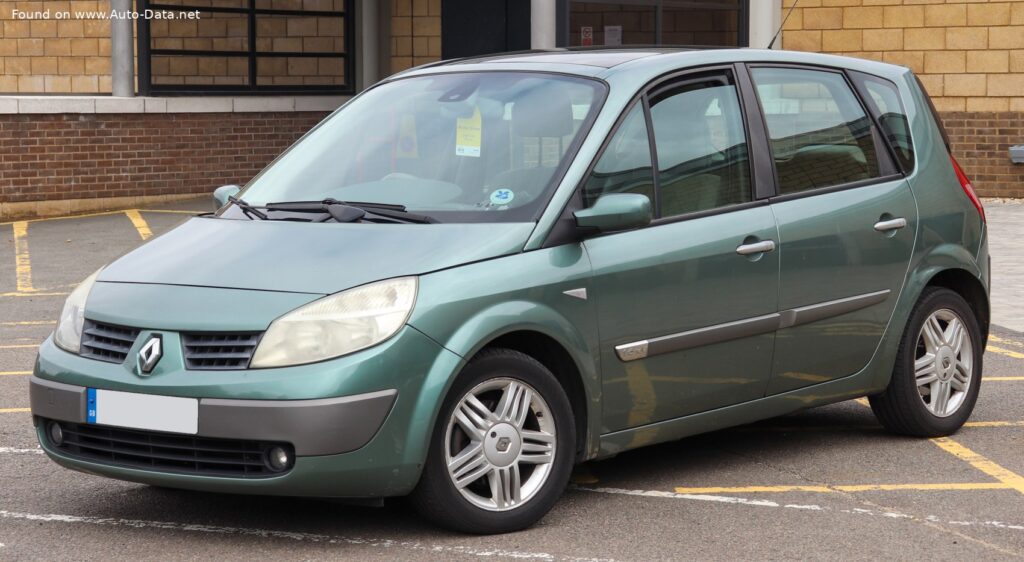
The Renault Scenic II (Phase I) 2.0 dCi, produced in 2006, represents a significant iteration in Renault’s popular compact minivan line. Introduced as a successor to the original Scenic, the Scenic II aimed to refine the formula of spaciousness, practicality, and family-focused features. This particular variant, equipped with a 2.0-liter diesel engine producing 150 horsepower, was primarily marketed in Europe, where compact MPVs (Multi-Purpose Vehicles) held a substantial market share. The Scenic II competed with vehicles like the Citroën Xsara Picasso, Opel/Vauxhall Zafira, and Ford Focus C-Max, offering a blend of comfort, versatility, and relatively efficient diesel power.
Renault Scenic II (Phase I) 2.0 dCi: An Overview
The Scenic II Phase I marked a step forward in design and technology for Renault. It retained the core principles of the original Scenic – a spacious interior, modular seating, and a focus on practicality – but incorporated a more refined aesthetic and improved mechanical components. The 2.0 dCi engine was a key component of the Scenic II’s appeal, offering a balance of performance and fuel economy that resonated with European buyers. While not officially sold in the United States, understanding the Scenic II provides insight into the European automotive landscape of the mid-2000s and the growing demand for versatile, family-oriented vehicles.
Engine & Performance
The heart of the Scenic II 2.0 dCi is Renault’s M9R engine, a 1995cc inline four-cylinder diesel powerplant. This engine utilizes a turbocharger with an intercooler and a diesel commonrail fuel injection system to deliver 150 horsepower at 4000 rpm and 260 Nm (191.77 lb.-ft.) of torque at 2000 rpm. This torque output provides strong acceleration and effortless cruising, particularly beneficial for a vehicle designed to carry passengers and cargo. The engine’s power-to-weight ratio of 9.8 kg/Hp and torque-to-weight ratio of 5.6 kg/Nm contribute to its responsive feel. Performance figures include a 0-100 km/h (0-62 mph) acceleration time of 9.4 seconds and a top speed of 204 km/h (126.76 mph). Fuel economy is a strong point, with combined cycle consumption rated at 5.8 l/100 km (40.6 US mpg), and CO2 emissions of 154 g/km, meeting Euro 4 emission standards.
Design & Features
The Renault Scenic II Phase I is a five-door minivan designed to accommodate five passengers. Its body style emphasizes practicality and space efficiency. Key design features include a relatively high roofline, large windows for good visibility, and a rear end designed to maximize cargo capacity. The interior is characterized by its modularity, with sliding rear seats and folding front passenger seats allowing for a variety of seating configurations. The trunk offers a minimum capacity of 430 liters (15.19 cu. ft.), expanding to a substantial 1840 liters (64.98 cu. ft.) with the rear seats folded. Safety features, typical for a 2006 vehicle, include ABS (Anti-lock Braking System). The Scenic II also offered features like power steering, air conditioning, and a range of audio systems, depending on the trim level. The focus was on creating a comfortable and versatile environment for families.
Technical Specifications
| Brand | Renault |
| Model | Scenic |
| Generation | Scenic II (Phase I) |
| Type (Engine) | 2.0 dCi (150 Hp) |
| Start of production | 2006 |
| End of production | 2006 |
| Powertrain Architecture | Internal Combustion engine |
| Body type | Minivan |
| Seats | 5 |
| Doors | 5 |
| Fuel consumption (urban) | 7.3 l/100 km (32.2 US mpg) |
| Fuel consumption (extra urban) | 5.0 l/100 km (47 US mpg) |
| Fuel consumption (combined) | 5.8 l/100 km (40.6 US mpg) |
| CO2 emissions | 154 g/km |
| Fuel Type | Diesel |
| Acceleration 0 – 100 km/h | 9.4 sec |
| Acceleration 0 – 62 mph | 9.4 sec |
| Acceleration 0 – 60 mph | 8.9 sec |
| Maximum speed | 204 km/h (126.76 mph) |
| Emission standard | Euro 4 |
| Weight-to-power ratio | 9.8 kg/Hp |
| Weight-to-torque ratio | 5.6 kg/Nm |
| Power | 150 Hp @ 4000 rpm |
| Torque | 260 Nm @ 2000 rpm (191.77 lb.-ft. @ 2000 rpm) |
| Engine layout | Front, Transverse |
| Engine Model/Code | M9R |
| Engine displacement | 1995 cm3 (121.74 cu. in.) |
| Number of cylinders | 4 |
| Engine configuration | Inline |
| Cylinder Bore | 84 mm (3.31 in.) |
| Piston Stroke | 90 mm (3.54 in.) |
| Number of valves per cylinder | 2 |
| Fuel injection system | Diesel Commonrail |
| Engine aspiration | Turbocharger, Intercooler |
| Engine oil capacity | 7.5 l (7.93 US qt | 6.6 UK qt) |
| Coolant | 6.6 l (6.97 US qt | 5.81 UK qt) |
| Kerb Weight | 1465 kg (3229.77 lbs.) |
| Max. weight | 2025 kg (4464.36 lbs.) |
| Max load | 560 kg (1234.59 lbs.) |
| Trunk (boot) space – minimum | 430 l (15.19 cu. ft.) |
| Trunk (boot) space – maximum | 1840 l (64.98 cu. ft.) |
| Fuel tank capacity | 60 l (15.85 US gal | 13.2 UK gal) |
| Max. roof load | 80 kg (176.37 lbs.) |
| Permitted trailer load with brakes (12%) | 1300 kg (2866.01 lbs.) |
| Permitted trailer load without brakes | 650 kg (1433 lbs.) |
| Permitted towbar download | 75 kg (165.35 lbs.) |
| Length | 4259 mm (167.68 in.) |
| Width | 1810 mm (71.26 in.) |
| Width including mirrors | 2087 mm (82.17 in.) |
| Height | 1620 mm (63.78 in.) |
| Wheelbase | 2685 mm (105.71 in.) |
| Front track | 1514 mm (59.61 in.) |
| Rear (Back) track | 1514 mm (59.61 in.) |
| Front overhang | 851 mm (33.5 in.) |
| Rear overhang | 723 mm (28.46 in.) |
| Ride height (ground clearance) | 130 mm (5.12 in.) |
| Minimum turning circle (turning diameter) | 10.7 m (35.1 ft.) |
| Drivetrain Architecture | Front wheel drive |
| Number of gears and type of gearbox | 6 gears, manual transmission |
| Front suspension | Independent type McPherson |
| Rear suspension | Elastic beam |
| Front brakes | Ventilated discs, 300 mm |
| Rear brakes | Disc, 270 mm |
| Assisting systems | ABS (Anti-lock braking system) |
| Steering type | Steering rack and pinion |
| Power steering | Electric Steering |
| Tires size | 205/60 R16 |
| Wheel rims size | 16 |