
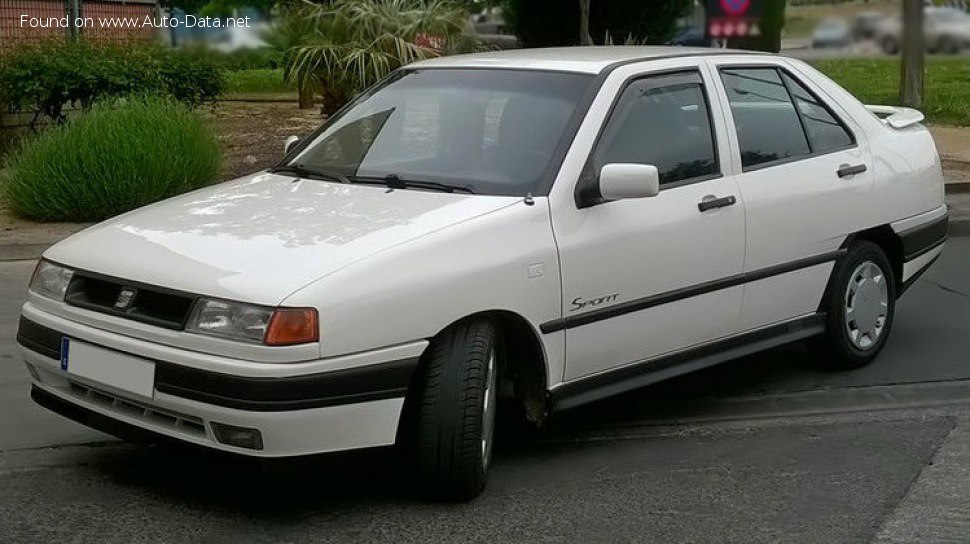
The SEAT Toledo I (1L), specifically the 1.9 TD variant producing 75 horsepower, represents a significant entry for the Spanish automaker into the competitive mid-size sedan market of the early 1990s. Introduced in May 1991 and continuing production until July 1994, the Toledo was SEAT’s first entirely new model following its partnership with the Volkswagen Group. While SEAT was a long-established Spanish brand, prior to Volkswagen’s involvement, its models were largely based on licensed designs from Fiat. The Toledo, designated as the 1L internally, marked a departure, utilizing a platform shared with the Volkswagen Golf Mk2 and featuring modern engineering and styling. It was primarily aimed at the European market, offering a practical and relatively affordable family car option. The 1.9 TD model, in particular, appealed to buyers seeking fuel efficiency and reasonable performance from a diesel engine.
SEAT Toledo I (1L): A European Sedan
The Toledo I filled a crucial gap in SEAT’s lineup. Before the Toledo, SEAT primarily produced smaller, more utilitarian vehicles like the Ibiza. The partnership with Volkswagen provided access to advanced technology and a modern platform, allowing SEAT to compete more effectively in the broader European automotive landscape. The Toledo wasn’t a direct replacement for any existing SEAT model; it was an expansion into a new segment. Its design, penned by Giorgetto Giugiaro’s Italdesign, aimed for a contemporary and aerodynamic aesthetic, differentiating it from the more boxy designs prevalent in the 1980s. The 1.9 TD variant, while not the most powerful in the Toledo range, became a popular choice due to its balance of economy and usability, particularly for long-distance driving common in Europe.
Engine & Performance
The heart of the Toledo 1.9 TD is its 1.9-liter, four-cylinder diesel engine, internally designated AAZ. This engine produced 75 horsepower, a respectable figure for a naturally aspirated diesel of the era, boosted by the inclusion of a turbocharger. The engine employed a precombustion chamber injection system, a common diesel technology at the time, which improved combustion efficiency and reduced engine noise compared to earlier direct injection systems. The turbocharger significantly enhanced torque output, providing good pulling power for overtaking and handling inclines. While specific acceleration figures weren’t heavily emphasized in marketing materials, the 1.9 TD offered a comfortable cruising speed and reasonable responsiveness for everyday driving.
The engine’s architecture was robust and designed for longevity, typical of diesel engines of the period. It featured a cast iron block and cylinder head, contributing to its durability. The engine was mated to a five-speed manual transmission, the standard configuration for the Toledo 1.9 TD. Fuel economy was a key selling point, with the 1.9 TD achieving impressive mileage for its time, making it an attractive option for drivers covering significant distances. The engine’s relatively simple design also meant that maintenance costs were generally lower compared to more complex gasoline engines.
Design & Features
The SEAT Toledo I (1L) presented a distinctly modern sedan profile for its time. Its four-door body style offered practical access and comfortable seating for five passengers. The design emphasized smooth lines and a relatively low-slung silhouette, contributing to its aerodynamic efficiency. The interior was functional and well-appointed for a car in its class, featuring cloth upholstery and a straightforward dashboard layout.
Safety features, while not as comprehensive as those found in modern vehicles, included seatbelts for all occupants. Anti-lock braking systems (ABS) were available as an option on some models, a relatively advanced feature for the early 1990s. Standard equipment included power steering, central locking, and electric windows, enhancing driver convenience. The Toledo’s trunk offered a generous amount of space for luggage, making it suitable for family trips. The overall design philosophy prioritized practicality, affordability, and a contemporary aesthetic, appealing to a broad range of European buyers. The Toledo’s success helped establish SEAT as a credible competitor in the mid-size sedan segment, paving the way for future models and further expansion of the brand.
Technical Specifications
| Brand | Seat |
| Model | Toledo |
| Generation | Toledo I (1L) |
| Type (Engine) | 1.9 TD (75 Hp) |
| Start of production | May, 1991 |
| End of production | July, 1994 |
| Powertrain Architecture | Internal Combustion engine |
| Body type | Sedan |
| Seats | 5 |
| Doors | 4 |
| Fuel Type | Diesel |
| Power | 75 Hp |
| Engine Model/Code | AAZ |
| Fuel injection system | Precombustion chamber injection |
| Engine aspiration | Turbocharger |
| Engine oil capacity | 4.3 l / 4.54 US qt / 3.78 UK qt |
| Coolant capacity | 6.5 l / 6.87 US qt / 5.72 UK qt |
| Fuel tank capacity | 55 l / 14.53 US gal / 12.1 UK gal |
