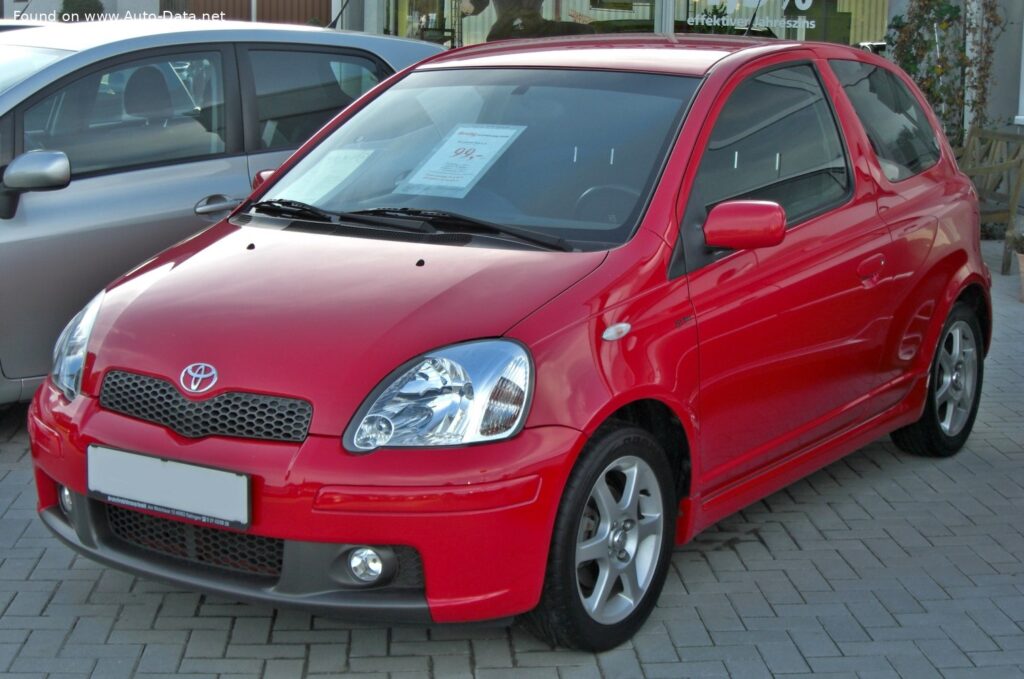
The Toyota Yaris, known in Japan as the Vitz, is a subcompact hatchback produced by Toyota since 1999. The first generation, known as the Yaris I, was a significant departure for Toyota, representing a move towards more contemporary and youthful styling. Introduced in Europe in 2003, the facelifted version, as detailed here, offered a refined aesthetic and efficient engine options. This particular model, the 3-door 1.4 D-4D (75 Hp), was primarily aimed at the European market, where smaller, fuel-efficient vehicles are highly valued. It represented Toyota’s commitment to providing practical and economical transportation in a competitive segment.
Toyota Yaris I (Facelift 2003) 1.4 D-4D: An Overview
The Yaris I facelift, produced between 2003 and 2005, built upon the success of the original model with subtle styling updates and continued focus on fuel efficiency and reliability. The 3-door configuration catered to buyers seeking a more sporty and compact option. The 1.4 D-4D engine was a key selling point, offering a balance of performance and exceptional diesel economy, making it a popular choice for urban commuters and those covering longer distances.
Engine & Performance
The heart of the Yaris I 1.4 D-4D is a 1.4-liter inline-4 cylinder diesel engine, designated the 1ND-TV. This engine produces 75 horsepower at 4000 rpm and 170 Nm (125.39 lb.-ft.) of torque between 2000 and 2800 rpm. While not a performance powerhouse, the engine’s strength lies in its efficiency. The use of a turbocharger and intercooler helps to maximize power output while maintaining excellent fuel economy. The engine features a diesel common rail fuel injection system, contributing to smooth operation and reduced emissions. Acceleration from 0 to 100 km/h (0-62 mph) takes 12.9 seconds, and it achieves a maximum speed of 170 km/h (105.63 mph). The engine’s 18.5:1 compression ratio is typical for a diesel engine, optimizing combustion efficiency. The front-wheel-drive configuration, coupled with a 5-speed manual transmission, delivers a practical and engaging driving experience.
Design & Features
The Yaris I facelift retained the distinctive, upright hatchback silhouette of the original model. The 3-door body style offered a more dynamic appearance compared to the 5-door version. The interior was designed with practicality in mind, offering seating for five passengers, although rear space was somewhat limited. The facelift brought minor cosmetic changes to the front and rear fascias, including revised headlights and taillights. Key features included a relatively spacious trunk for its class, offering 205 liters (7.24 cu. ft.) of space with the rear seats up and expanding to 950 liters (33.55 cu. ft.) with the seats folded down. Safety features for the time included an Anti-lock Braking System (ABS), which was becoming increasingly standard on European vehicles. The hydraulic power steering provided ease of maneuverability, particularly in urban environments. The drag coefficient of 0.30 contributed to the vehicle’s fuel efficiency.
Technical Specifications
| Brand | Toyota |
| Model | Yaris |
| Generation | Yaris I (facelift 2003) 3-door |
| Type (Engine) | 1.4 D-4D (75 Hp) |
| Start of production | 2003 |
| End of production | 2005 |
| Powertrain Architecture | Internal Combustion engine |
| Body type | Hatchback |
| Seats | 5 |
| Doors | 3 |
| Fuel consumption (urban) | 5.1 l/100 km (46.1 US mpg, 55.4 UK mpg, 19.6 km/l) |
| Fuel consumption (extra urban) | 3.7 l/100 km (63.6 US mpg, 76.3 UK mpg, 27 km/l) |
| Fuel consumption (combined) | 4.2 l/100 km (56 US mpg, 67.3 UK mpg, 23.8 km/l) |
| CO2 emissions | 113 g/km |
| Fuel Type | Diesel |
| Acceleration 0 – 100 km/h | 12.9 sec |
| Acceleration 0 – 62 mph | 12.9 sec |
| Acceleration 0 – 60 mph | 12.3 sec |
| Maximum speed | 170 km/h (105.63 mph) |
| Emission standard | Euro 3 |
| Weight-to-power ratio | 12.3 kg/Hp, 81.1 Hp/tonne |
| Weight-to-torque ratio | 5.4 kg/Nm, 183.8 Nm/tonne |
| Power | 75 Hp @ 4000 rpm |
| Power per litre | 55 Hp/l |
| Torque | 170 Nm @ 2000-2800 rpm (125.39 lb.-ft. @ 2000-2800 rpm) |
| Engine layout | Front, Transverse |
| Engine Model/Code | 1ND-TV |
| Engine displacement | 1364 cm3 (83.24 cu. in.) |
| Number of cylinders | 4 |
| Engine configuration | Inline |
| Cylinder Bore | 73 mm (2.87 in.) |
| Piston Stroke | 81.5 mm (3.21 in.) |
| Compression ratio | 18.5:1 |
| Number of valves per cylinder | 2 |
| Fuel injection system | Diesel Commonrail |
| Engine aspiration | Turbocharger, Intercooler |
| Valvetrain | SOHC |
| Engine oil capacity | 4.1 l (4.33 US qt | 3.61 UK qt) |
| Coolant | 4 l (4.23 US qt | 3.52 UK qt) |
| Kerb Weight | 925-1035 kg (2039.28 – 2281.78 lbs.) |
| Max. weight | 1410 kg (3108.52 lbs.) |
| Max load | 375-485 kg (826.73 – 1069.24 lbs.) |
| Trunk (boot) space – minimum | 205 l (7.24 cu. ft.) |
| Trunk (boot) space – maximum | 950 l (33.55 cu. ft.) |
| Fuel tank capacity | 45 l (11.89 US gal | 9.9 UK gal) |
| Permitted trailer load with brakes (12%) | 900 kg (1984.16 lbs.) |
| Permitted trailer load without brakes | 400 kg (881.85 lbs.) |
| Length | 3640 mm (143.31 in.) |
| Width | 1660 mm (65.35 in.) |
| Height | 1500 mm (59.06 in.) |
| Wheelbase | 2370 mm (93.31 in.) |
| Front track | 1440 mm (56.69 in.) |
| Rear (Back) track | 1420 mm (55.91 in.) |
| Drag coefficient (Cd) | 0.30 |
| Minimum turning circle (turning diameter) | 10.4 m (34.12 ft.) |
| Drivetrain Architecture | Front wheel drive |
| Number of gears and type of gearbox | 5 gears, manual transmission |
| Front suspension | Independent, type McPherson with coil spring and anti-roll bar |
| Rear suspension | Trailing arm, Coil spring, Torsion |
| Front brakes | Ventilated discs, 235 mm |
| Rear brakes | Drum |
| Assisting systems | ABS (Anti-lock braking system) |
| Steering type | Steering rack and pinion |
| Power steering | Hydraulic Steering |
| Tires size | 175/65 R14 |
| Wheel rims size | 5.5J x 14 |
The Toyota Yaris I (facelift 2003) 1.4 D-4D represented a compelling package for European buyers seeking a reliable, economical, and practical subcompact hatchback. Its fuel efficiency, combined with its compact size and ease of driving, made it a popular choice in crowded urban environments. While not a performance car, it offered a comfortable and efficient driving experience, cementing its place as a significant model in Toyota’s European lineup.