
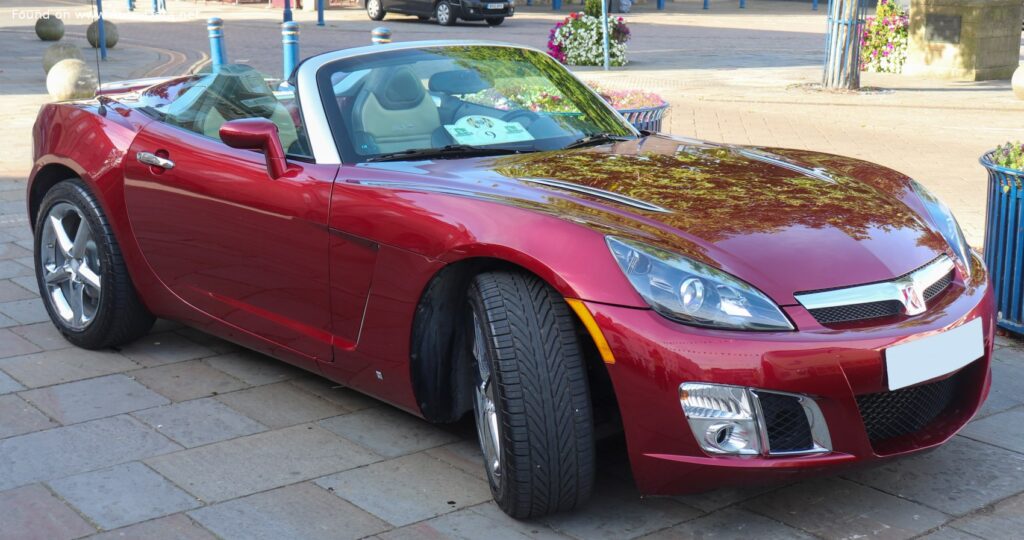
The Saturn Sky 2.4i 16V, produced from 2006 to 2009, was a two-seat, rear-wheel drive roadster marketed by Saturn, a General Motors (GM) division. Positioned as an affordable sports car, the Sky aimed to recapture the spirit of the original Pontiac Solstice, with which it shared its platform. The Sky distinguished itself with a more refined interior and a focus on comfortable cruising, appealing to buyers seeking an accessible entry into the sports car segment. While relatively short-lived, the Saturn Sky remains a notable example of GM’s attempt to revitalize the Saturn brand and offer a compelling alternative to established roadsters like the Mazda MX-5 Miata.
Saturn Sky 2.4i 16V: Overview and Market Position
The Saturn Sky was part of a broader GM initiative to develop a family of rear-wheel-drive vehicles using the Kappa platform. This platform also underpinned the Pontiac Solstice and Opel GT. Unlike the Solstice, which emphasized a raw, visceral driving experience, the Sky was designed to be more approachable and comfortable for everyday use. It was sold exclusively as a cabriolet (convertible) with a power-operated soft top. The Sky’s relatively low production numbers and the eventual demise of the Saturn brand have contributed to its growing collectibility among automotive enthusiasts.
Engine & Performance
The Saturn Sky 2.4i 16V was powered by the LE5 2.4-liter inline-four cylinder engine. This naturally aspirated engine produced 177 horsepower at 6600 rpm and 225 Nm (165.95 lb.-ft.) of torque at 4800 rpm. The engine featured multi-port fuel injection and a compression ratio of 10.4:1. Power was delivered to the rear wheels through a five-speed manual transmission. The Sky’s relatively light weight – 1330 kg (2932.15 lbs.) – contributed to its respectable performance. Acceleration from 0 to 100 km/h (0-62 mph) took 7.2 seconds, while 0 to 60 mph was achieved in approximately 6.8 seconds. The vehicle had a maximum speed of 198 km/h (123.03 mph). The weight-to-power ratio of 7.5 kg/Hp and weight-to-torque ratio of 5.9 kg/Nm further highlight the car’s performance characteristics.
Design & Features
The Saturn Sky boasted a distinctive exterior design characterized by its sculpted body lines and aggressive stance. The cabriolet configuration offered an open-air driving experience, enhanced by the power-operated soft top. The vehicle’s dimensions – 4091 mm (161.06 in.) in length, 1813 mm (71.38 in.) in width, and 1274 mm (50.16 in.) in height – positioned it as a compact roadster. Inside, the Sky offered a driver-focused cockpit with supportive seats and a straightforward layout. While the interior materials were not luxurious, they were generally considered to be of acceptable quality for the price point. Standard safety features included ABS (Anti-lock Braking System) and ventilated disc brakes on the front wheels, with disc brakes on the rear. Trunk space was limited, offering 57 liters (2.01 cu. ft.) with the top up and 153 liters (5.4 cu. ft.) with the top down. The Sky’s suspension utilized spring struts on both the front and rear axles, providing a balance between ride comfort and handling.
Technical Specifications
| Brand | Saturn |
| Model | Sky |
| Generation | Sky |
| Type (Engine) | 2.4i 16V (177 Hp) |
| Start of production | 2006 |
| End of production | July, 2009 |
| Powertrain Architecture | Internal Combustion engine |
| Body type | Cabriolet |
| Seats | 2 |
| Doors | 2 |
| Fuel consumption (urban) | 11.8 l/100 km (19.9 US mpg) |
| Fuel consumption (extra urban) | 8.4 l/100 km (28 US mpg) |
| Fuel Type | Petrol (Gasoline) |
| Acceleration 0 – 100 km/h | 7.2 sec |
| Acceleration 0 – 62 mph | 7.2 sec |
| Acceleration 0 – 60 mph | 6.8 sec |
| Maximum speed | 198 km/h (123.03 mph) |
| Weight-to-power ratio | 7.5 kg/Hp |
| Weight-to-torque ratio | 5.9 kg/Nm |
| Power | 177 Hp @ 6600 rpm |
| Torque | 225 Nm @ 4800 rpm (165.95 lb.-ft. @ 4800 rpm) |
| Engine layout | Front, Longitudinal |
| Engine Model/Code | LE5 |
| Engine displacement | 2384 cm3 (145.48 cu. in.) |
| Number of cylinders | 4 |
| Engine configuration | Inline |
| Cylinder Bore | 88 mm (3.46 in.) |
| Piston Stroke | 98 mm (3.86 in.) |
| Compression ratio | 10.4:1 |
| Number of valves per cylinder | 4 |
| Fuel injection system | Multi-port manifold injection |
| Engine aspiration | Naturally aspirated |
| Engine oil capacity | 4.7 l (4.97 US qt | 4.14 UK qt) |
| Coolant capacity | 8.4 l (8.88 US qt | 7.39 UK qt) |
| Kerb Weight | 1330 kg (2932.15 lbs.) |
| Trunk (boot) space – minimum | 57 l (2.01 cu. ft.) |
| Trunk (boot) space – maximum | 153 l (5.4 cu. ft.) |
| Fuel tank capacity | 52 l (13.74 US gal | 11.44 UK gal) |
| Length | 4091 mm (161.06 in.) |
| Width | 1813 mm (71.38 in.) |
| Height | 1274 mm (50.16 in.) |
| Wheelbase | 2415 mm (95.08 in.) |
| Front track | 1543 mm (60.75 in.) |
| Rear track | 1561 mm (61.46 in.) |
| Drivetrain Architecture | Rear wheel drive |
| Number of gears and type of gearbox | 5 gears, manual transmission |
| Front suspension | Spring Strut |
| Rear suspension | Spring Strut |
| Front brakes | Ventilated discs |
| Rear brakes | Disc |
| Tires size | 245/45 R18 |
The Saturn Sky, despite its brief production run, offered a compelling package for those seeking an affordable and enjoyable roadster experience. Its rear-wheel-drive layout, responsive engine, and attractive styling made it a standout in its class. Today, the Sky is appreciated by enthusiasts for its unique character and represents a final chapter in the Saturn brand’s history.
