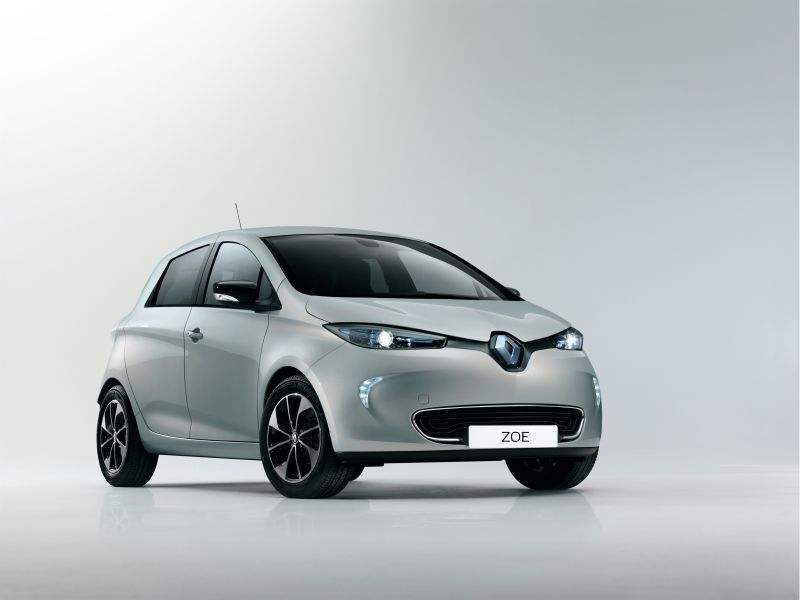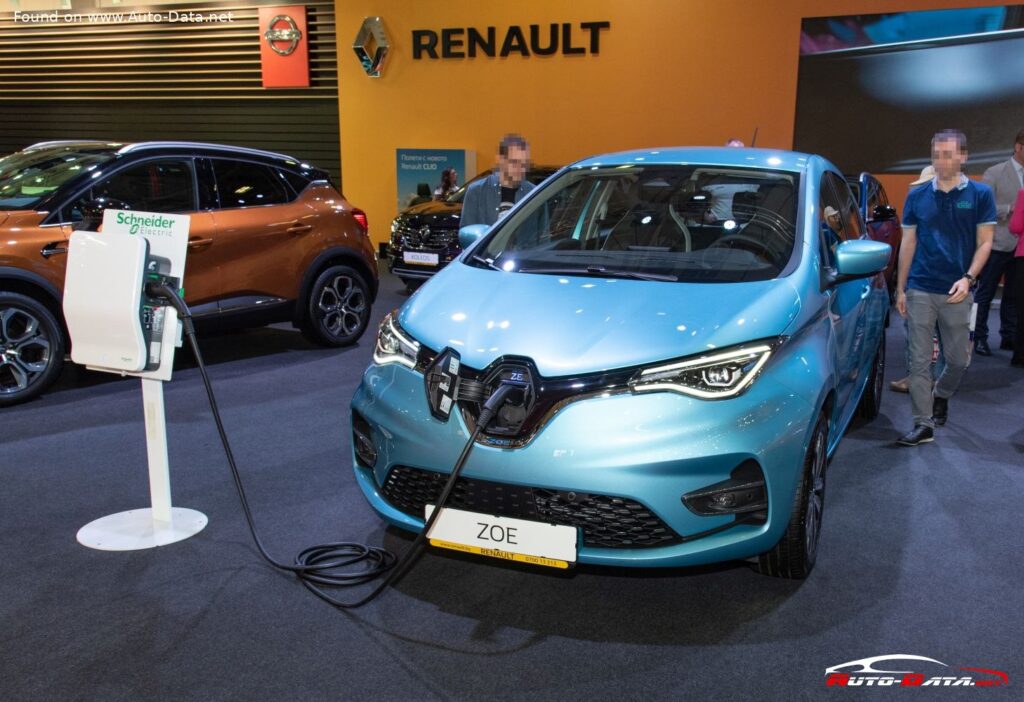
The Renault Zoe is a supermini electric car produced by the French manufacturer Renault. Introduced in 2012, the Zoe was Renault’s first mass-market all-electric vehicle and played a significant role in popularizing electric mobility in Europe. The Zoe I, representing the first generation, underwent several revisions, with the Phase II update in 2019 bringing notable improvements to range, power, and features. This version, specifically the R110 52 kWh model producing 108 horsepower, was a key offering in Renault’s electric lineup until production ceased in March 2024. While not officially sold in the United States, the Zoe represents a crucial step in the development and adoption of electric vehicles globally.
Renault Zoe I (Phase II, 2019) R110: An Overview
The Zoe I (Phase II) R110 52 kWh is a front-wheel-drive, five-door hatchback designed primarily for urban and suburban commuting. It distinguishes itself as a Battery Electric Vehicle (BEV), meaning it relies solely on electricity for propulsion. The Phase II update focused on increasing the vehicle’s real-world usability, addressing earlier criticisms regarding range anxiety and performance. The R110 designation refers to the motor’s power output, while the 52 kWh indicates the usable capacity of the lithium-ion battery pack. The Zoe’s compact size and zero-emission operation made it a popular choice in densely populated European cities with increasing environmental regulations.
Engine & Performance
The Renault Zoe R110 is powered by a single electric motor, model 5AQ 60, producing 108 horsepower at between 3395 and 10886 rpm, and 225 Nm (165.95 lb.-ft.) of torque available from 500 to 3395 rpm. This electric motor drives the front wheels through a single-speed automatic transmission. Acceleration from 0 to 100 km/h (0-62 mph) takes 11.4 seconds, while 0 to 60 mph is achieved in approximately 10.8 seconds. The vehicle has a maximum speed of 135 km/h (83.89 mph). The weight-to-power ratio is 13.9 kg/Hp, or 71.9 Hp/tonne, and the weight-to-torque ratio is 6.7 kg/Nm, or 149.8 Nm/tonne. The 52 kWh lithium-ion battery, located under the floor, provides a WLTP-certified all-electric range of up to 395 km (245.44 miles), with a realistic range typically falling between 240-375 km (149.13 – 233.01 miles) depending on driving conditions.
Design & Features
The Zoe I (Phase II) maintains the hatchback body style of its predecessor, offering a practical and space-efficient design. It seats five passengers and provides 338 liters (11.94 cu. ft.) of trunk space, expandable to 1225 liters (43.26 cu. ft.) with the rear seats folded down. The exterior design received subtle updates in the Phase II revision, including revised headlights and a more prominent Renault logo. Inside, the Zoe features a minimalist dashboard layout with a focus on digital displays. Key features include regenerative braking, which helps to recapture energy during deceleration, and various driver assistance systems such as ABS (Anti-lock Braking System). The vehicle’s low center of gravity, due to the battery pack’s placement, contributes to stable handling. The Zoe’s design prioritizes functionality and efficiency, reflecting its role as a city-focused electric vehicle.
Safety and Technology
The 2019 Zoe I (Phase II) incorporated several safety features, including ABS, and electronic stability control. While not achieving top ratings in all independent safety assessments, the Zoe offered a reasonable level of protection for its occupants. The vehicle’s technology focused heavily on maximizing range and convenience. The energy consumption is rated at 17.2 kWh/100 km (27.68 kWh/100 mi), equating to 122 MPGe, 5.8 km/kWh, or 3.6 mi/kWh. Charging is facilitated through standard charging ports. The interior features a digital instrument cluster and a touchscreen infotainment system, providing access to navigation, entertainment, and vehicle settings.
Technical Specifications
| Brand | Renault |
| Model | Zoe |
| Generation | Zoe I (Phase II, 2019) |
| Type (Engine) | R110 52 kWh (108 Hp) Electric |
| Start of production | September, 2019 |
| End of production | March, 2024 |
| Powertrain Architecture | BEV (Electric Vehicle) |
| Body type | Hatchback |
| Seats | 5 |
| Doors | 5 |
| Fuel Type | Electricity |
| Acceleration 0 – 100 km/h | 11.4 sec |
| Acceleration 0 – 62 mph | 11.4 sec |
| Acceleration 0 – 60 mph | 10.8 sec |
| Maximum speed | 135 km/h (83.89 mph) |
| Weight-to-power ratio | 13.9 kg/Hp, 71.9 Hp/tonne |
| Weight-to-torque ratio | 6.7 kg/Nm, 149.8 Nm/tonne |
| Gross battery capacity | 52 kWh |
| Battery voltage | 400 V |
| Battery technology | Lithium-ion (Li-Ion) |
| Battery weight | 326 kg (718.71 lbs.) |
| Battery location | Below the floor |
| All-electric range (WLTP) | 395 km (245.44 mi) |
| All-electric range | 240-375 km (149.13 – 233.01 mi) |
| Average Energy consumption (WLTP) | 17.2 kWh/100 km (27.68 kWh/100 mi) |
| Electric motor power | 108 Hp @ 3395-10886 rpm |
| Electric motor Torque | 225 Nm (165.95 lb.-ft.) @ 500-3395 rpm |
| Electric motor model/code | 5AQ 60 |
| Electric motor location | Front, Transverse |
| System power | 108 Hp @ 3395-10886 rpm |
| System torque | 225 Nm (165.95 lb.-ft.) @ 500-3395 rpm |
| Kerb Weight | 1502 kg (3311.34 lbs.) |
| Max. weight | 1988 kg (4382.79 lbs.) |
| Max load | 486 kg (1071.45 lbs.) |
| Trunk (boot) space – minimum | 338 l (11.94 cu. ft.) |
| Trunk (boot) space – maximum | 1225 l (43.26 cu. ft.) |
| Length | 4084 mm (160.79 in.) |
| Width | 1730 mm (68.11 in.) |
| Width including mirrors | 1945 mm (76.57 in.) |
| Height | 1562 mm (61.5 in.) |
| Wheelbase | 2588 mm (101.89 in.) |
| Front track | 1506 mm (59.29 in.) |
| Rear (Back) track | 1489 mm (58.62 in.) |
| Ride height (ground clearance) | 120 mm (4.72 in.) |
| Minimum turning circle (turning diameter) | 10.56 m (34.65 ft.) |
| Drivetrain Architecture | One electric motor drives the front wheels. |
| Drive wheel | Front wheel drive |
| Number of gears and type of gearbox | 1 gears, automatic transmission |
| Front brakes | Ventilated discs, 280 mm |
| Rear brakes | Ventilated discs, 260 mm |
| Steering type | Steering rack and pinion |
| Power steering | Electric Steering |
| Tires size | Front wheel tires: 185/65 R15 92T; 195/55 R16 91T; 215/45 R17 91V Rear wheel tires: 205/45 R17 88V |
| Wheel rims size | Front wheel rims: 15; 16; 17 Rear wheel rims: 17 |