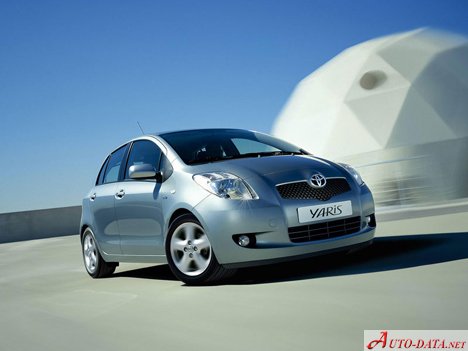
The Toyota Yaris II 1.3 i VVT-i (87 Hp), produced between 2005 and 2008, represents the second generation of Toyota’s globally successful supermini. While not initially a major seller in the United States – the Yaris didn’t gain significant traction in the US market until later iterations – the Yaris II was a crucial model for Toyota in Europe and other international markets. It offered a practical, fuel-efficient, and reliable option in the highly competitive small car segment, appealing to urban drivers and those seeking economical transportation. This generation marked a significant step forward in terms of design, safety, and refinement compared to its predecessor.
Toyota Yaris II: An Overview
The Yaris II, known as the XP90 chassis code, was designed to appeal to a broader audience than the first generation. Toyota focused on creating a more sophisticated and stylish vehicle while maintaining the Yaris’s core strengths: affordability, fuel efficiency, and dependability. The 1.3 i VVT-i model, equipped with the 2SZ-FE engine, was a popular choice due to its balance of performance and economy. It served as an entry point into the Yaris range, offering a cost-effective solution for everyday commuting and city driving.
Engine & Performance
The heart of the Yaris II 1.3 i VVT-i is the 2SZ-FE 1.3-liter inline-four cylinder gasoline engine. This naturally aspirated engine produces 87 horsepower at 6000 rpm and 121 Nm (89.25 lb-ft) of torque at 4200 rpm. While not a performance powerhouse, the engine provides adequate power for urban driving and reasonable performance on open roads. The engine’s Variable Valve Timing-intelligent (VVT-i) system optimizes valve timing for improved fuel efficiency and responsiveness. Acceleration from 0 to 100 km/h (0-62 mph) takes approximately 11.5 seconds, and it reaches a top speed of 170 km/h (105.63 mph). The engine is paired with a five-speed manual transmission, delivering power to the front wheels. The weight-to-power ratio of 11.6 kg/Hp and weight-to-torque ratio of 8.3 kg/Nm contribute to its relatively nimble handling.
Design & Features
The Yaris II adopted a more contemporary and rounded design compared to the first generation. The hatchback body style provides a practical and versatile layout, offering ample space for passengers and cargo. The interior was designed with functionality in mind, featuring a straightforward dashboard layout and durable materials. The Yaris II prioritized safety, incorporating features such as Anti-lock Braking System (ABS) as standard equipment. The interior offers seating for five passengers, and the rear seats can be folded down to increase cargo capacity. The trunk space ranges from 272 liters (9.61 cu. ft.) with the rear seats up to 1086 liters (38.35 cu. ft.) with the rear seats folded. The vehicle’s compact dimensions – a length of 3750 mm (147.64 in.) and a width of 1695 mm (66.73 in.) – make it easy to maneuver in tight urban environments.
Technical Specifications
| Brand | Toyota |
| Model | Yaris |
| Generation | Yaris II |
| Type (Engine) | 1.3 i VVT-i (87 Hp) |
| Start of production | 2005 |
| End of production | 2008 |
| Powertrain Architecture | Internal Combustion engine |
| Body type | Hatchback |
| Seats | 5 |
| Doors | 5 |
| Fuel consumption (urban) | 7.2 l/100 km (32.7 US mpg) |
| Fuel consumption (extra urban) | 5.3 l/100 km (44.4 US mpg) |
| Fuel consumption (combined) | 6 l/100 km (39.2 US mpg) |
| Fuel Type | Petrol (Gasoline) |
| Acceleration 0 – 100 km/h | 11.5 sec |
| Acceleration 0 – 62 mph | 11.5 sec |
| Acceleration 0 – 60 mph | 10.9 sec |
| Maximum speed | 170 km/h (105.63 mph) |
| Weight-to-power ratio | 11.6 kg/Hp |
| Weight-to-torque ratio | 8.3 kg/Nm |
| Power | 87 Hp @ 6000 rpm |
| Torque | 121 Nm @ 4200 rpm (89.25 lb.-ft. @ 4200 rpm) |
| Engine layout | Front, Transverse |
| Engine Model/Code | 2SZ-FE |
| Engine displacement | 1296 cm3 (79.09 cu. in.) |
| Number of cylinders | 4 |
| Engine configuration | Inline |
| Cylinder Bore | 72 mm (2.83 in.) |
| Piston Stroke | 79.6 mm (3.13 in.) |
| Compression ratio | 11:1 |
| Number of valves per cylinder | 4 |
| Fuel injection system | Multi-port manifold injection |
| Engine aspiration | Naturally aspirated engine |
| Valvetrain | DOHC |
| Engine oil capacity | 3.2 l (3.38 US qt | 2.82 UK qt) |
| Coolant | 5.1 l (5.39 US qt | 4.49 UK qt) |
| Kerb Weight | 1010 kg (2226.67 lbs.) |
| Max. weight | 1480 kg (3262.84 lbs.) |
| Max load | 470 kg (1036.17 lbs.) |
| Trunk (boot) space – minimum | 272 l (9.61 cu. ft.) |
| Trunk (boot) space – maximum | 1086 l (38.35 cu. ft.) |
| Fuel tank capacity | 42 l (11.1 US gal | 9.24 UK gal) |
| Length | 3750 mm (147.64 in.) |
| Width | 1695 mm (66.73 in.) |
| Height | 1530 mm (60.24 in.) |
| Wheelbase | 2460 mm (96.85 in.) |
| Front track | 1475 mm (58.07 in.) |
| Rear (Back) track | 1460 mm (57.48 in.) |
| Minimum turning circle | 9.4 m (30.84 ft.) |
| Drivetrain Architecture | Front wheel drive |
| Number of gears | 5 gears, manual transmission |
| Front suspension | Spring Strut |
| Rear suspension | Torsion |
| Front brakes | Ventilated discs |
| Rear brakes | Drum |
| Assisting systems | ABS (Anti-lock braking system) |
| Steering type | Steering rack and pinion |
| Tires size | 185/60 R15 |
| Wheel rims size | 15 |
The Toyota Yaris II 1.3 i VVT-i offered a compelling package for buyers seeking a reliable, economical, and practical small car. Its success in European and Asian markets solidified the Yaris’s reputation as a leader in the supermini segment, paving the way for subsequent generations to build upon its strengths and expand its global reach.