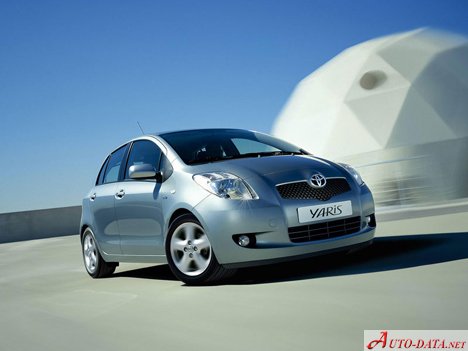
The Toyota Yaris II, produced from 2005 to 2011 (with the 1.33 VVT-i model running from 2009-2010), represents the second generation of Toyota’s globally successful supermini. While not initially a major seller in the United States – Toyota did not officially offer the Yaris II in the US market – it was a hugely important vehicle in Europe, Asia, and other parts of the world. Positioned as a competitor to the Ford Fiesta, Volkswagen Polo, and Renault Clio, the Yaris II focused on maximizing interior space within a compact footprint, offering fuel efficiency, and providing a practical and affordable transportation solution. The 1.33 VVT-i variant, producing 101 horsepower, was a popular choice for buyers seeking a balance between economy and performance.
Toyota Yaris II 1.33 VVT-i: An Overview
The Yaris II marked a significant step forward in design and engineering compared to its predecessor. It featured a more refined interior, improved ride quality, and a wider range of available features. The 1.33 VVT-i engine, a key component of the lineup, was designed to deliver responsive performance while maintaining excellent fuel economy. The Yaris II was available in both 3-door and 5-door body styles, catering to different customer preferences. Its compact size made it ideal for navigating crowded city streets and parking in tight spaces.
Engine & Performance
The heart of the Yaris II 1.33 VVT-i is the 1NR-FE 1.3-liter inline-four cylinder gasoline engine. This naturally aspirated engine utilizes Toyota’s Variable Valve Timing-intelligent (VVT-i) technology to optimize engine performance across the rev range. Producing 101 horsepower at 6000 rpm and 97.36 lb.-ft. of torque at 4000 rpm, the engine provides adequate power for everyday driving. The power-to-litre ratio is a respectable 76 hp/l. Acceleration from 0 to 60 mph takes approximately 11.1 seconds, while 0-100 km/h is achieved in 11.7 seconds. The Yaris II 1.33 VVT-i has a top speed of 108.74 mph (175 km/h). The engine is paired with a 6-speed manual transmission, providing drivers with precise control over gear selection. Fuel economy is a strong point, with combined fuel consumption rated at 44.4 US mpg (5.3 l/100 km). Urban driving yields 35.6 US mpg (6.6 l/100 km), while extra-urban driving achieves 51.1 US mpg (4.6 l/100 km).
Design & Features
The Yaris II features a distinctive hatchback body style, available in both 3-door and 5-door configurations. The design prioritizes practicality and space efficiency. The interior is designed to be user-friendly and comfortable, with a focus on maximizing space for passengers and cargo. While not overtly luxurious, the Yaris II offered a reasonable level of equipment for its price point. Safety features included ABS (Anti-lock Braking System) as standard, contributing to improved braking performance and stability. The Yaris II’s compact dimensions – a length of 149.02 inches (3785 mm), a width of 66.73 inches (1695 mm), and a height of 60.24 inches (1530 mm) – make it easy to maneuver in urban environments. The wheelbase measures 96.85 inches (2460 mm). The front and rear tracks are 57.87 inches (1470 mm) and 57.48 inches (1460 mm) respectively. The minimum turning circle is 30.84 feet (9.4 meters).
Technical Specifications
| Brand | Toyota |
| Model | Yaris |
| Generation | Yaris II |
| Type (Engine) | 1.33 VVT-i (101 Hp) |
| Start of production | 2009 |
| End of production | 2010 |
| Powertrain Architecture | Internal Combustion engine |
| Body type | Hatchback |
| Seats | 5 |
| Doors | 3/5 |
| Fuel consumption (urban) | 6.6 l/100 km (35.6 US mpg) |
| Fuel consumption (extra urban) | 4.6 l/100 km (51.1 US mpg) |
| Fuel consumption (combined) | 5.3 l/100 km (44.4 US mpg) |
| Fuel Type | Petrol (Gasoline) |
| Acceleration 0 – 100 km/h | 11.7 sec |
| Acceleration 0 – 62 mph | 11.7 sec |
| Acceleration 0 – 60 mph | 11.1 sec |
| Maximum speed | 175 km/h (108.74 mph) |
| Emission standard | Euro 4 |
| Power | 101 Hp @ 6000 rpm |
| Torque | 132 Nm @ 4000 rpm (97.36 lb.-ft. @ 4000 rpm) |
| Engine layout | Front, Transverse |
| Engine Model/Code | 1NR-FE |
| Engine displacement | 1329 cm3 (81.1 cu. in.) |
| Number of cylinders | 4 |
| Engine configuration | Inline |
| Cylinder Bore | 72.5 mm (2.85 in.) |
| Piston Stroke | 80.5 mm (3.17 in.) |
| Compression ratio | 11.5:1 |
| Number of valves per cylinder | 4 |
| Fuel injection system | Multi-port manifold injection |
| Engine aspiration | Naturally aspirated engine |
| Valvetrain | DOHC |
| Engine oil capacity | 3.4 l (3.59 US qt | 2.99 UK qt) |
| Coolant | 4.1 l (4.33 US qt | 3.61 UK qt) |
| Length | 3785 mm (149.02 in.) |
| Width | 1695 mm (66.73 in.) |
| Height | 1530 mm (60.24 in.) |
| Wheelbase | 2460 mm (96.85 in.) |
| Front track | 1470 mm (57.87 in.) |
| Rear track | 1460 mm (57.48 in.) |
| Minimum turning circle | 9.4 m (30.84 ft.) |
| Drivetrain Architecture | Front wheel drive |
| Number of gears | 6 gears, manual transmission |
| Front suspension | Independent, type McPherson with coil spring and anti-roll bar |
| Rear suspension | Independent multi-link spring suspension with stabilizer |
| Front brakes | Ventilated discs |
| Rear brakes | Drum |
| Assisting systems | ABS (Anti-lock braking system) |
| Steering type | Steering rack and pinion |
| Power steering | Electric Steering |
| Tires size | 185/60 R15 |
The Toyota Yaris II 1.33 VVT-i, while not sold in the US, remains a significant example of Toyota’s commitment to building efficient, reliable, and practical vehicles for the global market. Its blend of fuel economy, compact size, and reasonable performance made it a popular choice for drivers in Europe and Asia, solidifying the Yaris’s reputation as a leading supermini.