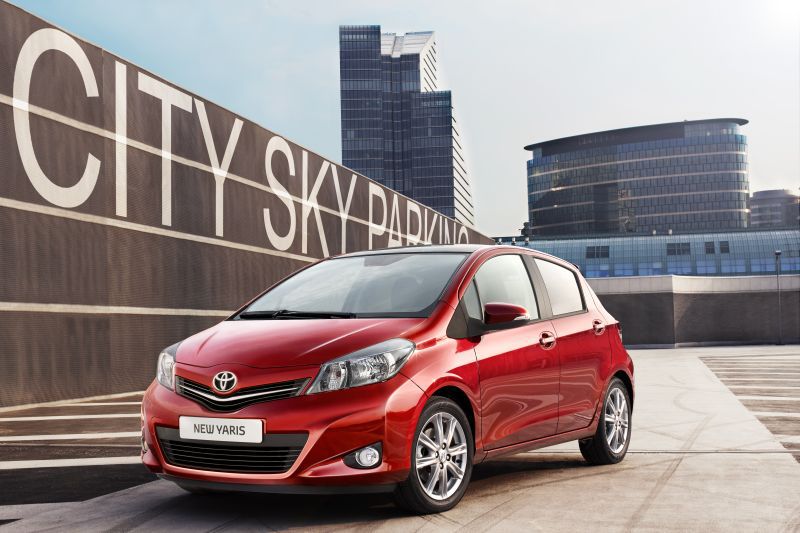
The Toyota Yaris III, produced from 2011 to 2014, represents the third generation of Toyota’s globally successful supermini. While not initially a major seller in the United States – the Yaris was discontinued in the US after 2020 – it was a cornerstone of Toyota’s European lineup, known for its fuel efficiency, practicality, and reliability. This generation Yaris offered a significant step forward in design, interior quality, and technology compared to its predecessors, aiming to compete effectively with rivals like the Volkswagen Polo, Ford Fiesta, and Renault Clio. The 1.33 Dual VVT-i model, producing 99 horsepower, was a popular choice for buyers seeking a balance between economy and performance.
Toyota Yaris III 1.33 Dual VVT-i: An Overview
The Yaris III was designed with a focus on maximizing interior space within a compact footprint. It’s a five-door hatchback, offering seating for five passengers. The 1.33 Dual VVT-i variant specifically targeted urban drivers and those prioritizing fuel economy. The “Dual VVT-i” designation refers to Toyota’s Variable Valve Timing-intelligent system, applied to both the intake and exhaust valves, optimizing engine performance and efficiency across a wider range of engine speeds. This model year saw improvements in safety features and a more refined driving experience compared to earlier Yaris generations.
Engine & Performance
The heart of the Yaris III 1.33 Dual VVT-i is the 1NR-FE 1.329-liter (81.1 cubic inches) inline four-cylinder gasoline engine. This naturally aspirated engine produces 99 horsepower at 6000 rpm and 125 Nm (92.2 lb.-ft.) of torque at 4000 rpm. While not a performance-oriented engine, it provides adequate power for everyday driving. The engine’s power-to-weight ratio is 11 kg/Hp, and the torque-to-weight ratio is 8.7 kg/Nm. Acceleration from 0 to 100 km/h (0-62 mph) takes 11.7 seconds, and 0 to 60 mph is achieved in approximately 11.1 seconds. The Yaris III 1.33 has a maximum speed of 175 km/h (108.74 mph). The engine is paired with a six-speed manual transmission, contributing to its fuel efficiency. The engine utilizes multi-port fuel injection and a double overhead camshaft (DOHC) valvetrain.
Design & Features
The Yaris III adopted a more contemporary and visually appealing design compared to the second generation. The exterior features a rounded hatchback silhouette with a distinctive front grille and headlight design. Inside, the cabin was redesigned with improved materials and a more ergonomic layout. The 1.33 Dual VVT-i model typically included features such as air conditioning, power steering, electric front windows, and a basic audio system. Safety features, crucial for this generation, included Anti-lock Braking System (ABS) as standard. The Yaris III prioritizes practicality with a trunk (boot) space of 286 liters (10.1 cubic feet) – expandable with the rear seats folded down. The vehicle’s kerb weight is 1090 kg (2403.04 lbs), with a maximum permissible weight of 1470 kg (3240.8 lbs). The Yaris III’s compact dimensions – a length of 3885 mm (152.95 in) and a width of 1695 mm (66.73 in) – make it easy to maneuver in urban environments.
Technical Specifications
| Brand | Toyota |
| Model | Yaris |
| Generation | Yaris III |
| Type (Engine) | 1.33 Dual VVT-i (99 Hp) |
| Start of production | 2011 |
| End of production | 2014 |
| Powertrain Architecture | Internal Combustion engine |
| Body type | Hatchback |
| Seats | 5 |
| Doors | 5 |
| Fuel consumption (urban) | 6.8 l/100 km (34.6 US mpg, 41.5 UK mpg, 14.7 km/l) |
| Fuel consumption (extra urban) | 4.7 l/100 km (50 US mpg, 60.1 UK mpg, 21.3 km/l) |
| Fuel consumption (combined) | 5.5 l/100 km (42.8 US mpg, 51.4 UK mpg, 18.2 km/l) |
| CO2 emissions | 127 g/km |
| Fuel Type | Petrol (Gasoline) |
| Acceleration 0 – 100 km/h | 11.7 sec |
| Acceleration 0 – 62 mph | 11.7 sec |
| Acceleration 0 – 60 mph | 11.1 sec |
| Maximum speed | 175 km/h (108.74 mph) |
| Emission standard | Euro 5 |
| Weight-to-power ratio | 11 kg/Hp |
| Weight-to-torque ratio | 8.7 kg/Nm |
| Power | 99 Hp @ 6000 rpm |
| Torque | 125 Nm @ 4000 rpm (92.2 lb.-ft. @ 4000 rpm) |
| Engine layout | Front, Transverse |
| Engine Model/Code | 1NR-FE |
| Engine displacement | 1329 cm3 (81.1 cu. in.) |
| Number of cylinders | 4 |
| Engine configuration | Inline |
| Cylinder Bore | 72.5 mm (2.85 in.) |
| Piston Stroke | 80.5 mm (3.17 in.) |
| Compression ratio | 11.5:1 |
| Number of valves per cylinder | 4 |
| Fuel injection system | Multi-port manifold injection |
| Engine aspiration | Naturally aspirated engine |
| Valvetrain | DOHC |
| Engine oil capacity | 3.4 l (3.59 US qt | 2.99 UK qt) |
| Coolant capacity | 4.6 l (4.86 US qt | 4.05 UK qt) |
| Kerb Weight | 1090 kg (2403.04 lbs.) |
| Max. weight | 1470 kg (3240.8 lbs.) |
| Max load | 380 kg (837.76 lbs.) |
| Trunk (boot) space – minimum | 286 l (10.1 cu. ft.) |
| Fuel tank capacity | 42 l (11.1 US gal | 9.24 UK gal) |
| Max. roof load | 50 kg (110.23 lbs.) |
| Permitted trailer load with brakes (12%) | 900 kg (1984.16 lbs.) |
| Permitted trailer load without brakes | 550 kg (1212.54 lbs.) |
| Permitted towbar download | 50 kg (110.23 lbs.) |
| Length | 3885 mm (152.95 in.) |
| Width | 1695 mm (66.73 in.) |
| Height | 1510 mm (59.45 in.) |
| Wheelbase | 2510 mm (98.82 in.) |
| Front track | 1460 mm (57.48 in.) |
| Rear (Back) track | 1445 mm (56.89 in.) |
| Minimum turning circle (turning diameter) | 9.4 m (30.84 ft.) |
| Drive wheel | Front wheel drive |
| Number of gears and type of gearbox | 6 gears, manual transmission |
| Front suspension | Independent type McPherson |
| Rear suspension | Torsion |
| Front brakes | Ventilated discs |
| Rear brakes | Drum |
| Assisting systems | ABS (Anti-lock braking system) |
| Steering type | Steering rack and pinion |
| Tires size | 195/50 R16 |
| Wheel rims size | 16 |