
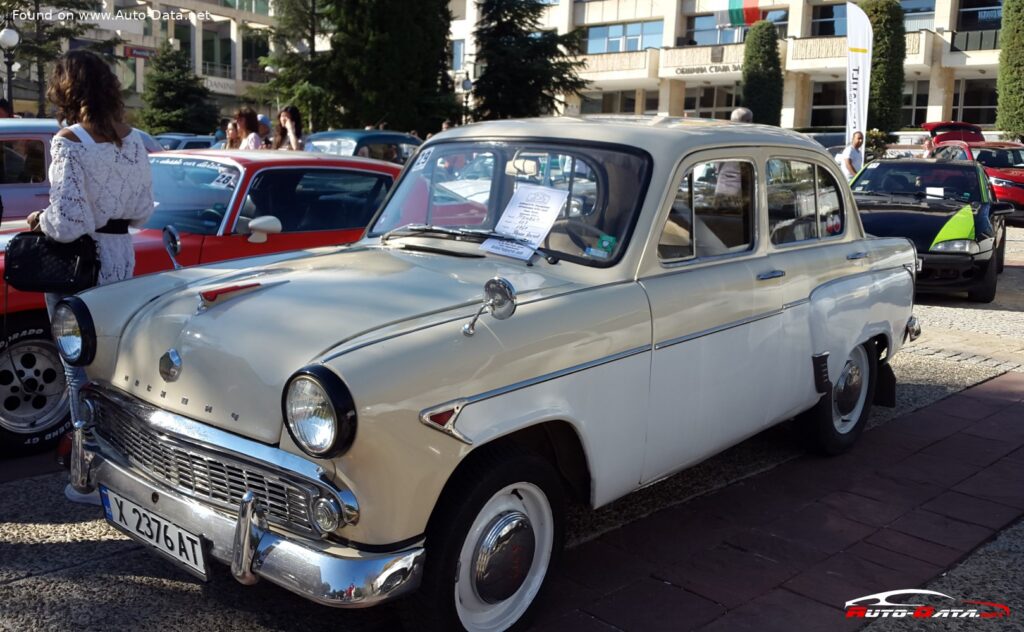
The Moskvich 407 was a Soviet-built sedan produced from 1958 to 1963, representing a significant step forward in post-war automotive design and production within the Eastern Bloc. Positioned as a family car, the 407 aimed to provide reliable transportation for the burgeoning Soviet middle class. While never officially exported to the United States, the Moskvich 407 holds a notable place in automotive history as a symbol of Soviet engineering and a key vehicle in the modernization of personal transport in the USSR and its satellite states. The 407 was a direct development of the earlier Moskvich 402, incorporating numerous improvements in styling, mechanics, and overall refinement.
Moskvich 407: A Soviet Automotive Milestone
The Moskvich 407 was manufactured by the Moscow Automobile Plant (Moskvitch), and it quickly became one of the most popular cars in the Soviet Union. It filled a crucial niche, offering a relatively affordable and practical vehicle for everyday use. The car’s design reflected influences from both Western and Soviet automotive trends of the era, resulting in a distinctive aesthetic. The 407 was more than just a mode of transportation; it was a status symbol and a reflection of the aspirations of Soviet citizens during a period of social and economic change.
Engine & Performance
The Moskvich 407 was powered by a 1.4-liter (82.99 cubic inches) inline-four cylinder engine. This engine produced 45 horsepower at 4500 rpm and 88 Nm (64.91 lb-ft) of torque at 2600 rpm. While these figures may seem modest by modern standards, they were competitive for vehicles of its class and era. The engine featured a 7:1 compression ratio and utilized a carburetor fuel injection system. The engine was longitudinally mounted at the front of the vehicle, driving the rear wheels. The car’s performance was adequate for its intended purpose, with a maximum speed of approximately 115 km/h (71.46 mph). The weight-to-power ratio was 20.2 kg/Hp, and the weight-to-torque ratio was 10.3 kg/Nm. The 407 featured a four-speed manual transmission.
Design & Features
The Moskvich 407 was a four-door sedan with a relatively spacious interior for its size, accommodating four passengers comfortably. Its body design was characterized by rounded lines, a prominent grille, and integrated headlights. Styling cues borrowed from contemporary American and European designs were evident, though adapted to Soviet manufacturing capabilities. Interior appointments were basic but functional, reflecting the utilitarian focus of Soviet automotive design. Features included drum brakes on all four wheels, though ABS was not available. Suspension consisted of a wishbone setup at the front and a leaf spring arrangement at the rear. The steering system employed a cone worm with recirculation balls. The car’s overall design prioritized durability and ease of maintenance over luxury or high performance. The fuel tank capacity was 35 liters (9.25 US gallons).
Technical Specifications
| Brand | Moskvich |
| Model | 407 |
| Generation | 407 |
| Type (Engine) | 1.4 (45 Hp) |
| Start of production | 1958 |
| End of production | 1963 |
| Powertrain Architecture | Internal Combustion engine |
| Body type | Sedan |
| Seats | 4 |
| Doors | 4 |
| Fuel consumption (urban) | 10 l/100 km (23.5 US mpg, 28.2 UK mpg, 10 km/l) |
| Fuel consumption (extra urban) | 6.5 l/100 km (36.2 US mpg, 43.5 UK mpg, 15.4 km/l) |
| Fuel consumption (combined) | 8 l/100 km (29.4 US mpg, 35.3 UK mpg, 12.5 km/l) |
| Fuel Type | Petrol (Gasoline) |
| Maximum speed | 115 km/h (71.46 mph) |
| Weight-to-power ratio | 20.2 kg/Hp |
| Weight-to-torque ratio | 10.3 kg/Nm |
| Power | 45 Hp @ 4500 rpm |
| Power per litre | 33.1 Hp/l |
| Torque | 88 Nm @ 2600 rpm (64.91 lb.-ft. @ 2600 rpm) |
| Engine layout | Front, Longitudinal |
| Engine displacement | 1360 cm3 (82.99 cu. in.) |
| Number of cylinders | 4 |
| Engine configuration | Inline |
| Cylinder Bore | 76 mm (2.99 in.) |
| Piston Stroke | 75 mm (2.95 in.) |
| Compression ratio | 7:1 |
| Number of valves per cylinder | 2 |
| Fuel injection system | Carburettor |
| Engine aspiration | Naturally aspirated engine |
| Kerb Weight | 910 kg (2006.21 lbs.) |
| Max. weight | 1290 kg (2843.96 lbs.) |
| Max load | 380 kg (837.76 lbs.) |
| Fuel tank capacity | 35 l (9.25 US gal | 7.7 UK gal) |
| Length | 4055 mm (159.65 in.) |
| Width | 1540 mm (60.63 in.) |
| Height | 1560 mm (61.42 in.) |
| Wheelbase | 2370 mm (93.31 in.) |
| Front track | 1220 mm (48.03 in.) |
| Rear track | 1220 mm (48.03 in.) |
| Drivetrain Architecture | Rear wheel drive |
| Drive wheel | Rear wheel drive |
| Number of gears and type of gearbox | 4 gears, manual transmission |
| Front suspension | Wishbone |
| Rear suspension | Leaf spring |
| Front brakes | Drum |
| Rear brakes | Drum |
| Assisting systems | ABS (Anti-lock braking system) |
| Steering type | Cone worm with recirculation balls |
| Tires size | 145/80 R15 |
| Wheel rims size | 4.5K x 15 |
The Moskvich 407, while not a technological marvel, represented a significant achievement for the Soviet automotive industry. It provided a reliable and affordable means of transportation for millions of people and played a role in shaping the automotive landscape of the Eastern Bloc. Its simple design and robust construction ensured its longevity, and many examples remain in operation today, serving as a testament to its enduring quality and historical significance.
