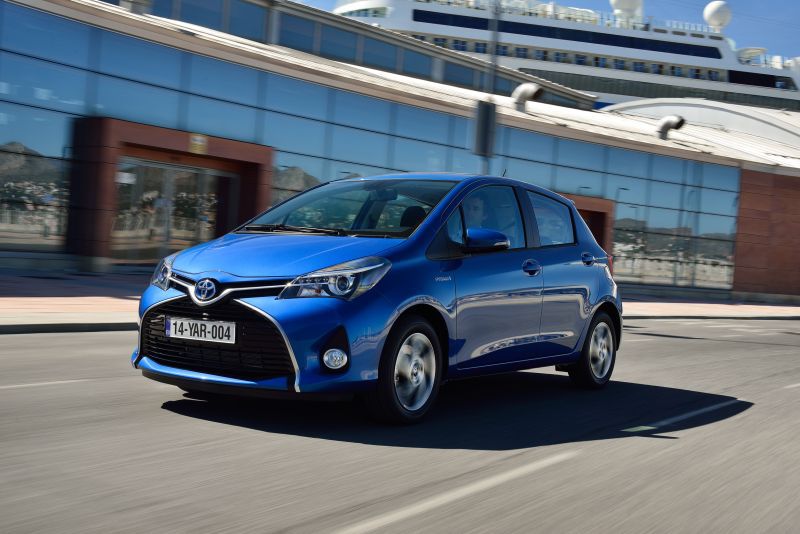
The Toyota Yaris III (facelift 2014) 1.5 Hybrid e-CVT represents a significant evolution of Toyota’s supermini, primarily aimed at the European market. While the Yaris has been sold in the United States in previous generations, this specific iteration and powertrain were not officially offered. The Yaris, known as the Echo in some early US markets, has consistently been a benchmark for fuel efficiency and compact urban mobility. The third generation, and particularly this 2014 facelift, focused heavily on refining Toyota’s Hybrid Synergy Drive system and improving overall vehicle refinement. It competes directly with other subcompact hatchbacks like the Volkswagen Polo, Renault Clio, and Ford Fiesta in Europe.
Toyota Yaris III (facelift 2014) 1.5 Hybrid: An Overview
The facelifted Yaris III, produced from 2014 to 2017, brought styling updates and further enhancements to the already efficient hybrid powertrain. This model year saw revisions to the front fascia, interior materials, and suspension tuning, all aimed at improving the driving experience and appealing to a broader customer base. The 1.5 Hybrid variant, equipped with Toyota’s e-CVT transmission, was a key offering, emphasizing fuel economy and low emissions without sacrificing everyday usability. The Yaris’s compact size makes it ideal for navigating congested city streets, while its hybrid system provides a smooth and quiet driving experience.
Engine & Performance
The heart of the Yaris III 1.5 Hybrid is a 1.5-liter, four-cylinder gasoline engine (model code 1NZ-FXE) paired with an electric motor. This powertrain utilizes Toyota’s Full Hybrid Electric Vehicle (FHEV) technology, allowing the car to operate in electric-only mode at low speeds and during certain driving conditions. The gasoline engine produces 75 horsepower at 4800 rpm and 81.87 lb-ft of torque between 3600-4400 rpm. The electric motor contributes an additional 61 horsepower and 124.65 lb-ft of torque. Combined, the system delivers a total output of 100 horsepower. The e-CVT (electronically controlled continuously variable transmission) seamlessly blends the power from both sources, providing smooth acceleration and optimized fuel efficiency. Acceleration from 0 to 60 mph takes approximately 11.2 seconds, and the car has a top speed of 102.53 mph. A key feature of this powertrain is its ability to recapture energy during braking, further enhancing fuel economy.
Design & Features
The Yaris III (facelift 2014) is a five-door hatchback, offering seating for five passengers. Its exterior design is characterized by a relatively high roofline and a compact footprint, maximizing interior space within a small overall size. The facelift brought a more assertive front grille, revised headlights, and updated bumper designs. Inside, the cabin is functional and well-built, with a focus on practicality. Standard features typically included air conditioning, power windows, a basic audio system, and ABS brakes. Safety features were also improved with the facelift, including the addition of more advanced driver-assistance systems depending on the trim level. The trunk offers 10.1 cubic feet of cargo space, which can be expanded by folding down the rear seats. The Yaris prioritizes usability and efficiency over outright luxury, making it a sensible choice for urban commuters.
Technical Specifications
| Brand | Toyota |
| Model | Yaris |
| Generation | Yaris III (facelift 2014) |
| Type (Engine) | 1.5 (100 Hp) Hybrid e-CVT |
| Start of production | 2014 |
| End of production | 2017 |
| Powertrain Architecture | FHEV (Full Hybrid Electric Vehicle) |
| Body type | Hatchback |
| Seats | 5 |
| Doors | 5 |
| Fuel consumption (urban) | 3.3-3.6 l/100 km (71.3 – 65.3 US mpg) |
| Fuel consumption (extra urban) | 3.1-3.3 l/100 km (75.9 – 71.3 US mpg) |
| Fuel consumption (combined) | 3.3-3.6 l/100 km (71.3 – 65.3 US mpg) |
| CO2 emissions | 75-82 g/km |
| Fuel Type | Petrol (Gasoline) |
| Acceleration 0 – 100 km/h | 11.8 sec |
| Acceleration 0 – 62 mph | 11.8 sec |
| Acceleration 0 – 60 mph | 11.2 sec |
| Maximum speed | 165 km/h (102.53 mph) |
| Emission standard | Euro 6 |
| Weight-to-power ratio | 10.9 kg/Hp |
| Weight-to-torque ratio | 9.8 kg/Nm |
| Gross battery capacity | 0.94 kWh |
| Battery voltage | 144 V |
| Battery technology | Nickel-metal hydride (NiMH) |
| Battery location | Under the rear seats |
| Electric motor power | 61 Hp |
| Electric motor Torque | 169 Nm (124.65 lb.-ft.) |
| System power | 100 Hp |
| System torque | 111 Nm @ 3600-4400 rpm (81.87 lb.-ft. @ 3600-4400 rpm) |
| Engine Power | 75 Hp @ 4800 rpm |
| Engine Torque | 111 Nm @ 3600-4400 rpm (81.87 lb.-ft. @ 3600-4400 rpm) |
| Engine displacement | 1497 cm3 (91.35 cu. in.) |
| Number of cylinders | 4 |
| Cylinder Bore | 75 mm (2.95 in.) |
| Piston Stroke | 84.7 mm (3.33 in.) |
| Compression ratio | 13.4:1 |
| Engine oil capacity | 3.7 l (3.91 US qt | 3.26 UK qt) |
| Coolant capacity | 4.5 l (4.76 US qt | 3.96 UK qt) |
| Kerb Weight | 1085-1150 kg (2392.02 – 2535.32 lbs.) |
| Max. weight | 1565 kg (3450.23 lbs.) |
| Trunk (boot) space (minimum) | 286 l (10.1 cu. ft.) |
| Fuel tank capacity | 36 l (9.51 US gal | 7.92 UK gal) |
| Length | 3950 mm (155.51 in.) |
| Width | 1695 mm (66.73 in.) |
| Height | 1510 mm (59.45 in.) |
| Wheelbase | 2510 mm (98.82 in.) |
| Drivetrain | Front wheel drive, FHEV |
| Gearbox | e-CVT automatic |
The Toyota Yaris III (facelift 2014) 1.5 Hybrid e-CVT remains a compelling option for those seeking a fuel-efficient and reliable compact hatchback. Its hybrid powertrain, combined with its practical design and reasonable price point, made it a popular choice in the European market and a testament to Toyota’s commitment to hybrid technology.