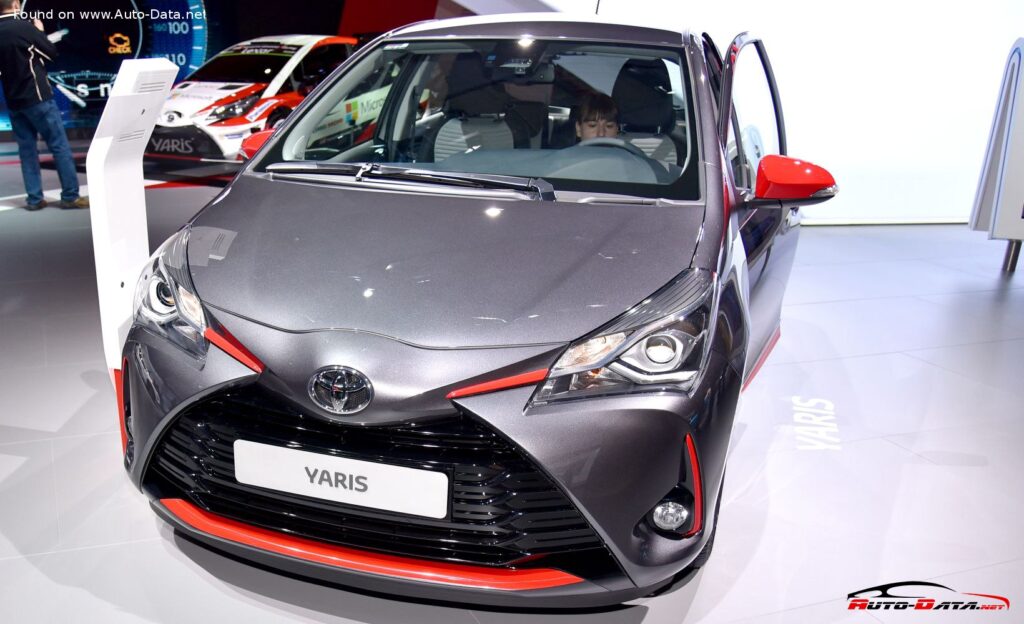
The Toyota Yaris III, particularly the facelifted version introduced in 2017, represents Toyota’s continued commitment to the subcompact hatchback segment. While the Yaris nameplate has a longer history, the third generation, produced from 2011 to 2020, saw significant changes in design and technology. The 2017 facelift brought further refinements, focusing on styling, safety features, and powertrain efficiency. This iteration of the Yaris was primarily aimed at the European market, where the demand for small, fuel-efficient vehicles is high. In the United States, Toyota offers a different, larger vehicle marketed as the Yaris, which is essentially a rebadged Mazda2. The Yaris III, however, is a distinct model designed specifically for European tastes and regulations.
Toyota Yaris III (2017 Facelift): A Detailed Overview
The Yaris III facelift of 2017 built upon the foundation of its predecessor, offering a more contemporary aesthetic and improved driving experience. The model year 2017-2018 Yaris 1.5 Dual-VVT-iE with the Multidrive S transmission is a notable variant, combining a responsive engine with a continuously variable transmission for optimal fuel economy and ease of use. This version was designed to appeal to drivers seeking a practical, reliable, and economical city car.
Engine & Performance
At the heart of the 2017 Toyota Yaris III 1.5 Dual-VVT-iE is a 1.5-liter inline four-cylinder gasoline engine, designated the 2NR-FKE. This naturally aspirated engine produces 111 horsepower (Hp) and 136 Newton-meters of torque (100.31 lb.-ft.) at 4400 rpm. The Dual-VVT-iE (Dual Variable Valve Timing-intelligent with Electric motor) system optimizes valve timing for both intake and exhaust, enhancing both power delivery and fuel efficiency. The engine’s power-to-liter ratio is a respectable 74.1 Hp/l.
Power is delivered to the front wheels via Toyota’s Multidrive S transmission, a continuously variable transmission (CVT) that simulates stepped gear changes for a more conventional driving feel. This transmission contributes to the Yaris’s fuel efficiency, allowing for smooth acceleration and optimized engine operation. Performance figures include a 0-60 mph (0-96.6 km/h) acceleration time of approximately 10.6 seconds, and a 0-62 mph (0-100 km/h) time of 11.2 seconds. The vehicle has a maximum speed of 175 km/h (108.74 mph). Fuel economy is a strong point, with combined cycle figures ranging from 4.7 to 4.8 liters per 100 kilometers (50-49 US mpg or 60.1-58.9 UK mpg).
Design & Features
The 2017 Yaris III maintains the hatchback body style, offering a practical and versatile layout. It’s a five-door vehicle with seating for five passengers. The facelift brought a revised front fascia with a more prominent grille and updated headlights, giving the car a more modern appearance. The interior features a functional design with a focus on ergonomics and usability.
Safety features were enhanced in the 2017 model, including the standard inclusion of the Toyota Safety Sense suite, which incorporates systems like Automatic Emergency Braking, Lane Departure Alert, and Road Sign Recognition. These features contribute to a safer driving experience. Other notable features include electric power steering, ventilated front disc brakes, and an anti-lock braking system (ABS). The Yaris III prioritizes practicality and efficiency, making it a well-suited vehicle for urban environments.
Technical Specifications
| Brand | Toyota |
| Model | Yaris |
| Generation | Yaris III (facelift 2017) |
| Type (Engine) | 1.5 Dual-VVT-iE (111 Hp) Multidrive S |
| Start of production | 2017 |
| End of production | 2018 |
| Powertrain Architecture | Internal Combustion engine |
| Body type | Hatchback |
| Seats | 5 |
| Doors | 5 |
| Fuel consumption (urban) | 5.9-6.0 l/100 km (39.9 – 39.2 US mpg) |
| Fuel consumption (extra urban) | 4.0-4.1 l/100 km (58.8 – 57.4 US mpg) |
| Fuel consumption (combined) | 4.7-4.8 l/100 km (50 – 49 US mpg) |
| CO2 emissions | 109-112 g/km |
| Fuel Type | Petrol (Gasoline) |
| Acceleration 0 – 100 km/h | 11.2 sec |
| Acceleration 0 – 62 mph | 11.2 sec |
| Acceleration 0 – 60 mph | 10.6 sec |
| Maximum speed | 175 km/h (108.74 mph) |
| Emission standard | Euro 6 |
| Power | 111 Hp |
| Power per litre | 74.1 Hp/l |
| Torque | 136 Nm @ 4400 rpm (100.31 lb.-ft. @ 4400 rpm) |
| Engine layout | Front, Transverse |
| Engine Model/Code | 2NR-FKE |
| Engine displacement | 1497 cm3 (91.35 cu. in.) |
| Number of cylinders | 4 |
| Engine configuration | Inline |
| Number of valves per cylinder | 4 |
| Fuel injection system | Multi-port manifold injection |
| Engine aspiration | Naturally aspirated engine |
| Valvetrain | DOHC |
| Engine oil capacity | 3.6 l (3.8 US qt | 3.17 UK qt) |
| Coolant capacity | 5.7 l (6.02 US qt | 5.02 UK qt) |
| Length | 3945 mm (155.31 in.) |
| Width | 1695 mm (66.73 in.) |
| Height | 1510 mm (59.45 in.) |
| Drivetrain Architecture | ICE drives front wheels |
| Drive wheel | Front wheel drive |
| Number of gears and type of gearbox | automatic transmission Multidrive S |
| Front suspension | Independent, type McPherson with coil spring and anti-roll bar |
| Front brakes | Ventilated discs |
| Assisting systems | ABS (Anti-lock braking system) |
| Steering type | Steering rack and pinion |
| Power steering | Electric Steering |
The Toyota Yaris III (2017 facelift) 1.5 Dual-VVT-iE Multidrive S represents a well-rounded package for those seeking a reliable, fuel-efficient, and practical subcompact hatchback. Its combination of a responsive engine, smooth transmission, and enhanced safety features makes it a compelling choice in its segment, particularly within the European market where it was specifically designed to excel.