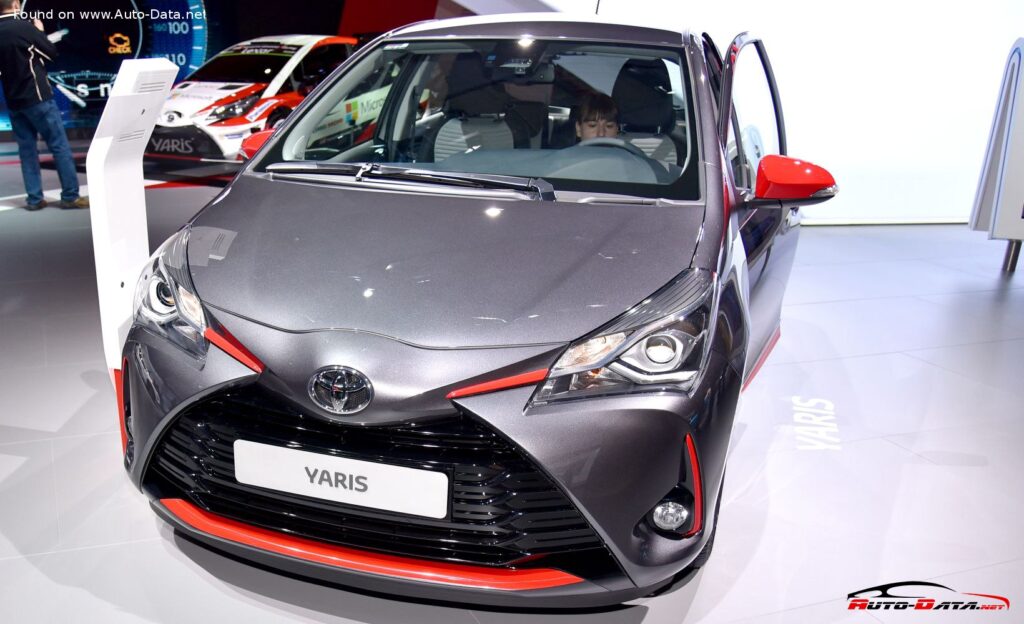
The Toyota Yaris III (facelift 2017) 1.5 VVT-i (100 Hp) Hybrid e-CVT represents a significant evolution of Toyota’s supermini, designed primarily for the European market. While the Yaris has been sold in various forms in the United States, this specific generation and powertrain were not officially offered. The Yaris, known as the Echo in some early US iterations, has consistently been a benchmark for fuel efficiency and compact urban mobility. The third generation, and particularly this 2017 facelift, focused on refining these qualities with a more sophisticated hybrid system and updated styling. It competes within the subcompact hatchback segment, facing rivals like the Volkswagen Polo, Renault Clio, and Honda Jazz (Fit in the US).
Toyota Yaris III: A Focus on Hybrid Efficiency
The Yaris III, launched in 2011 and receiving a substantial facelift in 2017, aimed to broaden the appeal of the Yaris range. The facelift brought revised front-end styling, interior enhancements, and improvements to the hybrid powertrain. Toyota positioned the Yaris as a practical, economical, and reliable choice for city driving, with the hybrid model being a key differentiator. The emphasis on fuel economy and low emissions was driven by increasingly stringent European regulations and growing consumer demand for environmentally friendly vehicles. This generation marked a move towards more advanced safety features and a more refined driving experience compared to its predecessors.
Engine & Performance
The 2017 Yaris 1.5 VVT-i Hybrid utilizes Toyota’s Hybrid Synergy Drive system, a full hybrid (FHEV) architecture. The powertrain combines a 1.5-liter, four-cylinder 1NZ-FXE gasoline engine with an electric motor. The gasoline engine produces 75 horsepower and 111 Nm (81.87 lb.-ft.) of torque at 3600-4400 rpm. The electric motor contributes an additional 61 horsepower and 169 Nm (124.65 lb.-ft.) of torque. The combined system output is 100 horsepower. Power is delivered to the front wheels via an electronically controlled continuously variable transmission (e-CVT). This transmission seamlessly blends the power from both the engine and motor, optimizing fuel efficiency and providing smooth acceleration.
Performance figures include a 0-100 km/h (0-62 mph) acceleration time of 11.8 seconds and a top speed of 165 km/h (102.53 mph). While not designed for outright speed, the hybrid system provides adequate performance for urban and highway driving. A key strength of this powertrain is its exceptional fuel economy, achieving between 3.3 and 3.6 liters per 100 kilometers (71.3 – 65.3 US mpg) on the combined cycle, with CO2 emissions ranging from 75 to 82 g/km. The electric motor draws power from a 0.94 kWh nickel-metal hydride (NiMH) battery pack located under the rear seats.
Design & Features
The Yaris III is a five-door hatchback, offering seating for five passengers. The 2017 facelift brought a more assertive front grille, redesigned headlights, and a revised bumper, giving the car a more modern appearance. The interior was also updated with improved materials and a more user-friendly infotainment system. The Yaris prioritizes practicality and space efficiency. The trunk offers 286 liters (10.1 cu. ft.) of cargo space with the rear seats up, expanding to 768 liters (27.12 cu. ft.) when the seats are folded down.
Safety features were enhanced in the facelifted model, including standard fitment of Toyota Safety Sense, a suite of active safety technologies. This included pre-collision system with autonomous emergency braking, lane departure alert, and automatic high beam. Other features included air conditioning, power windows, central locking, and an audio system. The Yaris was designed to be easy to maneuver in tight urban environments, with a compact footprint and responsive steering. The suspension utilizes a McPherson strut setup at the front and a torsion beam at the rear, providing a comfortable ride quality.
Technical Specifications
| Brand | Toyota |
| Model | Yaris |
| Generation | Yaris III (facelift 2017) |
| Type (Engine) | 1.5 VVT-i (100 Hp) Hybrid e-CVT |
| Start of production | 2017 |
| End of production | 2018 |
| Powertrain Architecture | FHEV (Full Hybrid Electric Vehicle) |
| Body type | Hatchback |
| Seats | 5 |
| Doors | 5 |
| Fuel consumption (urban) | 3.3-3.6 l/100 km (71.3 – 65.3 US mpg) |
| Fuel consumption (extra urban) | 3.1-3.3 l/100 km (75.9 – 71.3 US mpg) |
| Fuel consumption (combined) | 3.3-3.6 l/100 km (71.3 – 65.3 US mpg) |
| CO2 emissions | 75-82 g/km |
| Fuel Type | Petrol (Gasoline) |
| Acceleration 0 – 100 km/h | 11.8 sec |
| Acceleration 0 – 62 mph | 11.8 sec |
| Acceleration 0 – 60 mph | 11.2 sec |
| Maximum speed | 165 km/h (102.53 mph) |
| Emission standard | Euro 6 |
| Weight-to-power ratio | 9.8 kg/Hp |
| Weight-to-torque ratio | 8.8 kg/Nm |
| Gross battery capacity | 0.94 kWh |
| Battery voltage | 144 V |
| Battery technology | Nickel-metal hydride (NiMH) |
| Battery location | Under the rear seats |
| Electric motor power | 61 Hp |
| Electric motor Torque | 169 Nm (124.65 lb.-ft.) |
| Electric motor location | Integrated into the transmission |
| System power | 100 Hp |
| Internal combustion engine power | 75 Hp |
| Torque | 111 Nm @ 3600-4400 rpm (81.87 lb.-ft. @ 3600-4400 rpm) |
| Engine displacement | 1497 cm3 (91.35 cu. in.) |
| Number of cylinders | 4 |
| Engine oil capacity | 3.7 l (3.91 US qt | 3.26 UK qt) |
| Coolant capacity | 4.5 l (4.76 US qt | 3.96 UK qt) |
| Kerb Weight | 980-1040 kg (2160.53 – 2292.81 lbs.) |
| Max. weight | 1565 kg (3450.23 lbs.) |
| Trunk (boot) space – minimum | 286 l (10.1 cu. ft.) |
| Trunk (boot) space – maximum | 768 l (27.12 cu. ft.) |
| Fuel tank capacity | 36 l (9.51 US gal | 7.92 UK gal) |
| Length | 3945 mm (155.31 in.) |
| Width | 1695 mm (66.73 in.) |
| Height | 1510 mm (59.45 in.) |
| Wheelbase | 2510 mm (98.82 in.) |
The Toyota Yaris III (facelift 2017) 1.5 VVT-i Hybrid e-CVT remains a compelling option in the subcompact hybrid segment, particularly for drivers prioritizing fuel efficiency and reliability. Its compact size, practical interior, and advanced safety features make it well-suited for urban environments. While not a performance-oriented vehicle, its hybrid powertrain delivers a smooth and economical driving experience.