
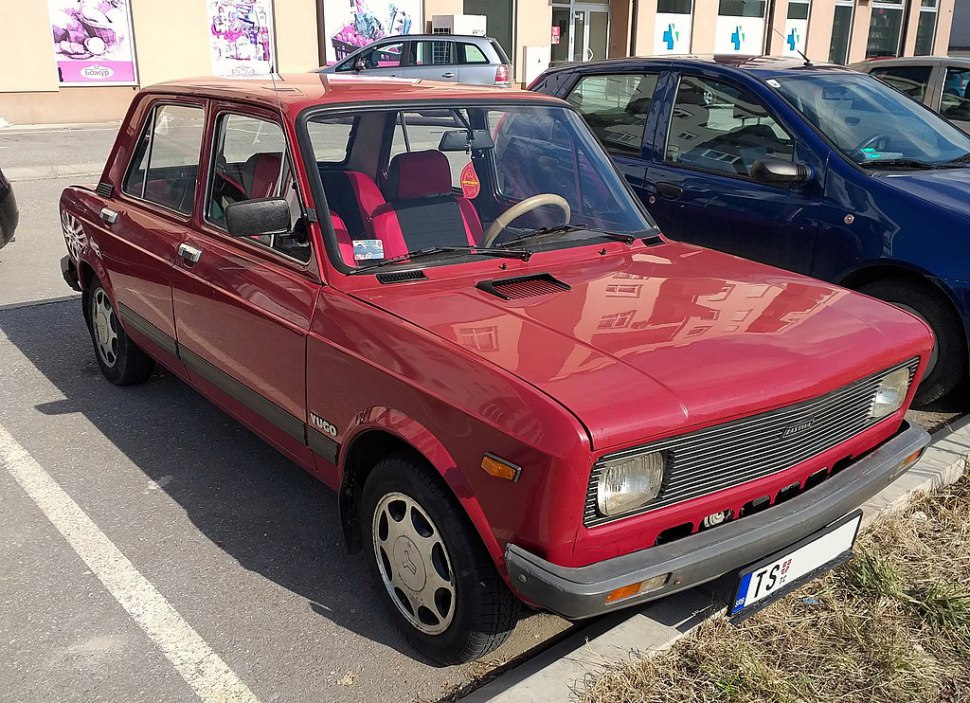
The Zastava 128 Skala 1.3, producing 65 horsepower, was a significant vehicle in the automotive landscape of Yugoslavia and, subsequently, Serbia. Produced from 1984 to 1995, the Skala represented a modernization effort by Zastava, the state-owned automotive manufacturer, building upon the foundation of the original Zastava 128. While largely unknown in North America, the 128 Skala served as a crucial affordable family car in its domestic market and export markets within Eastern Europe, offering a practical and relatively modern solution for personal transportation. It occupied the subcompact hatchback segment, competing with vehicles like the Fiat Uno and Renault 5 in its region.
Zastava 128 Skala: A Legacy of Affordability
The Zastava 128 Skala wasn’t simply a localized version of a Western European car; it was a product of licensed production and subsequent engineering adaptations. The original Zastava 128 was based on the Fiat 128, a groundbreaking design in the late 1960s known for its transverse engine and front-wheel-drive layout. The Skala, introduced in 1984, represented a substantial facelift and mechanical upgrade to the original 128, extending its production life and improving its appeal. The “Skala” designation, meaning “scale” or “dimension” in Serbian, signified the model’s updated features and broader market positioning. Throughout its production run, the Skala remained a popular choice for its reliability, ease of maintenance, and low cost of ownership.
Engine & Performance
The Zastava 128 Skala 1.3 was powered by an inline four-cylinder, naturally aspirated 1.3-liter (79.45 cubic inches) gasoline engine. This engine produced 65 horsepower at 6000 rpm and 72.28 lb.-ft. of torque at 3000 rpm. While not a performance car by any means, the engine provided adequate power for everyday driving. The power-to-weight ratio of 12.9 kg/Hp (77.4 Hp/tonne) and torque-to-weight ratio of 8.6 kg/Nm (116.7 Nm/tonne) reflected its focus on practicality rather than speed. The engine featured a carburetor fuel injection system, common for vehicles of its era and price point. The Skala’s performance figures included a 0-60 mph (0-100 km/h) acceleration time of approximately 13.5-14.2 seconds, and a top speed of around 86.99 mph (140 km/h). Power per liter was rated at 49.9 Hp/l.
Design & Features
The Zastava 128 Skala was a five-door hatchback, offering a practical body style for families and urban dwellers. Its design, while dated by modern standards, was functional and relatively streamlined for its time. The Skala’s interior was basic but offered seating for five passengers. Key features included a relatively spacious cabin for its size, a usable trunk with a minimum capacity of 11.48 cubic feet (325 liters) expandable to 35.67 cubic feet (1010 liters) with the rear seats folded down, and a fuel tank capacity of 9.51 US gallons (36 liters). Safety features were limited by the standards of the 1980s and 1990s, but later models did incorporate an Anti-lock braking system (ABS). The steering utilized a rack and pinion system, providing reasonably precise handling. The vehicle rode on 145/80 R13 tires.
Technical Specifications
| Brand | Zastava |
| Model | 128 Skala |
| Generation | 128 Skala |
| Type (Engine) | 1.3 (65 Hp) |
| Start of production | 1984 |
| End of production | 1995 |
| Powertrain Architecture | Internal Combustion engine |
| Body type | Hatchback |
| Seats | 5 |
| Doors | 5 |
| Fuel Type | Petrol (Gasoline) |
| Acceleration 0 – 100 km/h | 14.2 sec |
| Acceleration 0 – 62 mph | 14.2 sec |
| Acceleration 0 – 60 mph | 13.5 sec |
| Maximum speed | 140 km/h / 86.99 mph |
| Weight-to-power ratio | 12.9 kg/Hp, 77.4 Hp/tonne |
| Weight-to-torque ratio | 8.6 kg/Nm, 116.7 Nm/tonne |
| Power | 65 Hp @ 6000 rpm |
| Power per litre | 49.9 Hp/l |
| Torque | 98 Nm @ 3000 rpm / 72.28 lb.-ft. @ 3000 rpm |
| Engine layout | Front, Transverse |
| Engine displacement | 1302 cm3 / 79.45 cu. in. |
| Number of cylinders | 4 |
| Engine configuration | Inline |
| Cylinder Bore | 86.4 mm / 3.4 in. |
| Piston Stroke | 55.5 mm / 2.19 in. |
| Compression ratio | 9.2:1 |
| Number of valves per cylinder | 2 |
| Fuel injection system | Carburettor |
| Engine aspiration | Naturally aspirated engine |
| Kerb Weight | 840 kg / 1851.88 lbs |
| Trunk (boot) space – minimum | 325 l / 11.48 cu. ft. |
| Trunk (boot) space – maximum | 1010 l / 35.67 cu. ft. |
| Fuel tank capacity | 36 l / 9.51 US gal | 7.92 UK gal |
| Length | 3840 mm / 151.18 in. |
| Width | 1590 mm / 62.6 in. |
| Height | 1350 mm / 53.15 in. |
| Wheelbase | 2450 mm / 96.46 in. |
| Front track | 1310 mm / 51.57 in. |
| Rear (Back) track | 1315 mm / 51.77 in. |
| Drivetrain Architecture | The Internal combustion engine (ICE) drives the front wheels of the vehicle. |
| Drive wheel | Front wheel drive |
| Number of gears and type of gearbox | 5 gears, manual transmission |
| Front suspension | Coil spring |
| Rear suspension | Coil spring |
| Front brakes | Disc |
| Rear brakes | Drum |
| Assisting systems | ABS (Anti-lock braking system) |
| Steering type | Steering rack and pinion |
| Tires size | 145/80 R13 |
The Zastava 128 Skala 1.3, while not a technological marvel, played a vital role in providing affordable transportation to a wide segment of the population in Yugoslavia and beyond. Its enduring popularity is a testament to its practicality, reliability, and the enduring legacy of the Fiat 128 design upon which it was based. The Skala ultimately ceased production in 1995, marking the end of an era for Zastava and a significant chapter in the automotive history of the region.
