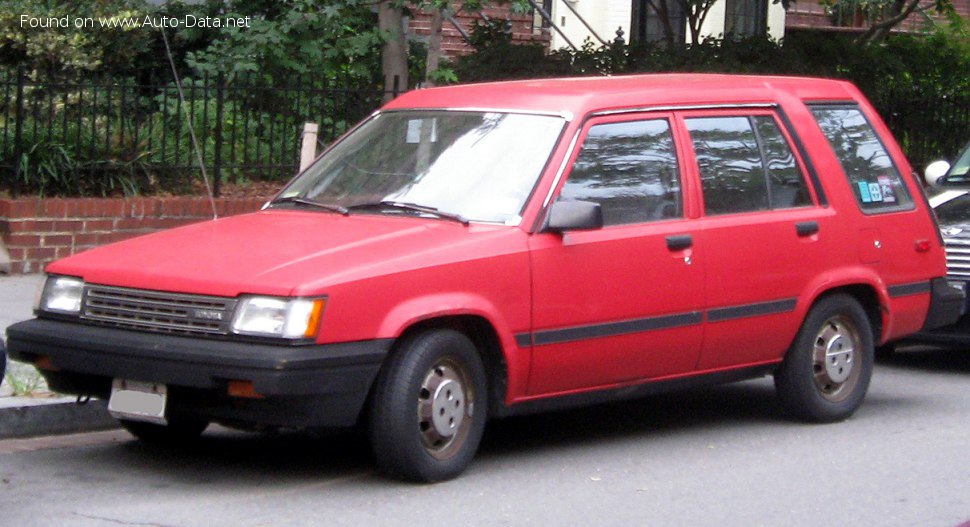
The Toyota Tercel (AL25) 1.4, particularly the 71 horsepower, four-wheel-drive variant, represents a significant entry in Toyota’s history, primarily aimed at providing affordable and reliable transportation during the early to mid-1980s. While not initially a major player in the burgeoning US compact car market, the Tercel carved a niche for itself as a practical, fuel-efficient vehicle, especially appealing to buyers seeking a small, all-weather capable wagon. The AL25 generation, produced from 1982 to 1988, was a key step in Toyota’s expansion of its global presence, demonstrating the company’s commitment to building durable and economical vehicles. This model was particularly popular in markets outside North America, where the combination of a small footprint, wagon body style, and available four-wheel drive was highly valued.
Toyota Tercel (AL25) 1.4: A Detailed Overview
The AL25 Tercel was part of a broader strategy by Toyota to offer a range of vehicles catering to diverse consumer needs. In a period marked by rising fuel costs and increasing demand for smaller cars, the Tercel provided a compelling alternative to larger, less efficient vehicles. The availability of a four-wheel-drive system, though relatively simple by modern standards, broadened its appeal to buyers in regions with inclement weather or challenging road conditions. The wagon body style, or “estate” as it was often called in European markets, maximized interior space for its compact dimensions, making it a practical choice for small families or individuals needing to transport larger items.
Engine & Performance
The heart of the AL25 Tercel 1.4 was a 1.4-liter, naturally aspirated four-cylinder gasoline engine. This engine produced 71 horsepower, which, while modest by today’s standards, was adequate for the vehicle’s light weight and intended purpose. The engine was designed for fuel efficiency and reliability rather than outright performance. It featured a simple overhead valve (OHV) configuration and a two-barrel carburetor. The four-wheel-drive system was a part-time system, meaning it could be engaged or disengaged as needed. When engaged, it provided enhanced traction on slippery surfaces, but also resulted in a slight decrease in fuel economy. The transmission options typically included a four-speed manual or a three-speed automatic. Acceleration was not a strong point, with 0 to 60 mph times estimated to be around 15-18 seconds, but the Tercel was never intended to be a performance vehicle. Its strength lay in its dependability and low running costs.
Design & Features
The AL25 Tercel’s design was functional and utilitarian, reflecting its focus on practicality and affordability. The station wagon body style offered a generous cargo area for its size, with rear seats that could be folded down to create even more space. The exterior styling was simple and boxy, typical of cars from the early 1980s. Interior appointments were basic but durable, with vinyl or cloth upholstery and minimal trim. Safety features were limited by the standards of the time, typically including seatbelts and a collapsible steering column. Air conditioning and power steering were often optional extras. The dashboard layout was straightforward, with clearly labeled controls and a simple instrument cluster. The vehicle’s relatively small size made it easy to maneuver in urban environments and park in tight spaces. The four-wheel-drive system added a degree of all-weather capability, making it a suitable choice for buyers in regions with snow or gravel roads. The AL25 Tercel wasn’t about luxury or style; it was about providing reliable and affordable transportation.
Market Position and Legacy
The Toyota Tercel, particularly the AL25 generation, played a crucial role in establishing Toyota’s reputation for quality and reliability in international markets. While it didn’t achieve the same level of popularity in the US as some of its competitors, it gained a loyal following among buyers who valued its practicality and fuel efficiency. The availability of the four-wheel-drive wagon variant further broadened its appeal, particularly in regions where all-weather capability was a priority. The AL25 Tercel paved the way for subsequent generations of the Tercel, which continued to offer affordable and reliable transportation for many years. It also helped to solidify Toyota’s position as a major player in the global automotive industry. The AL25 Tercel represents a snapshot of automotive engineering from the early 1980s, prioritizing functionality and durability over extravagance and performance.
Technical Specifications
| Brand | Toyota |
| Model | Tercel |
| Generation | Tercel (AL25) |
| Type (Engine) | 1.4 (71 Hp) 4WD |
| Start of production | 1982 |
| End of production | 1988 |
| Powertrain Architecture | Internal Combustion engine |
| Body type | Station wagon (estate) |
| Fuel Type | Petrol (Gasoline) |
| Power | 71 Hp |
| Engine aspiration | Naturally aspirated engine |