
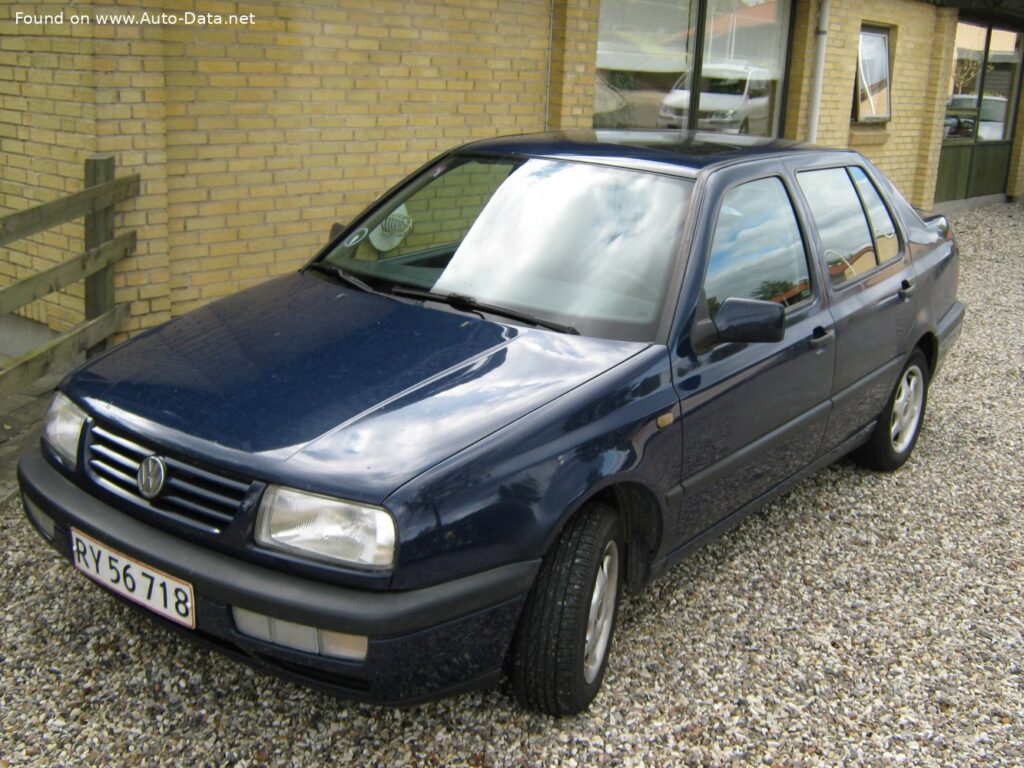
The Volkswagen Vento (1HX0), a compact sedan produced between 1992 and 1998, represents Volkswagen’s entry into the globally competitive C-segment. Sold primarily in Europe, Latin America, and Asia, the Vento was conceived as a more affordable and practical alternative to the Passat, offering a blend of German engineering and value. While not officially sold in the United States during its production run, the Vento is essentially the European-market equivalent of the Jetta III (Mk3) sold in North America. This generation marked a significant step forward for Volkswagen in terms of build quality, safety features, and overall refinement.
Development & History
The Vento was developed as a replacement for the Volkswagen Jetta II (Mk2) in 1992. It utilized the Volkswagen Group’s A2 platform, which was an evolution of the platform underpinning the Mk2 Golf and Jetta. This platform was chosen for its cost-effectiveness and proven reliability. The “1HX0” chassis code specifically designates the Vento sedan. The Vento name itself was chosen to evoke a sense of freshness and modernity, aligning with Volkswagen’s marketing strategy at the time. Production continued until 1998, when it was superseded by the New Beetle-based Bora (Mk4 Jetta in North America), which moved to the newer A4 platform. The Vento’s development focused on improving upon the Mk2 Jetta’s shortcomings, particularly in areas of interior space, safety, and handling.
Powertrain & Performance
The Vento 1.8, equipped with an automatic transmission, was a popular configuration. It featured a 1.8-liter, inline-four cylinder gasoline engine, designated as the ABS or ADZ engine code. This engine produced 90 horsepower at 5500 rpm and 145 Nm (106.95 lb-ft) of torque at 2500 rpm. The engine employed single-point fuel injection and a naturally aspirated design. Power delivery was relatively smooth, though not particularly brisk, geared towards fuel efficiency and everyday usability. The four-speed automatic transmission provided convenient operation, although it did impact acceleration times. The Vento 1.8 Automatic achieved a 0-60 mph (0-97 km/h) time of approximately 13.8 seconds and a top speed of 108.74 mph (175 km/h). Fuel economy figures were rated at 27.7 US mpg combined (8.5 l/100 km), with 21.2 US mpg (11.1 l/100 km) in urban driving and 34.1 US mpg (6.9 l/100 km) on the highway.
Chassis & Handling
The Vento’s chassis employed a front-engine, front-wheel-drive layout. The front suspension utilized a wishbone configuration, while the rear suspension featured a torsion beam setup with traction connecting levers. This combination provided a reasonable balance between ride comfort and handling. Braking duties were handled by disc brakes at the front and drum brakes at the rear. An Anti-lock Braking System (ABS) was included as a standard safety feature. The steering system was a rack and pinion type with hydraulic power assistance, offering a relatively direct and responsive feel. The Vento’s handling characteristics were generally considered safe and predictable, prioritizing stability over sporty dynamics. Tire size was typically 185/60 R14, mounted on 6J x 14 inch wheel rims.
Design & Interior
The Vento’s exterior design was characterized by clean lines and a conservative aesthetic, typical of early 1990s European automotive design. The sedan body style featured a traditional three-box configuration with a distinct hood, passenger compartment, and trunk. The interior was functional and ergonomically designed, prioritizing practicality and ease of use. Materials were durable, though not particularly luxurious, reflecting the Vento’s positioning as an affordable family car. The Vento offered seating for five passengers and provided a trunk capacity of 500 liters (17.66 cubic feet) with the rear seats up, expanding to 885 liters (31.25 cubic feet) with the rear seats folded down. Safety features included seatbelts and the aforementioned ABS system. The dashboard layout was straightforward, with clearly labeled controls and a basic instrument cluster.
Variants & Special Editions
The Vento was offered in a range of trim levels, varying by market. These typically included base models with minimal equipment and higher-spec versions with features such as power windows, central locking, and upgraded interior trim. While there weren’t dedicated high-performance “sport” versions of the Vento comparable to a GTI, some models were equipped with more powerful engine options, such as a 1.9-liter diesel or a 2.0-liter gasoline engine. Limited edition models were occasionally released, often featuring unique cosmetic enhancements or additional equipment. These special editions were typically market-specific and produced in relatively small numbers.
Technical Specifications
| Data Type | Value |
| Brand | Volkswagen |
| Model | Vento |
| Generation | Vento (1HX0) |
| Type (Engine) | 1.8 (90 Hp) Automatic |
| Start of production | January, 1992 |
| End of production | 1998 |
| Fuel Consumption (Urban) | 11.1 l/100 km (21.2 US mpg) |
| Fuel Consumption (Extra Urban) | 6.9 l/100 km (34.1 US mpg) |
| Fuel Consumption (Combined) | 8.5 l/100 km (27.7 US mpg) |
| Fuel Type | Petrol (Gasoline) |
| Acceleration 0-100 km/h | 14.5 sec |
| Acceleration 0-62 mph | 14.5 sec |
| Acceleration 0-60 mph | 13.8 sec |
| Maximum Speed | 175 km/h (108.74 mph) |
| Power | 90 Hp @ 5500 rpm |
| Torque | 145 Nm @ 2500 rpm (106.95 lb-ft @ 2500 rpm) |
| Engine Layout | Front, Transverse |
| Engine Model/Code | ABS, ADZ |
| Engine Displacement | 1781 cm3 (108.68 cu. in.) |
| Number of Cylinders | 4 |
| Engine Configuration | Inline |
| Cylinder Bore | 81 mm (3.19 in.) |
| Piston Stroke | 86.4 mm (3.4 in.) |
| Compression Ratio | 10:1 |
| Number of Valves per Cylinder | 2 |
| Fuel Injection System | Single-point injection |
| Engine Aspiration | Naturally aspirated |
| Engine Oil Capacity | 3.8 l (4.02 US qt | 3.34 UK qt) |
| Kerb Weight | 1180 kg (2601.45 lbs.) |
| Max. Weight | 1590 kg (3505.35 lbs.) |
| Max Load | 410 kg (903.9 lbs.) |
| Trunk (Boot) Space (Minimum) | 500 l (17.66 cu. ft.) |
| Trunk (Boot) Space (Maximum) | 885 l (31.25 cu. ft.) |
| Fuel Tank Capacity | 55 l (14.53 US gal | 12.1 UK gal) |
| Length | 4380 mm (172.44 in.) |
| Width | 1695 mm (66.73 in.) |
| Height | 1425 mm (56.1 in.) |
| Wheelbase | 2475 mm (97.44 in.) |
| Number of Gears | 4 |
| Gearbox Type | Automatic Transmission |
Legacy & Reception
The Volkswagen Vento, while not a groundbreaking vehicle, proved to be a solid and reliable family sedan. It earned a reputation for its build quality, comfortable ride, and relatively fuel-efficient engine. Critics generally praised its practicality and affordability, though some noted its somewhat uninspired styling and modest performance. The Vento successfully filled a gap in Volkswagen’s lineup, providing a more accessible alternative to the larger Passat. Its legacy lies in its contribution to Volkswagen’s continued success in the compact sedan segment and its role as a precursor to the more modern Jetta models. The Vento remains a popular choice among classic Volkswagen enthusiasts, appreciated for its simplicity, reliability, and enduring appeal.
