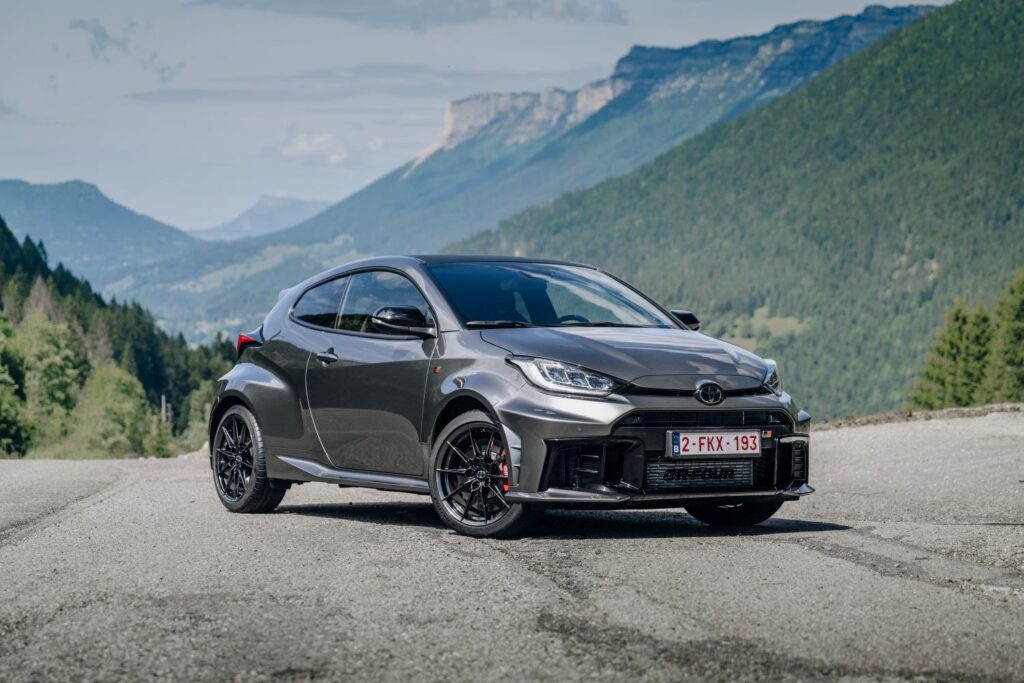
The Toyota Yaris GR 1.6 Turbo, introduced in July 2024 as part of the XP210 facelift, represents the high-performance pinnacle of the fourth-generation Yaris lineup. This variant, distinguished by its potent 280 horsepower engine and GR-FOUR all-wheel-drive system paired with an 8-speed automatic transmission, is a significant departure from the standard Yaris models, targeting driving enthusiasts seeking a compact, yet capable, performance hatchback. It builds upon the foundation of the A3 platform (internally designated 1HX0) and is a direct response to the growing demand for accessible, rally-inspired road cars.
Toyota Yaris GR 1.6 Turbo: A Performance Focus
The GR 1.6 Turbo occupies the top-tier performance position within the Yaris range. Unlike the standard Yaris models focused on fuel efficiency and affordability, the GR is engineered for dynamic driving. It stands apart from any previous Yaris iterations, offering a level of performance previously unseen in the model line. This focus on performance places it in a different segment than the base Yaris trims, appealing to a buyer prioritizing driving experience over economy.
Powertrain & Engine Architecture
At the heart of the Yaris GR is the G16E-GTS, a 1.6-liter turbocharged inline-three cylinder engine. This engine is a marvel of engineering, producing 280 hp at 6500 rpm and 390 Nm (287.65 lb-ft) of torque between 3250-4600 rpm. The engine utilizes a combination of direct injection and multi-port manifold injection to optimize combustion efficiency and power delivery. A key feature is its cylinder head, which incorporates DOHC (Dual Overhead Camshaft) valvetrain and four valves per cylinder, enhancing breathing and overall performance. The engine’s 87.5 mm bore and 89.7 mm stroke contribute to its responsive character. The turbocharger and intercooler are integral to achieving the engine’s high output, managing intake air temperature for consistent power.
The engine is mated to an 8-speed automatic transmission, specifically tuned for quick and precise shifts. This transmission is crucial for managing the engine’s power and delivering it effectively to all four wheels. The GR-FOUR all-wheel-drive system is a sophisticated setup, employing a multi-plate clutch to distribute torque between the front and rear axles. This allows for a variable torque split, ranging from 60:40 in Normal mode to 30:70 in Sport mode, and a 50:50 split in Track mode, optimizing traction and handling for different driving conditions.
Driving Characteristics
The Yaris GR 1.6 Turbo delivers a thrilling driving experience. The 0-100 km/h (0-62 mph) acceleration is achieved in just 5.2 seconds, with a calculated 0-60 mph time of 4.9 seconds, and a top speed of 230 km/h (142.92 mph). The automatic transmission provides seamless gear changes, allowing the driver to focus on maximizing performance. The GR-FOUR system provides exceptional grip and stability, particularly when cornering. The variable torque split allows the car to rotate readily, making it feel agile and responsive. Compared to a hypothetical manual version, the automatic offers convenience and consistent launch control, though some purists may prefer the engagement of a manual gearbox. The power delivery is linear and predictable, making it accessible even for drivers less experienced with high-performance vehicles.
Equipment & Trim Levels
The Yaris GR 1.6 Turbo is generally well-equipped, reflecting its premium positioning within the Yaris lineup. Standard features typically include sport seats with enhanced bolstering, a unique GR-branded steering wheel, and a comprehensive infotainment system. Interior upholstery is typically a combination of fabric and synthetic leather, with GR-specific accents. Optional extras may include a premium audio system, advanced driver-assistance systems (ADAS), and upgraded interior trim materials. The dashboard configuration is tailored to the GR model, featuring unique gauges and displays providing real-time performance data.
Chassis & Braking
The Yaris GR boasts a reinforced chassis and a specially tuned suspension system to handle the increased power and performance. The front suspension utilizes an independent McPherson strut setup, while the rear employs a double wishbone configuration. This combination provides a balance of comfort and handling precision. The braking system features ventilated discs on all four wheels – 356 mm at the front and 297 mm at the rear – providing ample stopping power. ABS (Anti-lock Braking System) is standard, enhancing safety and control. The electric power steering is calibrated for precise and responsive handling. The car rides on 225/40 ZR18 tires mounted on 18-inch alloy wheels.
Market Reception & Comparison
The Yaris GR 1.6 Turbo has been widely praised by automotive critics for its exceptional performance and engaging driving dynamics. It has been favorably compared to rivals such as the Hyundai i20 N and the Ford Fiesta ST, often lauded for its superior all-wheel-drive system and refined powertrain. Fuel consumption is rated at 9.0 l/100 km (26.1 US mpg, 31.4 UK mpg), which is reasonable considering the car’s performance capabilities. However, CO2 emissions are higher at 204 g/km. Reliability is expected to be good, given Toyota’s reputation for build quality, though long-term data is still emerging. Compared to the standard Yaris models, the GR offers significantly higher performance but at the cost of increased fuel consumption and a higher purchase price.
Technical Specifications
| Brand | Toyota |
| Model | Yaris |
| Generation | Yaris (XP210, facelift 2024) |
| Type | GR 1.6 Turbo (280 Hp) GR-FOUR AWD Automatic |
| Start of production | July, 2024 |
| Powertrain Architecture | Internal Combustion engine |
| Body type | Hatchback |
| Seats | 4 |
| Doors | 3 |
| Combined fuel consumption (WLTP) | 9.0 l/100 km (26.1 US mpg, 31.4 UK mpg, 11.1 km/l) |
| CO2 emissions (WLTP) | 204 g/km |
| Fuel Type | Petrol (Gasoline) |
| Acceleration 0 – 100 km/h | 5.2 sec |
| Acceleration 0 – 62 mph | 5.2 sec |
| Acceleration 0 – 60 mph | 4.9 sec |
| Maximum speed | 230 km/h (142.92 mph) |
| Weight-to-power ratio | 4.6 kg/Hp, 215.4 Hp/tonne |
| Weight-to-torque ratio | 3.3 kg/Nm, 300 Nm/tonne |
| Power | 280 Hp @ 6500 rpm |
| Power per litre | 173.1 Hp/l |
| Torque | 390 Nm @ 3250-4600 rpm (287.65 lb.-ft. @ 3250-4600 rpm) |
| Engine layout | Front, Transverse |
| Engine Model/Code | G16E-GTS |
| Engine displacement | 1618 cm3 (98.74 cu. in.) |
| Number of cylinders | 3 |
| Engine configuration | Inline |
| Cylinder Bore | 87.5 mm (3.44 in.) |
| Piston Stroke | 89.7 mm (3.53 in.) |
| Compression ratio | 10.5:1 |
| Number of valves per cylinder | 4 |
| Fuel injection system | Direct injection and Multi-port manifold injection |
| Engine aspiration | Turbocharger, Intercooler |
| Valvetrain | DOHC |
| Engine oil capacity | 4.3 l (4.54 US qt | 3.78 UK qt) |
| Coolant | 5.2 l (5.49 US qt | 4.58 UK qt) |
| Kerb Weight | 1300-1325 kg (2866.01 – 2921.12 lbs.) |
| Max. weight | 1645 kg (3626.6 lbs.) |
| Max load | 320-345 kg (705.48 – 760.59 lbs.) |
| Trunk (boot) space – minimum | 174 l (6.14 cu. ft.) |
| Fuel tank capacity | 50 l (13.21 US gal | 11 UK gal) |
| Length | 3995 mm (157.28 in.) |
| Width | 1805 mm (71.06 in.) |
| Height | 1455 mm (57.28 in.) |
| Wheelbase | 2560 mm (100.79 in.) |
| Front track | 1536 mm (60.47 in.) |
| Rear (Back) track | 1572 mm (61.89 in.) |
| Ride height (ground clearance) | 124 mm (4.88 in.) |
| Drag coefficient (Cd) | 0.349 |
| Minimum turning circle (turning diameter) | 11.3 m (37.07 ft.) |
| Drivetrain Architecture | All wheel drive (4×4). ICE drives front wheels, rear wheels driven by clutch. |
| Number of gears and type of gearbox | 8 gears, automatic transmission |
Legacy
The Toyota Yaris GR 1.6 Turbo is poised to become a modern classic, representing a unique chapter in the Yaris’s history. Its combination of a potent turbocharged engine, sophisticated all-wheel-drive system, and engaging driving dynamics sets it apart from its predecessors. As a used car, the GR is likely to hold its value well, appealing to enthusiasts seeking a compact, high-performance hatchback. The G16E-GTS engine, while relatively new, is expected to be durable and reliable, provided it receives regular maintenance. The GR’s legacy will be as a benchmark for accessible performance and a testament to Toyota’s commitment to driving enjoyment.