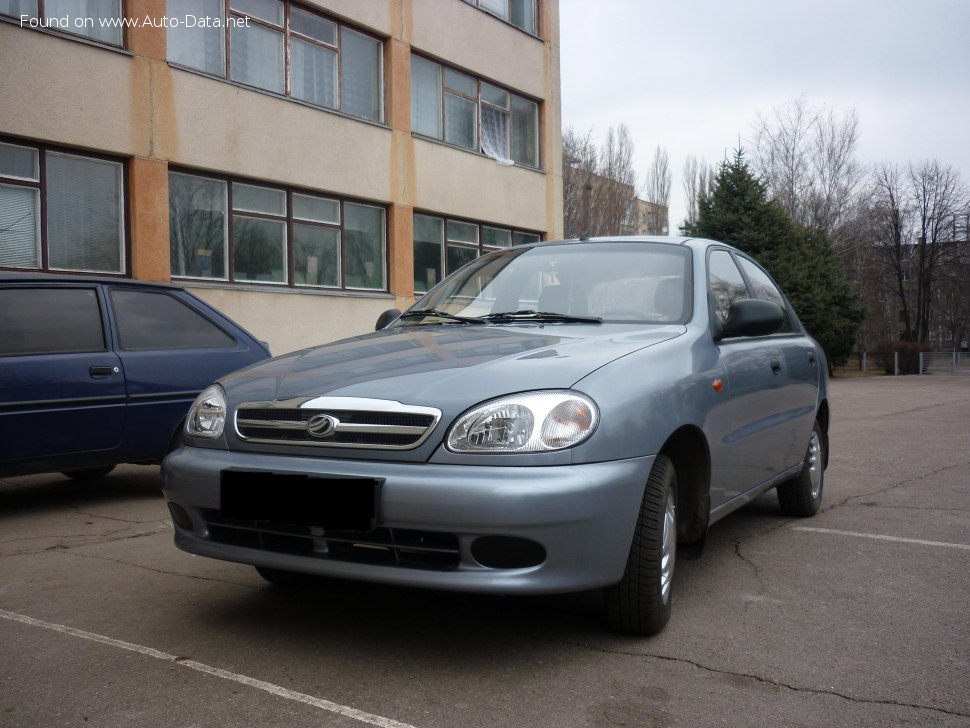
The ZAZ Sens Hatchback 1.3L (70 hp) was a subcompact car produced by the Ukrainian automobile manufacturer ZAZ from 2002 to 2018. It represented a significant step for ZAZ, moving away from heavily modified Lada designs towards a more modern, albeit still budget-focused, vehicle. The Sens Hatchback, based on the Daewoo Lanos platform acquired by ZAZ, was intended to provide affordable transportation for the Ukrainian and surrounding markets. The 1.3L 70 hp variant served as the entry-level model within the Sens Hatchback range, offering a balance between fuel economy and basic functionality. It occupied the lowest price point in the lineup, appealing to first-time car buyers and those prioritizing affordability over performance.
ZAZ Sens Hatchback 1.3L: Powertrain & Engine Architecture
The heart of the ZAZ Sens 1.3L was the ZAZ-1002.10 inline-four cylinder gasoline engine. This engine, while bearing a ZAZ designation, was heavily derived from the Daewoo/GM 1.3L Family I engine. It featured a single overhead camshaft (SOHC) valvetrain with two valves per cylinder. The engine displaced 1299 cubic centimeters (79.27 cubic inches) and produced a maximum power output of 70 horsepower at 5500 rpm, and 108 Nm (79.66 lb-ft) of torque at 3250 rpm. The compression ratio was 9.8:1. Fuel delivery was managed by a multi-port fuel injection system, a significant improvement over the carbureted engines found in earlier ZAZ models.
The 1.3L engine was typically paired with a five-speed manual transmission. This transmission was a standard design, providing relatively smooth shifts but lacking the refinement of more modern gearboxes. The drivetrain configuration was front-wheel drive, a common layout for subcompact cars of this era. The engine was mounted transversely in the front of the vehicle, contributing to a compact engine bay and maximizing interior space.
Engine Codes and Variations
While the core engine design remained consistent throughout the production run, minor variations existed. These were often related to emissions control equipment and fuel management systems, adapting to changing regulations in different markets. However, the fundamental characteristics of the 70 hp 1.3L engine remained largely unchanged.
Driving Characteristics
The ZAZ Sens 1.3L was not designed for spirited driving. Its 70 horsepower output and relatively high curb weight of 1182 kg (2605.86 lbs) resulted in modest acceleration. Zero to 100 km/h (0-62 mph) took approximately 17 seconds, and 0-60 mph was achieved in around 16.2 seconds. The top speed was limited to 162 km/h (100.66 mph). The engine’s torque peak at 3250 rpm meant that usable power was available in the mid-range, but required frequent downshifting for overtaking maneuvers or climbing hills.
The five-speed manual transmission helped to mitigate the engine’s limitations, allowing drivers to keep the engine within its optimal power band. Gear ratios were fairly standard for a vehicle in this class, prioritizing fuel economy over outright performance. Compared to potential higher-output variants (which were not widely available on the Sens Hatchback), the 1.3L offered a smoother, more predictable driving experience, albeit at the expense of speed and responsiveness.
Equipment & Trim Levels
The ZAZ Sens 1.3L was typically offered in a basic trim level, reflecting its position as the entry-level model. Standard equipment generally included steel wheels with hubcaps, manual windows and door locks, and a basic audio system. Interior upholstery was typically cloth, with a simple dashboard layout. Safety features were minimal, often limited to seatbelts and a basic braking system.
Optional extras were available, such as power windows, central locking, and an upgraded audio system. Air conditioning was also offered as an option, but was not commonly specified due to the added cost. The interior plastics were durable but lacked the refinement of more expensive vehicles. The focus was on providing a functional and affordable transportation solution, rather than luxury or advanced features.
Chassis & Braking
The ZAZ Sens Hatchback utilized a relatively simple chassis design. The front suspension consisted of MacPherson struts, while the rear suspension employed a torsion beam axle. This setup provided a reasonable ride quality for a vehicle in its class, but lacked the sophistication of independent rear suspension. The steering system was a rack and pinion type, offering adequate precision and feedback.
The braking system consisted of ventilated discs on the front wheels and drum brakes on the rear wheels. This configuration was common for vehicles in this price range. While adequate for normal driving conditions, the braking performance was not particularly strong, especially under heavy load or in emergency situations. The vehicle’s weight-to-power ratio of 16.9 kg/hp highlighted the need for cautious driving.
Market Reception & Comparison
The ZAZ Sens 1.3L was generally well-received in its target market, particularly in Ukraine and neighboring countries. Its affordability and relatively low running costs made it an attractive option for budget-conscious buyers. Critics acknowledged its basic nature but praised its practicality and reliability. Fuel consumption was a strong point, with an urban fuel economy of 8.9 l/100 km (26.4 US mpg).
Compared to other vehicles in its class, such as the Lada Granta or Dacia Logan, the ZAZ Sens 1.3L offered a similar level of value. However, it often lagged behind in terms of refinement, safety features, and overall build quality. The 1.3L engine, while economical, was noticeably less powerful than the larger engines offered in some competing models. Reliability was generally good, but maintenance costs could be higher due to the limited availability of spare parts in some regions.
Technical Specifications
| Brand | ZAZ |
| Model | Sens Hatchback |
| Generation | Sens Hatchback |
| Type (Engine) | 1.3L (70 Hp) |
| Start of production | 2002 year |
| End of production | 2018 year |
| Powertrain Architecture | Internal Combustion engine |
| Body type | Hatchback |
| Seats | 5 |
| Doors | 5 |
| Fuel consumption (urban) | 8.9 l/100 km (26.4 US mpg) |
| Fuel Type | Petrol (Gasoline) |
| Acceleration 0 – 100 km/h | 17 sec |
| Acceleration 0 – 62 mph | 17 sec |
| Acceleration 0 – 60 mph | 16.2 sec |
| Maximum speed | 162 km/h (100.66 mph) |
| Weight-to-power ratio | 16.9 kg/Hp |
| Weight-to-torque ratio | 10.9 kg/Nm |
| Power | 70 Hp @ 5500 rpm |
| Torque | 108 Nm @ 3250 rpm (79.66 lb.-ft. @ 3250 rpm) |
| Engine layout | Front, Transverse |
| Engine displacement | 1299 cm3 (79.27 cu. in.) |
| Number of cylinders | 4 |
| Engine configuration | Inline |
| Cylinder Bore | 75 mm (2.95 in.) |
| Piston Stroke | 73.5 mm (2.89 in.) |
| Compression ratio | 9.8:1 |
| Number of valves per cylinder | 2 |
| Fuel injection system | Multi-port manifold injection |
| Engine aspiration | Naturally aspirated engine |
| Kerb Weight | 1182 kg (2605.86 lbs.) |
| Max. weight | 1595 kg (3516.37 lbs.) |
| Max load | 413 kg (910.51 lbs.) |
| Fuel tank capacity | 48 l (12.68 US gal | 10.56 UK gal) |
| Length | 4074 mm (160.39 in.) |
| Width | 1678 mm (66.06 in.) |
| Height | 1432 mm (56.38 in.) |
| Wheelbase | 2520 mm (99.21 in.) |
| Front track | 1405 mm (55.31 in.) |
| Rear track | 1425 mm (56.1 in.) |
| Drivetrain Architecture | Front wheel drive |
| Number of gears and type of gearbox | 5 gears, manual transmission |
| Front brakes | Ventilated discs |
| Rear brakes | Drum |
| Steering type | Steering rack and pinion |
Legacy
The ZAZ Sens 1.3L, while not a groundbreaking vehicle, played an important role in the Ukrainian automotive market. It provided affordable transportation for a large segment of the population and helped to modernize ZAZ’s product lineup. The 1.3L engine proved to be relatively reliable, and many examples remain on the road today. However, its age and basic features mean that it is gradually being replaced by newer, more sophisticated vehicles. In the used car market, the Sens 1.3L remains an attractive option for buyers seeking a cheap and practical vehicle, but potential buyers should be aware of its limited safety features and potential maintenance requirements.