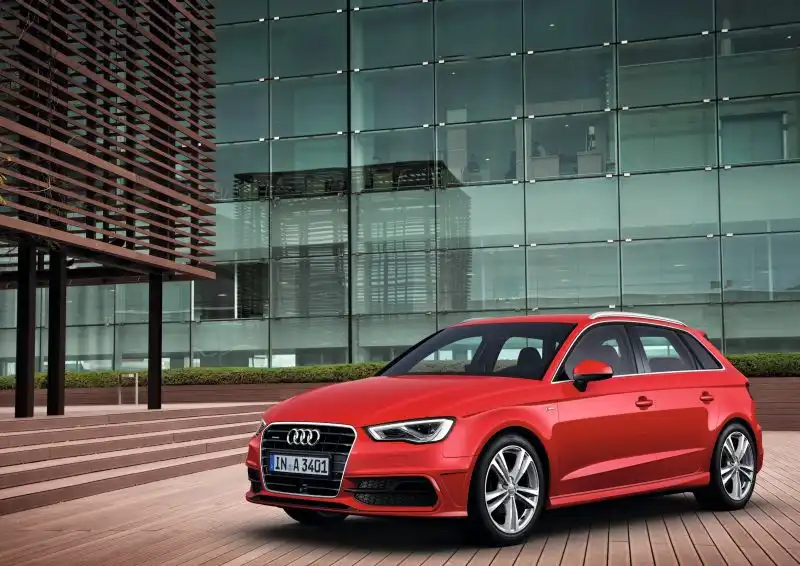
The Audi A3 Sportback (8V) G-tron 1.4 TFSI CNG, produced from 2014 to 2016, represents a unique offering within the broader A3 Sportback (8V) generation. This variant was specifically engineered to run on Compressed Natural Gas (CNG), offering a bi-fuel capability alongside traditional gasoline. Positioned as an environmentally conscious alternative, the G-tron aimed to appeal to European drivers seeking lower emissions and reduced running costs. It utilized the A3’s versatile 8V platform, shared with the Volkswagen Golf Mk7, SEAT Leon, and Skoda Octavia, but distinguished itself through its dedicated CNG powertrain.
Technical Specifications
| Brand | Audi |
| Model | A3 |
| Generation | A3 Sportback (8V) |
| Type (Engine) | G-tron 1.4 TFSI CNG (110 Hp) S tronic |
| Start of production | 2014 |
| End of production | 2016 |
| Powertrain Architecture | Internal Combustion engine |
| Body type | Hatchback |
| Seats | 5 |
| Doors | 5 |
| Fuel consumption (economy) – urban (NEDC) | 6.3 l/100 km (37.3 US mpg, 44.8 UK mpg, 15.9 km/l) |
| Fuel consumption (economy) – urban (CNG) (NEDC) | 4.2 kg/100 km |
| Fuel consumption (economy) – extra urban (NEDC) | 4.4 l/100 km (53.5 US mpg, 64.2 UK mpg, 22.7 km/l) |
| Fuel consumption (economy) – extra urban (CNG) (NEDC) | 2.7 kg/100 km |
| Fuel consumption (economy) – combined (NEDC) | 5.1 l/100 km (46.1 US mpg, 55.4 UK mpg, 19.6 km/l) |
| Fuel consumption (economy) – combined (CNG) (NEDC) | 3.3 kg/100 km |
| CO2 emissions (NEDC) | 117 g/km |
| CO2 emissions (CNG) (NEDC) | 89 g/km |
| Fuel Type | Petrol / CNG |
| Acceleration 0 – 100 km/h | 10.8 sec |
| Acceleration 0 – 62 mph | 10.8 sec |
| Acceleration 0 – 60 mph | 10.3 sec |
| Maximum speed | 197 km/h (122.41 mph) |
| Emission standard | Euro 6 |
| Weight-to-power ratio | 11.6 kg/Hp, 85.9 Hp/tonne |
| Weight-to-torque ratio | 6.4 kg/Nm, 156.3 Nm/tonne |
| Power | 110 Hp @ 4800-6000 rpm |
| Power per litre | 78.9 Hp/l |
| Torque | 200 Nm @ 1500-3500 rpm (147.51 lb.-ft. @ 1500-3500 rpm) |
| Engine layout | Front, Transverse |
| Engine Model/Code | CPWA |
| Engine displacement | 1395 cm3 (85.13 cu. in.) |
| Number of cylinders | 4 |
| Engine configuration | Inline |
| Cylinder Bore | 74.5 mm (2.93 in.) |
| Piston Stroke | 80 mm (3.15 in.) |
| Compression ratio | 10.5:1 |
| Number of valves per cylinder | 4 |
| Fuel injection system | Direct injection |
| Engine aspiration | Turbocharger, Intercooler |
| Valvetrain | DOHC |
| Engine oil capacity | 4 l (4.23 US qt | 3.52 UK qt) |
| Kerb Weight | 1280 kg (2821.92 lbs.) |
| Max. weight | 1820 kg (4012.41 lbs.) |
| Max load | 540 kg (1190.5 lbs.) |
| Trunk (boot) space – minimum | 280 l (9.89 cu. ft.) |
| Trunk (boot) space – maximum | 1120 l (39.55 cu. ft.) |
| Fuel tank capacity | 50 l (13.21 US gal | 11 UK gal) |
| CNG cylinder capacity | 14.40 kg |
| Permitted trailer load with brakes (8%) | 1500 kg (3306.93 lbs.) |
| Permitted trailer load without brakes | 670 kg (1477.1 lbs.) |
| Length | 4310 mm (169.69 in.) |
| Width | 1785 mm (70.28 in.) |
| Height | 1427 mm (56.18 in.) |
| Wheelbase | 2637 mm (103.82 in.) |
| Front track | 1542 mm (60.71 in.) |
| Rear (Back) track | 1514 mm (59.61 in.) |
| Drag coefficient (Cd) | 0.31 |
| Minimum turning circle (turning diameter) | 10.9 m (35.76 ft.) |
| Drivetrain Architecture | The Internal combustion engine (ICE) drives the front wheels of the vehicle. |
| Drive wheel | Front wheel drive |
| Number of gears and type of gearbox | 7 gears, automatic transmission S tronic |
| Front suspension | Independent type McPherson |
| Rear suspension | Torsion |
| Front brakes | Ventilated discs |
| Rear brakes | Disc |
| Assisting systems | ABS (Anti-lock braking system) |
| Steering type | Steering rack and pinion |
| Power steering | Electric Steering |
| Tires size | 205/55 R16 |
| Wheel rims size | 6.5J x 16 |
Powertrain & Engine Architecture
The heart of the A3 Sportback G-tron is the 1.4-liter, four-cylinder CPWA engine. This engine is a member of Volkswagen Group’s EA211 family, known for its efficiency and modular design. It utilizes direct fuel injection and a turbocharger with an intercooler to produce 110 horsepower and 200 Nm (147.51 lb.-ft.) of torque. The key difference lies in its bi-fuel capability, allowing it to run on either gasoline or Compressed Natural Gas (CNG). When running on CNG, the engine management system automatically adjusts to optimize combustion for the alternative fuel. The engine’s compression ratio is 10.5:1. The S tronic 7-speed dual-clutch transmission was standard, providing quick and smooth gear changes. This transmission is known for its efficiency and responsiveness, contributing to the overall driving experience.
Driving Characteristics
The 1.4 TFSI CNG with the S tronic transmission delivers a balanced driving experience. While not overtly sporty, it provides adequate performance for everyday driving. Acceleration from 0 to 100 km/h (0-62 mph) takes approximately 10.8 seconds. The S tronic transmission keeps the engine in its optimal power band, making overtaking maneuvers relatively effortless. Compared to the more powerful 1.8 TFSI or 2.0 TFSI variants, the G-tron feels less eager to accelerate, but the torque delivery is smooth and predictable. The automatic transmission’s gear ratios are tuned for fuel efficiency, prioritizing economy over outright performance. Switching to CNG doesn’t dramatically alter the driving experience, although some drivers report a slight reduction in power output when running solely on CNG.
Equipment & Trim Levels
The G-tron trim level typically included a good level of standard equipment. This often included features like air conditioning, a multi-function steering wheel, an infotainment system with a color display, and alloy wheels. Interior upholstery was generally cloth, with options for leather upgrades. Specific trim packages could add features like parking sensors, automatic headlights and wipers, and upgraded audio systems. The G-tron also featured a dedicated CNG fuel gauge and a warning system to indicate the CNG tank level.
Chassis & Braking
The A3 Sportback G-tron utilizes a McPherson strut front suspension and a torsion beam rear suspension. This setup provides a comfortable ride quality while maintaining reasonable handling characteristics. The braking system consists of ventilated discs at the front and solid discs at the rear, equipped with ABS (Anti-lock Braking System). The suspension tuning is geared towards comfort, making it well-suited for everyday driving. The weight distribution is generally balanced, contributing to stable handling.
Market Reception & Comparison
The A3 Sportback G-tron was primarily marketed in countries with well-developed CNG infrastructure, such as Germany and Italy. Critics praised its fuel efficiency and reduced emissions, but noted that the limited availability of CNG refueling stations could be a drawback for some drivers. Compared to the gasoline-powered A3 variants, the G-tron offered lower running costs, particularly for drivers who could take advantage of government incentives for CNG vehicles. However, the initial purchase price was typically higher. The 1.8 TFSI offered more performance, while the 1.6 TDI provided even better fuel economy, but at the cost of refinement.
Legacy
The Audi A3 Sportback G-tron represents an early attempt by Audi to offer a more sustainable alternative to traditional gasoline-powered vehicles. While CNG never achieved widespread adoption in many markets, the G-tron demonstrated Audi’s commitment to exploring alternative fuels. Today, these vehicles can be found on the used car market, often appealing to environmentally conscious buyers. The 1.4 TFSI engine, in general, has proven to be relatively reliable, although regular maintenance is essential. The S tronic transmission is also generally durable, but requires periodic servicing. The G-tron’s long-term value depends on the availability of CNG refueling infrastructure and the continued demand for environmentally friendly vehicles.