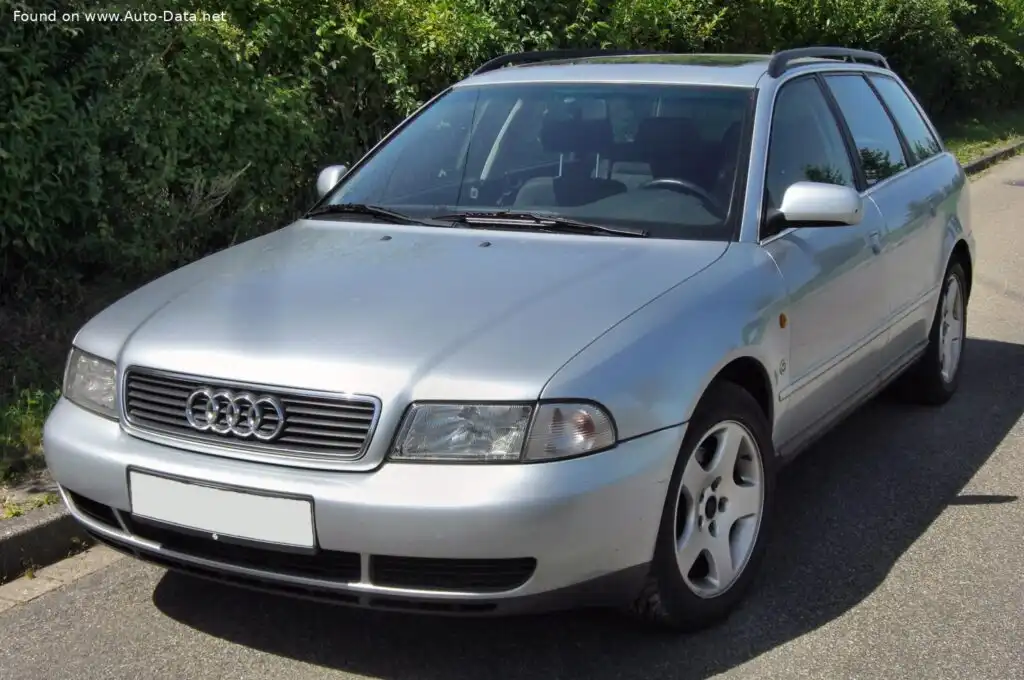
The Audi A4 Avant (B5, Typ 8D) 1.9 Di, produced between March 1996 and December 1998, represented a key entry point into the Audi A4 range during that period. Positioned as a fuel-efficient and practical option, this variant catered to buyers seeking the versatility of a station wagon (estate) without the higher costs associated with more powerful engines. It was part of the B5 generation A4, built on the Volkswagen Group’s 1HX0/A3 platform, which also underpinned models like the Volkswagen Golf and Bora. The 1.9 Di model aimed to provide a balance between economy, usability, and the premium feel expected of the Audi brand.
Technical Specifications
| Brand | Audi |
| Model | A4 |
| Generation | A4 Avant (B5, Typ 8D) |
| Type (Engine) | 1.9 Di (75 Hp) |
| Start of production | March, 1996 |
| End of production | December, 1998 |
| Powertrain Architecture | Internal Combustion engine |
| Body type | Station wagon (estate) |
| Seats | 5 |
| Doors | 5 |
| Fuel Type | Diesel |
| Maximum speed | 183 km/h (113.71 mph) |
| Power | 75 Hp @ 4400 rpm |
| Power per litre | 39.6 Hp/l |
| Torque | 140 Nm @ 2200 rpm (103.26 lb.-ft. @ 2200 rpm) |
| Engine layout | Front, Longitudinal |
| Engine Model/Code | AFF |
| Engine displacement | 1896 cm3 (115.7 cu. in.) |
| Number of cylinders | 4 |
| Engine configuration | Inline |
| Cylinder Bore | 79.5 mm (3.13 in.) |
| Piston Stroke | 95.5 mm (3.76 in.) |
| Compression ratio | 22.5:1 |
| Number of valves per cylinder | 2 |
| Fuel injection system | Direct injection |
| Engine aspiration | Turbocharger, Intercooler |
| Engine oil capacity | 3.5 l (3.7 US qt | 3.08 UK qt) |
| Coolant | 6.5 l (6.87 US qt | 5.72 UK qt) |
| Trunk (boot) space – minimum | 390 l (13.77 cu. ft.) |
| Trunk (boot) space – maximum | 1250 l (44.14 cu. ft.) |
| Fuel tank capacity | 62 l (16.38 US gal | 13.64 UK gal) |
| Length | 4478 mm (176.3 in.) |
| Width | 1733 mm (68.23 in.) |
| Height | 1417 mm (55.79 in.) |
| Wheelbase | 2622 mm (103.23 in.) |
| Front track | 1498 mm (58.98 in.) |
| Rear (Back) track | 1479 mm (58.23 in.) |
| Drag coefficient (Cd) | 0.31 |
| Minimum turning circle (turning diameter) | 11.1 m (36.42 ft.) |
| Drivetrain Architecture | The Internal combustion engine (ICE) drives the front wheels of the vehicle. |
| Drive wheel | Front wheel drive |
| Number of gears and type of gearbox | 5 gears, manual transmission |
| Front brakes | Disc |
| Rear brakes | Disc |
| Assisting systems | ABS (Anti-lock braking system) |
| Steering type | Steering rack and pinion |
| Power steering | Hydraulic Steering |
Powertrain & Engine Architecture
The heart of the A4 Avant 1.9 Di was the AFF engine code, a 1.9-liter inline-four cylinder diesel engine. This engine utilized direct injection (DI) technology, a relatively new advancement at the time, which allowed for more precise fuel delivery and improved combustion efficiency. A turbocharger with an intercooler was employed to boost power output, compensating for the inherent limitations of a naturally aspirated diesel. The engine featured a two-valve per cylinder configuration (SOHC) and a compression ratio of 22.5:1, typical for diesel engines of the era. The engine’s longitudinal mounting within the engine bay contributed to the A4’s balanced handling characteristics. While a five-speed manual transmission was standard, an optional four-speed automatic transmission was available, though less common with this engine.
Driving Characteristics
The 75 horsepower output of the 1.9 Di engine translated to a respectable, if not exhilarating, driving experience. Acceleration was adequate for everyday driving, but overtaking maneuvers required careful planning. The engine’s 140 Nm (103 lb-ft) of torque, available from 2200 rpm, provided sufficient pulling power for cruising and hauling loads. The five-speed manual transmission allowed drivers to keep the engine in its optimal power band, while the optional automatic, though convenient, resulted in some power loss and a less engaging driving experience. Compared to the more powerful 1.8 petrol variants or the later 1.9 TDI models, the 1.9 Di prioritized fuel economy over outright performance.
Equipment & Trim Levels
The 1.9 Di Avant typically came with a fairly basic level of equipment, reflecting its position as an entry-level model. Standard features generally included power windows, central locking, and an AM/FM radio. Interior upholstery was typically cloth, and the dashboard featured a functional, if somewhat understated, design. Optional extras included alloy wheels, a sunroof, air conditioning, and upgraded audio systems. The trim level was often simply designated as “Di,” with options packages available to add additional features.
Chassis & Braking
The A4 Avant’s chassis featured independent suspension at all four wheels, providing a comfortable ride and good handling. The front suspension utilized MacPherson struts, while the rear employed a multi-link setup. Brakes were disc brakes on all four wheels, providing adequate stopping power for the vehicle’s weight and performance. Anti-lock Braking System (ABS) was standard, enhancing safety in emergency braking situations. Stabilizer bars were fitted to both the front and rear axles to reduce body roll during cornering.
Market Reception & Comparison
The A4 Avant 1.9 Di was generally well-received by automotive critics as a practical and economical choice. It was praised for its fuel efficiency, spacious interior, and comfortable ride. However, its relatively low power output was often cited as a drawback, particularly when compared to the more powerful petrol and TDI variants. The 1.9 TDI, offering significantly more power and torque, quickly became the more popular choice for those seeking a balance between performance and economy. The 1.9 Di appealed to buyers prioritizing fuel costs and practicality over outright speed.
Legacy
The Audi A4 Avant 1.9 Di, while not the most sought-after variant of the B5 generation, has proven to be a relatively reliable and durable vehicle. The AFF engine, when properly maintained, is known for its longevity. Today, these cars are becoming increasingly rare and are sought after by enthusiasts looking for a classic Audi wagon. Parts availability is generally good, although some specific components may be becoming harder to find. The 1.9 Di represents a significant step in Audi’s development of diesel technology and remains a testament to the brand’s commitment to building practical and well-engineered vehicles.