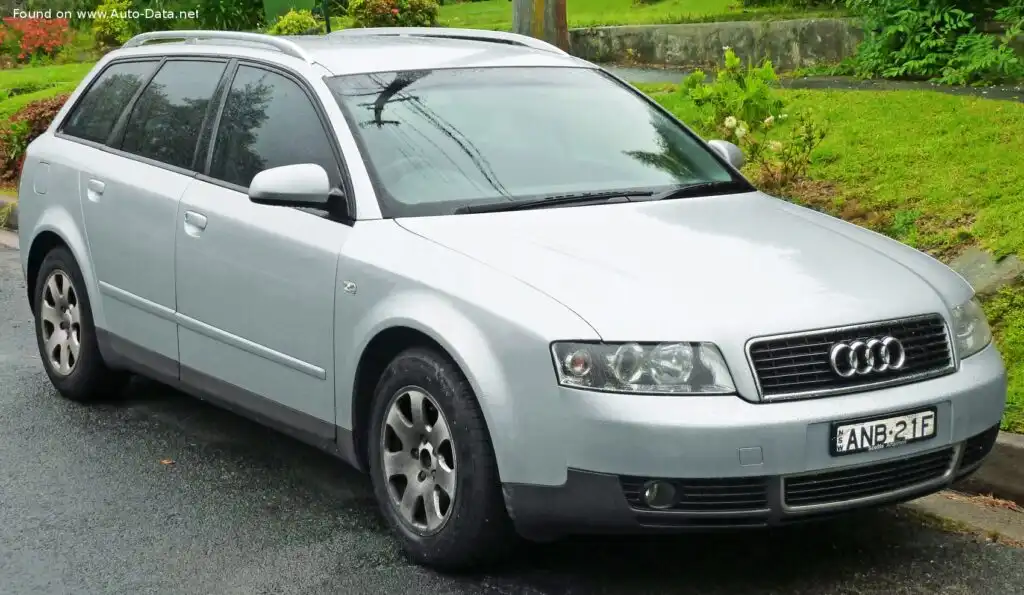
The Audi A4 Avant (B6 8E) 1.6i, produced from June 2001 to November 2004, represented the entry point into the B6 A4 Avant (wagon) model range. Positioned as an affordable and practical option, it catered to buyers prioritizing fuel efficiency and everyday usability over outright performance. This variant was a key component of Audi’s strategy to broaden the A4’s appeal within the competitive European market, offering a more accessible price point compared to the more powerful 1.8T and 2.0 models. It utilized the Volkswagen Group’s PL45 (also known as the B6) platform, shared with the Volkswagen Passat and Škoda Superb of the era.
Technical Specifications
| Brand | Audi |
| Model | A4 |
| Generation | A4 Avant (B6 8E) |
| Type (Engine) | 1.6i (102 Hp) |
| Start of production | June, 2001 |
| End of production | November, 2004 |
| Powertrain Architecture | Internal Combustion engine |
| Body type | Station wagon (estate) |
| Seats | 5 |
| Doors | 5 |
| Fuel consumption (urban) | 10.9 l/100 km (21.6 US mpg, 25.9 UK mpg, 9.2 km/l) |
| Fuel consumption (extra urban) | 6.1 l/100 km (38.6 US mpg, 46.3 UK mpg, 16.4 km/l) |
| Fuel consumption (combined) | 7.8 l/100 km (30.2 US mpg, 36.2 UK mpg, 12.8 km/l) |
| Fuel Type | Petrol (Gasoline) |
| Acceleration 0 – 100 km/h | 13.2 sec |
| Acceleration 0 – 62 mph | 13.2 sec |
| Acceleration 0 – 60 mph | 12.5 sec |
| Maximum speed | 186 km/h (115.58 mph) |
| Weight-to-power ratio | 13.2 kg/Hp, 75.6 Hp/tonne |
| Weight-to-torque ratio | 9.1 kg/Nm, 109.6 Nm/tonne |
| Power | 102 Hp @ 5600 rpm |
| Power per litre | 63.9 Hp/l |
| Torque | 148 Nm @ 3800 rpm (109.16 lb.-ft. @ 3800 rpm) |
| Engine layout | Front, Longitudinal |
| Engine Model/Code | ALZ |
| Engine displacement | 1595 cm3 (97.33 cu. in.) |
| Number of cylinders | 4 |
| Engine configuration | Inline |
| Cylinder Bore | 81 mm (3.19 in.) |
| Piston Stroke | 77.4 mm (3.05 in.) |
| Compression ratio | 10.3:1 |
| Number of valves per cylinder | 2 |
| Fuel injection system | Multi-port manifold injection |
| Engine aspiration | Naturally aspirated engine |
| Valvetrain | OHC |
| Engine oil capacity | 3.5 l (3.7 US qt | 3.08 UK qt) |
| Coolant | 7.5 l (7.93 US qt | 6.6 UK qt) |
| Kerb Weight | 1350 kg (2976.24 lbs.) |
| Max. weight | 1900 kg (4188.78 lbs.) |
| Max load | 550 kg (1212.54 lbs.) |
| Trunk (boot) space – minimum | 442 l (15.61 cu. ft.) |
| Trunk (boot) space – maximum | 1184 l (41.81 cu. ft.) |
| Fuel tank capacity | 70 l (18.49 US gal | 15.4 UK gal) |
| Length | 4548 mm (179.06 in.) |
| Width | 1772 mm (69.76 in.) |
| Height | 1428 mm (56.22 in.) |
| Wheelbase | 2650 mm (104.33 in.) |
| Front track | 1528 mm (60.16 in.) |
| Rear (Back) track | 1526 mm (60.08 in.) |
| Drag coefficient (Cd) | 0.30 |
| Minimum turning circle | 11.1 m (36.42 ft.) |
| Drivetrain Architecture | The Internal combustion engine (ICE) drives the front wheels of the vehicle. |
| Drive wheel | Front wheel drive |
| Number of gears and type of gearbox | 5 gears, manual transmission |
| Front suspension | Independent multi-link suspension |
| Rear suspension | Independent multi-link suspension |
| Front brakes | Ventilated discs |
| Rear brakes | Disc |
| Assisting systems | ABS (Anti-lock braking system) |
| Steering type | Steering rack and pinion |
| Power steering | Hydraulic Steering |
| Tires size | 195/65 R15 |
| Wheel rims size | 6J x 15 |
Powertrain & Engine Architecture
The A4 Avant 1.6i was powered by the Audi ALZ engine, a 1.6-liter inline-four cylinder gasoline engine. This engine was part of the Volkswagen Group’s EA827 family, known for its relatively simple design and durability. The ALZ featured a single overhead camshaft (OHC) operating two valves per cylinder. Fuel delivery was handled by a multi-port fuel injection system, providing adequate, though not exceptional, combustion control. The engine produced 102 horsepower at 5600 rpm and 148 Nm (109 lb-ft) of torque at 3800 rpm. The engine’s longitudinal mounting allowed for front-wheel drive configuration. The standard transmission was a five-speed manual gearbox, although a four-speed automatic transmission was also available, albeit less common. The automatic transmission, while offering convenience, did impact acceleration and fuel economy.
Driving Characteristics
The 1.6i A4 Avant offered a comfortable, but not particularly sporty, driving experience. Acceleration was modest, taking around 13.2 seconds to reach 62 mph. The engine felt strained when pushed hard, particularly when fully loaded or tackling inclines. The five-speed manual transmission allowed drivers to keep the engine in its optimal power band, but the automatic version often felt sluggish due to its limited number of gears and conservative programming. Steering was precise, typical of Audi, and the independent multi-link suspension provided a compliant ride, absorbing bumps effectively. Compared to the 1.8T and 2.0 models, the 1.6i lacked the punch and responsiveness that enthusiasts desired, but it excelled in providing a smooth and refined ride for everyday commuting.
Equipment & Trim Levels
The 1.6i A4 Avant typically came with a reasonable level of standard equipment, including power windows, central locking, and an air conditioning system. Interior upholstery was usually cloth, with options for upgraded materials. The dashboard layout was functional and well-designed, typical of Audi’s interior design philosophy at the time. Optional extras included alloy wheels, a sunroof, and a premium audio system. The trim level was generally considered the base model, focusing on providing essential features at an affordable price point. It was positioned below the more luxurious and better-equipped 1.8T and 2.0 variants.
Chassis & Braking
The B6 A4 Avant featured a fully independent suspension system, with multi-link setups at both the front and rear. This provided excellent handling and ride comfort. The front brakes were ventilated discs, offering good stopping power, while the rear brakes were solid discs. Anti-lock Braking System (ABS) was standard. The chassis was robust and well-engineered, contributing to the car’s overall stability and handling characteristics. The weight distribution was reasonably balanced, further enhancing its driving dynamics.
Market Reception & Comparison
The A4 Avant 1.6i was generally well-received as a practical and affordable family car. Critics praised its comfortable ride, spacious interior, and fuel efficiency. However, it was often criticized for its lack of performance compared to its more powerful siblings. The 1.8T models offered a significant performance upgrade, while the 2.0 TDI provided better fuel economy and torque. In terms of reliability, the 1.6i engine proved to be relatively robust, although regular maintenance was essential. Fuel economy was a strong point, averaging around 30.2 US mpg in combined driving conditions.
Legacy
The Audi A4 Avant (B6 8E) 1.6i remains a popular choice in the used car market, particularly for buyers seeking an affordable and reliable estate car. The ALZ engine, while not known for its performance, is generally considered durable and relatively easy to maintain. Parts availability is good, and repair costs are reasonable. While it may not offer the excitement of the higher-performance variants, the 1.6i A4 Avant provides a comfortable, practical, and economical transportation solution, making it a solid choice for those prioritizing value and reliability.