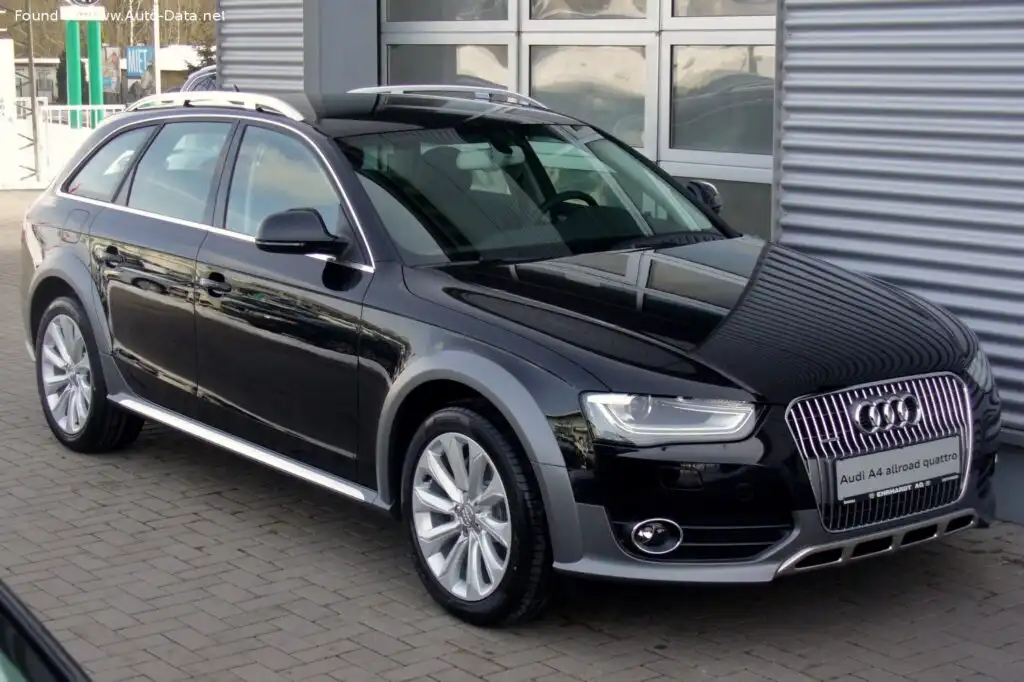
The Audi A4 Avant (B7 8E) 3.0 TDI V6 quattro DPF, produced from November 2005 to 2008, represents a compelling blend of performance, practicality, and technology within the broader B7 A4 Avant range. Positioned as a premium offering, this variant catered to buyers seeking the refinement of a V6 diesel engine coupled with the security and enhanced handling of Audi’s quattro all-wheel-drive system. It served as a flagship powertrain option for the Avant body style, offering a significant step up in performance compared to the four-cylinder gasoline and diesel engines available in the lineup. The B7 generation A4, built on the Volkswagen Group’s 1HX0/A3 platform, aimed to refine the successful B6 model with improvements to styling, interior quality, and technology.
Technical Specifications
| Brand | Audi |
| Model | A4 |
| Generation | A4 Avant (B7 8E) |
| Type (Engine) | 3.0 TDI V6 (233 Hp) quattro DPF |
| Start of production | November, 2005 |
| End of production | 2008 |
| Powertrain Architecture | Internal Combustion engine |
| Body type | Station wagon (estate) |
| Seats | 5 |
| Doors | 5 |
| Fuel consumption (economy) – urban | 10.8 l/100 km (21.8 US mpg, 26.2 UK mpg, 9.3 km/l) |
| Fuel consumption (economy) – extra urban | 5.9 l/100 km (39.9 US mpg, 47.9 UK mpg, 16.9 km/l) |
| Fuel consumption (economy) – combined | 7.6 l/100 km (30.9 US mpg, 37.2 UK mpg, 13.2 km/l) |
| CO2 emissions | 204 g/km |
| Fuel Type | Diesel |
| Acceleration 0 – 100 km/h | 7 sec |
| Acceleration 0 – 62 mph | 7 sec |
| Acceleration 0 – 60 mph | 6.7 sec |
| Maximum speed | 241 km/h (149.75 mph) |
| Emission standard | Euro 4 |
| Weight-to-power ratio | 7.1 kg/Hp, 140.4 Hp/tonne |
| Weight-to-torque ratio | 3.7 kg/Nm, 271.1 Nm/tonne |
| Power | 233 Hp @ 4000 rpm |
| Torque | 450 Nm @ 1400-3250 rpm (331.9 lb.-ft. @ 1400-3250 rpm) |
| Engine layout | Front, Longitudinal |
| Engine Model/Code | ASB |
| Engine displacement | 2967 cm3 (181.06 cu. in.) |
| Number of cylinders | 6 |
| Engine configuration | V-engine |
| Cylinder Bore | 83 mm (3.27 in.) |
| Piston Stroke | 91.4 mm (3.6 in.) |
| Compression ratio | 17:1 |
| Number of valves per cylinder | 4 |
| Fuel injection system | Diesel Commonrail |
| Engine aspiration | Turbocharger, Intercooler |
| Valvetrain | DOHC |
| Engine oil capacity | 8 l (8.45 US qt | 7.04 UK qt) |
| Coolant | 12 l (12.68 US qt | 10.56 UK qt) |
| Kerb Weight | 1660 kg (3659.67 lbs.) |
| Max. weight | 2210 kg (4872.22 lbs.) |
| Max load | 550 kg (1212.54 lbs.) |
| Trunk (boot) space – minimum | 442 l (15.61 cu. ft.) |
| Trunk (boot) space – maximum | 1354 l (47.82 cu. ft.) |
| Fuel tank capacity | 63 l (16.64 US gal | 13.86 UK gal) |
| Max. roof load | 75 kg (165.35 lbs.) |
| Permitted trailer load with brakes (8%) | 2000 kg (4409.25 lbs.) |
| Permitted trailer load with brakes (12%) | 1800 kg (3968.32 lbs.) |
| Permitted trailer load without brakes | 750 kg (1653.47 lbs.) |
| Permitted towbar download | 80 kg (176.37 lbs.) |
| Length | 4586 mm (180.55 in.) |
| Width | 1772 mm (69.76 in.) |
| Width including mirrors | 1937 mm (76.26 in.) |
| Height | 1427 mm (56.18 in.) |
| Wheelbase | 2642 mm (104.02 in.) |
| Front track | 1519 mm (59.8 in.) |
| Rear (Back) track | 1514 mm (59.61 in.) |
| Drag coefficient (Cd) | 0.31 |
| Minimum turning circle (turning diameter) | 11.1 m (36.42 ft.) |
| Drivetrain Architecture | The Internal combustion engine (ICE) drives permanently the four wheels of the vehicle. |
| Drive wheel | All wheel drive (4×4) |
| Number of gears and type of gearbox | 6 gears, manual transmission |
| Front suspension | Independent multi-link suspension |
| Rear suspension | Independent multi-link suspension |
| Front brakes | Ventilated discs |
| Rear brakes | Disc |
| Assisting systems | ABS (Anti-lock braking system) |
| Steering type | Steering rack and pinion |
| Power steering | Hydraulic Steering |
| Tires size | 215/55 R16 |
| Wheel rims size | 7J x 16 |
INTRODUCTION
The Audi A4 Avant (B7 8E) 3.0 TDI V6 quattro DPF, launched in late 2005, represented a significant upgrade within the A4 Avant range. It was positioned as a premium offering, appealing to buyers who desired the performance and refinement of a V6 diesel engine combined with the all-weather capability of Audi’s quattro all-wheel-drive system. The B7 generation, a facelift of the B6, focused on enhancing interior quality, refining the exterior styling, and introducing updated technology. This particular variant, with its 3.0-liter TDI engine, was a key component in Audi’s strategy to offer a compelling alternative to gasoline-powered vehicles, particularly in European markets where diesel fuel was more prevalent and often subject to favorable taxation.
Powertrain & Engine Architecture
At the heart of the A4 Avant 3.0 TDI quattro lies the ASB engine code, a 2,967 cc (181.06 cu. in.) V6 diesel engine. This engine utilizes a common rail direct injection system, delivering fuel at extremely high pressures for optimized combustion. The engine features a single turbocharger with an intercooler to increase air density and boost power output. The valvetrain employs double overhead camshafts (DOHC) with four valves per cylinder, contributing to efficient gas exchange. The engine produces 233 horsepower at 4,000 rpm and a substantial 450 Nm (331.9 lb.-ft.) of torque between 1,400 and 3,250 rpm. The engine’s longitudinal mounting and the quattro drivetrain necessitate a robust six-speed manual transmission to handle the power and torque. A particulate filter (DPF) was included to reduce emissions, complying with Euro 4 standards.
Driving Characteristics
The 3.0 TDI V6 quattro Avant offered a distinctly different driving experience compared to the lower-powered A4 variants. The abundant torque available from low engine speeds provided strong acceleration in everyday driving situations, making overtaking effortless. While not a sports car, the combination of the V6 engine and quattro all-wheel drive delivered confident handling and traction, particularly on slippery surfaces. The six-speed manual transmission allowed for precise control, although the gear ratios were geared towards maximizing fuel efficiency rather than outright performance. Compared to the 1.8T gasoline engine, the 3.0 TDI offered significantly more torque and better fuel economy, but lacked the high-revving character of the gasoline engine. Against other diesel variants, like the 2.0 TDI, the 3.0 TDI provided a smoother, more refined experience with considerably more power.
Equipment & Trim Levels
The 3.0 TDI quattro Avant typically came well-equipped, reflecting its position as a premium trim level. Standard features often included automatic climate control, a multi-function steering wheel, power windows and mirrors, and an upgraded audio system. Interior upholstery was typically a high-quality cloth or leather combination. Optional extras included a sunroof, navigation system, sport seats, and xenon headlights. The B7 A4 Avant offered a range of customization options, allowing buyers to tailor the vehicle to their specific preferences. The dashboard layout was generally consistent across the B7 range, with a focus on ergonomics and a clean, modern design.
Chassis & Braking
The A4 Avant’s chassis featured independent multi-link suspension at both the front and rear, providing a comfortable ride and good handling characteristics. The quattro all-wheel-drive system distributed power between the front and rear axles as needed, enhancing traction and stability. Braking duties were handled by ventilated discs at the front and solid discs at the rear, equipped with ABS (Anti-lock Braking System). The suspension was tuned to balance comfort and handling, offering a composed ride on most road surfaces. Stabilizer bars were fitted to both axles to reduce body roll during cornering.
Market Reception & Comparison
The Audi A4 Avant 3.0 TDI V6 quattro DPF was generally well-received by automotive critics. It was praised for its powerful and refined engine, comfortable ride, and the added security of the quattro all-wheel-drive system. Fuel economy was considered good for a vehicle of its size and performance. Compared to its competitors, such as the BMW 3 Series Touring and Mercedes-Benz C-Class Estate, the A4 Avant offered a compelling combination of features and value. However, some critics noted that the manual transmission could feel slightly notchy, and the ride could be firm on rough roads. Reliability was generally good, although the DPF system could require occasional maintenance.
Legacy
The ASB engine, found in the A4 Avant 3.0 TDI quattro, has proven to be a relatively durable and reliable powertrain when properly maintained. The engine’s robust construction and well-engineered design contribute to its longevity. In the used car market, these A4 Avants are sought after by buyers who appreciate the combination of performance, practicality, and refinement. However, potential buyers should be aware of the potential maintenance costs associated with the DPF system and the turbocharger. Overall, the A4 Avant 3.0 TDI V6 quattro DPF remains a desirable and capable vehicle, offering a compelling alternative to more modern estate cars.