Technical Specifications
| Brand | Audi |
| Model | A4 |
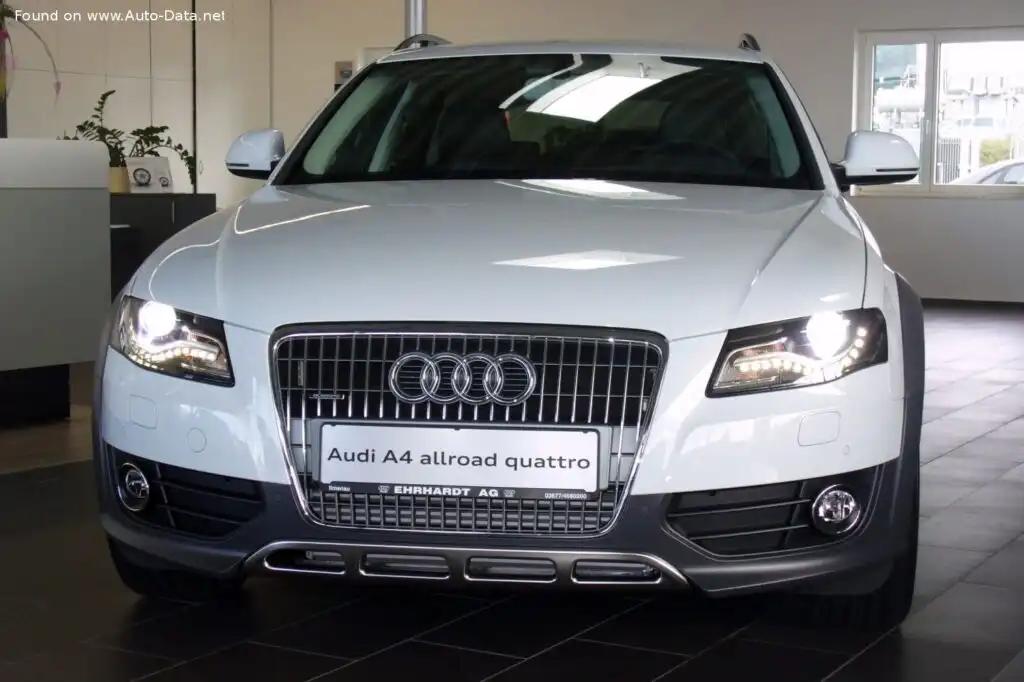
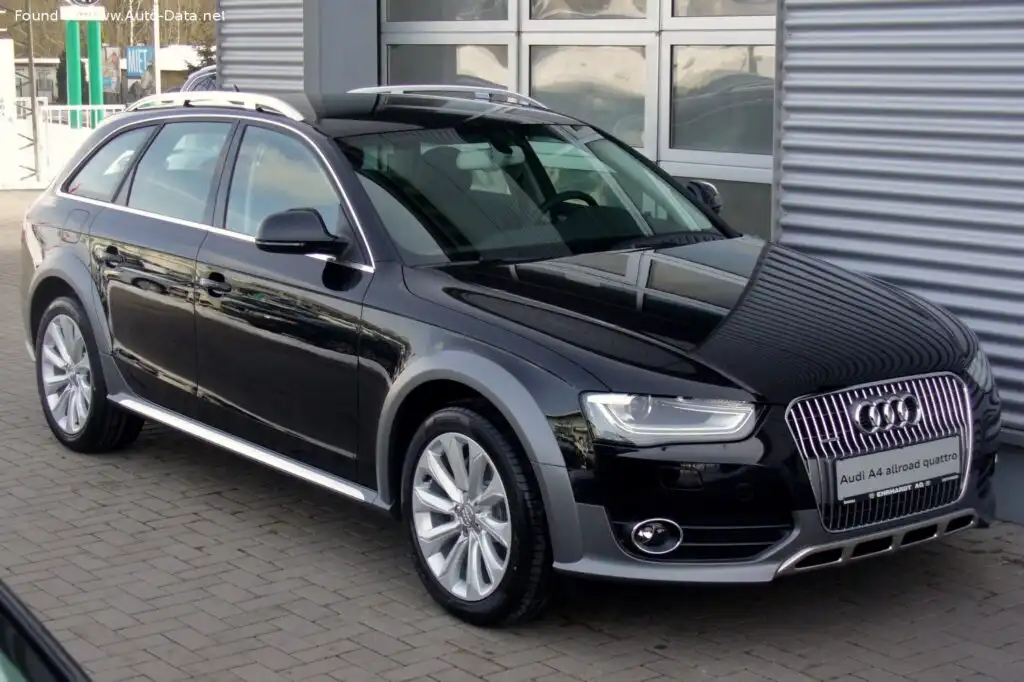
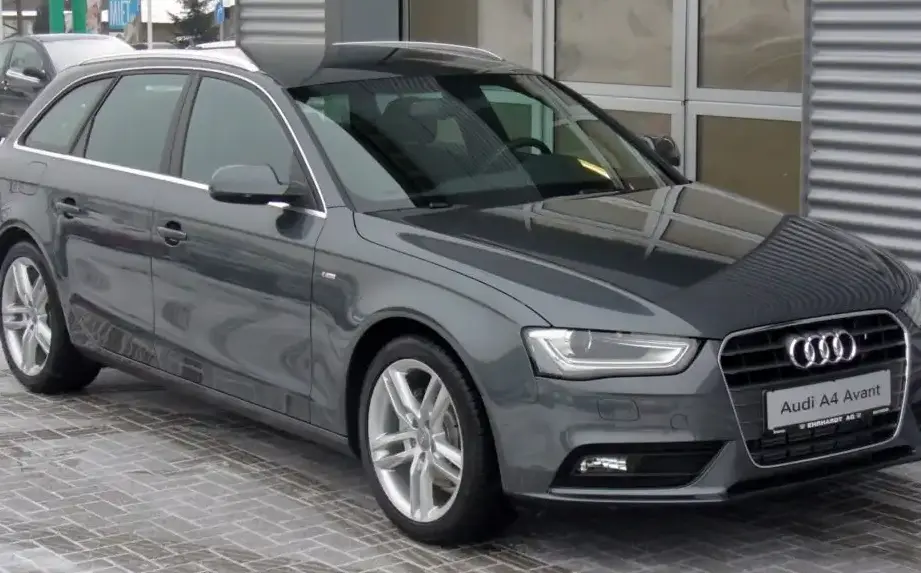
| Generation | A4 Avant (B8 8K, facelift 2011) |
| Type (Engine) | 2.0 TDI (190 Hp) quattro |
| Start of production | 2014 |
| End of production | 2015 |
| Powertrain Architecture | Internal Combustion engine |
| Body type | Station wagon (estate) |
| Seats | 5 |
| Doors | 5 |
| Fuel consumption (urban) | 6-6.3 l/100 km (39.2 – 37.3 US mpg, 47.1 – 44.8 UK mpg, 16.7 – 15.9 km/l) |
| Fuel consumption (extra urban) | 4.5-5 l/100 km (52.3 – 47 US mpg, 62.8 – 56.5 UK mpg, 22.2 – 20 km/l) |
| Fuel consumption (combined) | 5.1-5.5 l/100 km (46.1 – 42.8 US mpg, 55.4 – 51.4 UK mpg, 19.6 – 18.2 km/l) |
| CO2 emissions | 132-144 g/km |
| Fuel Type | Diesel |
| Acceleration 0 – 100 km/h | 7.6 sec |
| Acceleration 0 – 62 mph | 7.6 sec |
| Acceleration 0 – 60 mph | 7.2 sec |
| Maximum speed | 229 km/h (142.29 mph) |
| Emission standard | Euro 6 |
| Weight-to-power ratio | 8.7 kg/Hp, 114.8 Hp/tonne |
| Weight-to-torque ratio | 4.1 kg/Nm, 241.7 Nm/tonne |
| Power | 190 Hp @ 3800-4200 rpm |
| Torque | 400 Nm @ 1750-3000 rpm (295.02 lb.-ft. @ 1750-3000 rpm) |
| Engine layout | Front, Longitudinal |
| Engine Model/Code | EA288 / CNHA |
| Engine displacement | 1968 cm3 (120.09 cu. in.) |
| Number of cylinders | 4 |
| Engine configuration | Inline |
| Cylinder Bore | 81 mm (3.19 in.) |
| Piston Stroke | 95.5 mm (3.76 in.) |
| Compression ratio | 15.5:1 |
| Number of valves per cylinder | 4 |
| Fuel injection system | Diesel Commonrail |
| Engine aspiration | Turbocharger, Intercooler |
| Valvetrain | DOHC |
| Engine oil capacity | 4.7 l (4.97 US qt | 4.14 UK qt) |
| Coolant capacity | 13.2 l (13.95 US qt | 11.61 UK qt) |
| Kerb Weight | 1655 kg (3648.65 lbs.) |
| Max. weight | 2225 kg (4905.29 lbs.) |
| Max load | 570 kg (1256.63 lbs.) |
| Trunk (boot) space – minimum | 490 l (17.3 cu. ft.) |
| Trunk (boot) space – maximum | 1430 l (50.5 cu. ft.) |
| Fuel tank capacity | 61 l (16.11 US gal | 13.42 UK gal) |
| AdBlue tank capacity | 20 l (5.28 US gal | 4.4 UK gal) |
| Max. roof load | 90 kg (198.42 lbs.) |
| Permitted trailer load with brakes (8%) | 1800 kg (3968.32 lbs.) |
| Permitted trailer load with brakes (12%) | 1600 kg (3527.4 lbs.) |
| Permitted trailer load without brakes | 750 kg (1653.47 lbs.) |
| Permitted towbar download | 80 kg (176.37 lbs.) |
| Length | 4699 mm (185 in.) |
| Width | 1826 mm (71.89 in.) |
| Width including mirrors | 2040 mm (80.31 in.) |
| Height | 1436 mm (56.54 in.) |
| Wheelbase | 2808 mm (110.55 in.) |
| Front track | 1564 mm (61.57 in.) |
| Rear track | 1551 mm (61.06 in.) |
| Front overhang | 862 mm (33.94 in.) |
| Rear overhang | 1029 mm (40.51 in.) |
| Drag coefficient (Cd) | 0.32 |
| Minimum turning circle | 11.5 m (37.73 ft.) |
| Drivetrain Architecture | All wheel drive (4×4) |
| Number of gears | 6 |
| Type of gearbox | Manual transmission |
| Front suspension | Coil spring, Independent multi-link suspension, Transverse stabilizer |
| Rear suspension | Independent on trapezoidal lever, Transverse stabilizer, Coil spring |
| Front brakes | Ventilated discs, 314×25 mm |
| Rear brakes | Disc, 300×12 mm |
The Audi A4 Avant (B8) facelift, launched in 2011, represented a significant update to the already popular A4 series. The Avant, Audi’s designation for its station wagon models, continued to appeal to buyers seeking a premium vehicle with enhanced practicality. The 2.0 TDI quattro variant, produced from 2014-2015, was powered by the EA288 engine family, specifically the CNHA code, a 2.0-liter turbocharged diesel engine producing 190 horsepower. This model occupied a sweet spot in the A4 Avant range, offering a balance between fuel efficiency, performance, and all-weather capability thanks to Audi’s renowned quattro all-wheel-drive system. It was primarily sold in Europe, where diesel engines and wagons were, and continue to be, highly favored.
Powertrain & Engine Architecture
The heart of the A4 Avant 2.0 TDI quattro is the EA288 series engine, specifically the CNHA variant. This is a 2.0-liter inline-four cylinder diesel engine featuring common-rail direct injection and a turbocharger with an intercooler. The CNHA engine boasts a relatively high compression ratio of 15.5:1, contributing to its efficiency. The common-rail system, operating at very high pressures, ensures precise fuel delivery and optimized combustion. The engine utilizes a dual overhead camshaft (DOHC) valvetrain with four valves per cylinder, maximizing airflow and enhancing performance. The 190 horsepower and 400 Nm (295 lb-ft) of torque are delivered between 3800-4200 rpm and 1750-3000 rpm respectively. Paired with a six-speed manual transmission, the engine’s power is efficiently transferred to all four wheels via Audi’s quattro system. The quattro system employs a Torsen center differential, automatically distributing torque between the front and rear axles based on traction conditions.
Driving Characteristics
The 2.0 TDI quattro offers a refined and capable driving experience. While not overtly sporty, the 190 horsepower engine provides ample power for everyday driving and confident overtaking. The six-speed manual transmission is well-matched to the engine’s characteristics, offering precise shifts and a good spread of ratios. The quattro all-wheel-drive system provides excellent traction in all weather conditions, inspiring confidence on slippery surfaces. Compared to the lower-powered 1.8 TFSI variants, the 2.0 TDI quattro delivers noticeably stronger acceleration and a more relaxed cruising experience. It also offers superior fuel economy compared to the higher-output 3.0 TDI models. The gear ratios are tuned for a balance of performance and efficiency, with a relatively tall sixth gear for highway cruising. The steering is precise and well-weighted, providing good feedback to the driver.
Equipment & Trim Levels
The A4 Avant 2.0 TDI quattro typically came well-equipped, reflecting Audi’s premium positioning. Standard features included automatic climate control, a multi-function steering wheel, power windows and mirrors, and an audio system with CD player and auxiliary input. Higher trim levels offered options such as leather upholstery, a sunroof, navigation system, parking sensors, and bi-xenon headlights. Interior upholstery was typically cloth in the base models, with leather options available as upgrades. The dashboard layout was clean and functional, with a focus on ergonomics. Optional extras could significantly enhance the vehicle’s comfort and convenience, but also increased the price.
Chassis & Braking
The A4 Avant’s chassis is based on the Volkswagen Group’s PL46 platform. The front suspension utilizes a sophisticated independent multi-link setup with a transverse stabilizer, providing excellent ride comfort and handling. The rear suspension employs an independent trapezoidal link design, also with a transverse stabilizer. Braking duties are handled by ventilated discs at the front and solid discs at the rear. Anti-lock braking system (ABS) is standard, along with electronic brake-force distribution (EBD). The suspension tuning is geared towards providing a comfortable ride without sacrificing handling precision. The quattro system contributes to enhanced stability and cornering grip.
Market Reception & Comparison
The Audi A4 Avant 2.0 TDI quattro was generally well-received by automotive critics. It was praised for its refined engine, comfortable ride, and all-weather capability. Fuel economy was also a strong point, with combined fuel consumption figures ranging from 5.1 to 5.5 liters per 100 kilometers. Compared to the 1.8 TFSI Avant, the 2.0 TDI quattro offered superior torque and fuel efficiency, albeit at a slightly higher price point. The 3.0 TDI Avant provided more power but came with a higher fuel consumption and a significantly increased cost. Reliability was generally good, although diesel particulate filter (DPF) issues could occur with infrequent long-distance driving.
Legacy
The A4 Avant 2.0 TDI quattro remains a popular choice in the used car market, particularly in Europe. The EA288 engine is known for its durability and relatively low maintenance costs, provided it is properly maintained. The quattro all-wheel-drive system continues to be a valuable asset, especially in regions with harsh winters. While modern cars offer more advanced technology and improved fuel efficiency, the B8 A4 Avant 2.0 TDI quattro still represents a compelling package of practicality, performance, and refinement. Its enduring appeal is a testament to Audi’s engineering prowess and the enduring popularity of the station wagon body style.