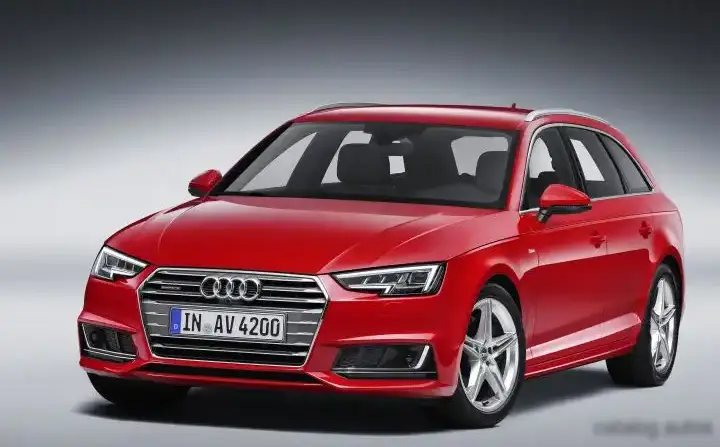
The Audi A4 Avant (B9 8W) 2.0 TDI producing 150 horsepower was a key variant within the fifth generation of Audi’s popular compact executive estate car. Produced from 2015 to 2018, this model occupied a significant position in the European market, offering a blend of practicality, efficiency, and the premium experience Audi is known for. It was positioned as a mid-range offering, appealing to buyers seeking lower running costs than the more powerful petrol or higher-output diesel options, but still desiring the refinement and features of the A4 Avant. This variant was never officially sold in the North American market, where Audi focused on sedan and coupe body styles.
Technical Specifications
| Brand | Audi |
| Model | A4 |
| Generation | A4 Avant (B9 8W) |
| Type (Engine) | 2.0 TDI (150 Hp) |
| Start of production | 2015 |
| End of production | 2018 |
| Powertrain Architecture | Internal Combustion engine |
| Body type | Station wagon (estate) |
| Seats | 5 |
| Doors | 5 |
| Fuel consumption (urban) | 4.9 l/100 km (48 US mpg, 57.6 UK mpg, 20.4 km/l) |
| Fuel consumption (extra urban) | 3.8 l/100 km (61.9 US mpg, 74.3 UK mpg, 26.3 km/l) |
| Fuel consumption (combined) | 4.1 l/100 km (57.4 US mpg, 68.9 UK mpg, 24.4 km/l) |
| CO2 emissions | 109 g/km |
| Fuel Type | Diesel |
| Acceleration 0 – 100 km/h | 9.2 sec |
| Acceleration 0 – 62 mph | 9.2 sec |
| Acceleration 0 – 60 mph | 8.7 sec |
| Maximum speed | 215 km/h (133.59 mph) |
| Emission standard | Euro 6 |
| Weight-to-power ratio | 9.8 kg/Hp, 101.7 Hp/tonne |
| Weight-to-torque ratio | 4.6 kg/Nm, 216.9 Nm/tonne |
| Power | 150 Hp @ 3250-4200 rpm |
| Power per litre | 76.2 Hp/l |
| Torque | 320 Nm @ 1500-3250 rpm (236.02 lb.-ft. @ 1500-3250 rpm) |
| Engine layout | Front, Longitudinal |
| Engine Model/Code | DEUA |
| Engine displacement | 1968 cm3 (120.09 cu. in.) |
| Number of cylinders | 4 |
| Engine configuration | Inline |
| Cylinder Bore | 81 mm (3.19 in.) |
| Piston Stroke | 95.5 mm (3.76 in.) |
| Compression ratio | 16.2:1 |
| Number of valves per cylinder | 4 |
| Fuel injection system | Diesel Commonrail |
| Engine aspiration | Turbocharger, Intercooler |
| Valvetrain | DOHC |
| Engine oil capacity | 4.7 l (4.97 US qt | 4.14 UK qt) |
| Kerb Weight | 1475 kg (3251.82 lbs.) |
| Max. weight | 2095 kg (4618.68 lbs.) |
| Max load | 620 kg (1366.87 lbs.) |
| Trunk (boot) space – minimum | 505 l (17.83 cu. ft.) |
| Trunk (boot) space – maximum | 1510 l (53.33 cu. ft.) |
| Fuel tank capacity | 40 l (10.57 US gal | 8.8 UK gal) |
| Max. roof load | 90 kg (198.42 lbs.) |
| Permitted trailer load with brakes (8%) | 1900 kg (4188.78 lbs.) |
| Permitted trailer load with brakes (12%) | 1700 kg (3747.86 lbs.) |
| Permitted towbar download | 80 kg (176.37 lbs.) |
| Length | 4725 mm (186.02 in.) |
| Width | 1842 mm (72.52 in.) |
| Width including mirrors | 2022 mm (79.61 in.) |
| Height | 1434 mm (56.46 in.) |
| Wheelbase | 2820 mm (111.02 in.) |
| Front track | 1572 mm (61.89 in.) |
| Rear (Back) track | 1555 mm (61.22 in.) |
| Front overhang | 880 mm (34.65 in.) |
| Rear overhang | 1025 mm (40.35 in.) |
| Drag coefficient (Cd) | 0.30 |
| Minimum turning circle (turning diameter) | 11.6 m (38.06 ft.) |
| Drivetrain Architecture | The Internal combustion engine (ICE) drives the front wheels of the vehicle. |
| Drive wheel | Front wheel drive |
| Number of gears and type of gearbox | 6 gears, manual transmission |
| Front suspension | Independent multi-link suspension |
| Rear suspension | Independent multi-link suspension |
| Front brakes | Ventilated discs |
| Rear brakes | Ventilated discs |
| Assisting systems | ABS (Anti-lock braking system) |
| Steering type | Steering rack and pinion |
| Power steering | Electric Steering |
| Tires size | 205/60 R16 |
| Wheel rims size | 7J x 16 |
INTRODUCTION
The Audi A4 Avant (B9 8W) 2.0 TDI 150 hp, launched in 2015, represented a significant update to Audi’s popular A4 estate. Built on the Volkswagen Group’s MLB Evo platform (1HX0/A3), this generation brought advancements in technology, efficiency, and interior refinement. The 2.0 TDI 150 hp variant was a mainstay of the A4 Avant range in Europe, offering a balance between performance and fuel economy. It catered to customers who prioritized practicality and running costs over outright speed, making it a popular choice for families and business users. This model was a direct competitor to vehicles like the BMW 3 Series Touring and Mercedes-Benz C-Class Estate.
Powertrain & Engine Architecture
At the heart of the A4 Avant 2.0 TDI 150 hp lies the Volkswagen Group’s EA288 series diesel engine, specifically the DEUA code. This is a 1968cc, four-cylinder, inline diesel engine featuring common rail direct injection and a turbocharger with an intercooler. The engine utilizes a sophisticated Bosch EDC17C60 engine control unit (ECU) to manage fuel delivery, ignition timing, and turbocharger boost. The valvetrain employs a dual overhead camshaft (DOHC) design with four valves per cylinder, optimizing gas flow for improved efficiency and power output. The 150 hp version was typically paired with a six-speed manual transmission, although a seven-speed S tronic dual-clutch transmission was also available as an option. The engine’s design focused on reducing internal friction and optimizing combustion to meet stringent Euro 6 emissions standards. A diesel particulate filter (DPF) was standard equipment, crucial for minimizing harmful emissions.
Driving Characteristics
The 2.0 TDI 150 hp A4 Avant offered a composed and refined driving experience. While not particularly sporty, it provided ample power for everyday driving and long-distance cruising. The engine delivered a respectable 320 Nm (236 lb-ft) of torque between 1500 and 3250 rpm, providing good low-end grunt for effortless acceleration. The six-speed manual transmission offered precise shifts, although the gear ratios were geared towards fuel efficiency rather than outright performance. Compared to the more powerful 190 hp TDI variant, the 150 hp model felt noticeably less responsive, particularly during overtaking maneuvers. However, the difference in fuel economy was significant, making the 150 hp version a more economical choice for high-mileage drivers. The front-wheel-drive configuration provided predictable handling, although it could exhibit some torque steer under hard acceleration.
Equipment & Trim Levels
The A4 Avant 2.0 TDI 150 hp typically came equipped with a generous level of standard features. These included Audi’s MMI infotainment system with a 6.5-inch color display, Bluetooth connectivity, automatic climate control, and a leather-wrapped multifunction steering wheel. Standard safety features included ABS, ESP, and multiple airbags. Higher trim levels, such as Sport and S line, added features like sport seats, upgraded interior trim, and exterior styling enhancements. Optional extras included a larger MMI display with navigation, a panoramic sunroof, and advanced driver assistance systems like adaptive cruise control and lane departure warning. Interior upholstery typically consisted of cloth or a combination of cloth and leatherette, with full leather options available at an extra cost.
Chassis & Braking
The B9 A4 Avant featured a sophisticated chassis design aimed at providing a comfortable yet engaging driving experience. The front suspension utilized a five-link independent setup, while the rear employed a multi-link configuration. This arrangement minimized body roll and provided excellent ride quality. The 150 hp TDI variant typically came equipped with ventilated disc brakes on all four wheels, providing ample stopping power. ABS (Anti-lock Braking System) and ESP (Electronic Stability Program) were standard features, enhancing safety and stability. The suspension tuning was generally softer on the 150 hp models compared to the higher-output variants, prioritizing comfort over sporty handling. Stabilizer bars were fitted front and rear to further reduce body roll.
Market Reception & Comparison
The Audi A4 Avant 2.0 TDI 150 hp was well-received by automotive critics for its blend of practicality, efficiency, and refinement. It was praised for its comfortable ride, spacious interior, and well-equipped features list. However, some critics noted that the engine lacked the punch of its more powerful counterparts. Compared to the 190 hp TDI variant, the 150 hp model offered significantly better fuel economy, making it a more attractive option for drivers prioritizing running costs. Against competitors like the BMW 3 Series Touring and Mercedes-Benz C-Class Estate, the A4 Avant 2.0 TDI 150 hp held its own, offering a compelling package of features and performance.
Legacy
The 2.0 TDI engine, in its various iterations, has proven to be a reliable and durable powertrain. However, like many modern diesel engines, the EA288 series is not without its potential issues. Common concerns include DPF clogging, EGR valve failures, and potential issues with the dual-mass flywheel. Regular maintenance, including timely oil changes and DPF regeneration, is crucial for ensuring long-term reliability. Today, the A4 Avant 2.0 TDI 150 hp remains a popular choice in the used car market, offering a practical and economical option for buyers seeking a premium estate car. Its reputation for reliability and relatively low running costs continues to make it a desirable vehicle.